Obama’s Albatross

Walter Russell Mead points to unemployment figures:

[A]s this piece from the Washington Post’s Ezra Klein points out, the unemployment rate no longer fits facts.  Unemployment is dropping because people are dropping out of the labor market.  Using historical figures, the unemployment rate is 11 percent; if more people get back into the workforce as the recovery continues, the headline unemployment rate could actually rise — during the election year.  People feel worse than the numbers show, and they are likely to continue doing so for some time.  This is why the President’s poll numbers aren’t going up, and this is why next November is still very much up in the air.

Is Greater Israel Now Mainly A Christianist Cause?

GT_CUFI_111209

Ackerman thinks along the same lines as I do:

This is why conspiratorial talk about the Israel Lobby seriously misses the point. The U.S. relationship with Israel is not determined by a narrow band of colluding Washington, New York and Hollywood Jews. It’s not even determined by Jews, full stop. It thrives because one of the most powerful constituencies in American politics, conservative Christians, identifies with Israel — and not with politicians who question it. You can see that, barometrically, in the GOP presidential debates, in which the candidates line up to outdo each other in vowing support for Israel and bashing Obama for his insufficient affection for Israel.

Goldblog pushes back:

I don't disagree with Ackerman about the priorities of conservative Christian "Zionists" (I'm not sure I would label what they believe "Zionism,' because their beliefs don't have much to do with the reasons actual political Zionism came into existence, but you should pardon the digression). What I don't fully accept is the notion that evangelical Christians are a) truly devoted in a permanent way to the cause of Israel, and b) that their current commitment is deep and abiding, and c) they possess the political infrastructure to protect, over time, Israel in the American foreign policy debate. 

Krauthammer, perhaps the most influential of Netanyahu's supporters in the US, differs. In fact, he agrees with me and Spencer:

98 percent of pro-Israeli Americans are gentile. It’s a very strong, important issue among the evangelical Christians. The association [of Israel] only with Jews is missing a very large story here.

Larison quibbles with Ackerman's understanding of the "Israel Lobby" thesis. Marc Tracy counters:

Despite the fact that it would be much more fruitful just to take Israel appeals directly to the evangelicals, the Republican hopefuls did not give their Israel speeches this week in front of Christians United for Israel; they gave their speeches in front of the Republican Jewish Coalition. This is why there is such intensity over the votes of a two percent bloc of the population: electorally, American Jews are walking force multipliers. It’s why a special election in a hilariously obscure (and obscurely Jewish) corner of Queens and Brooklyn became a national story, and why, a week later, Gov. Rick Perry’s Israel press conference featured himself and the victor, Rep. Bob Turner, as the only two Gentiles on a very crowded stage.

But without the 98 percent, there's only so much multiplication of force. The support for Greater Israel is now primarily a Christianist project. It will be headed if he wins the presidency by a Benedict XVI Catholic. It is at the core of the Christianist GOP base.

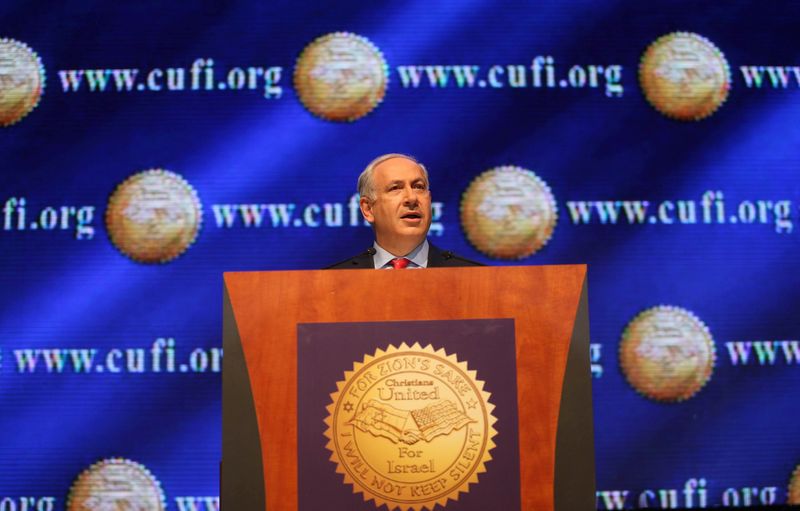
(Photo:  Israeli Prime Minister Benjamin Netanyahu speaks to the Christians United For Israel [CUFI] summit in Jerusalem, hosted by US televenangelical pastor John Hagee on March 8, 2010. By Gali Tibbon/AFP/Getty Images.)

Playing Politics With Plan B? Ctd

Invoking Bush's predilection for politics over science, Michael Specter sides with Traister against the Obama administration. A reader tries to follow the ban's logic:

Teenagers can't get Plan B without a prescription. Therefore they won't use it. We know that because prohibition has worked well for so many other drugs.

Scott Lemieux digs into the data:

[T]he most recent data I could find, of the roughly 758,000 teen pregnancies a year 212 of these involved girls 12 and younger.   If you’re getting into a debate about Plan B and 12-year-olds you’re being played for a sucker.   The relevant Plan B debate is about 15- and 16-year olds, and people who are bringing up the 0% of teenage pregnancies among 11-year olds are trying to make paternalistic regulations seem more reasonable. 

Harold Pollack weighs in:

I emailed this weekend with several experienced clinicians in this area. They report that Plan B has an award-winning easy-to-read label, that there are very few medical contraindications to this medication. My colleague Melissa Gilliam is section chief for the Section of Family Planning and Contraceptive Research at the University of Chicago. She has extensive experience treating sexual and reproductive health issues that arise among young women. Gilliam comments: “We seem to be saying that a young teen can increase her risk of becoming a parent (which entails lots of reading and complex tasks) but not read a label.”

Lauren Collins provides a counterpoint to Specter and Traister and shifts the debate:

To this thirty-one-year-old woman, the real absurdity is that birth-control pills … are not available without a prescription.

As the Daily Beast reported, a study in the journal Contraception found that sixty-eight per cent of women surveyed wanted to be able to buy the Pill over the counter. Who hasn’t experienced the panic of trying to replace pills that have gone missing on a work trip, or the hassle of trying find a pharmacy that’s open on Sunday, the day that doctors recommend you begin your pill pack? … It makes no sense that the government deems its female citizens smart enough to figure out how to use contraception safely in emergencies, but not in everyday life.

Why Sabotage Iran? Ctd

Steve Walt disagrees with my reluctant endorsement of our "secret" campaign:

[W]aging a covert, low-level war is not without risks, including the risk of undesirable escalation. No matter how carefully we try to control the level of force, there's always the danger that matters spiral out of control. Iran can't do much to us militarily, but it can cause trouble in limited ways and it could certainly take steps that would jack up oil prices and possibly derail the fragile global economic recovery. Moreover, if some U.S. operation misfired and a couple of hundred Iranians died, wouldn't the revolutionary government feel compelled to respond?

If U.S. or Israeli operatives are captured on Iranian soil, will pressure mount on us to do more? (Just imagine what all the GOP candidates would start saying!) Such developments may not be likely, of course, but it would be foolhardy to ignore such possibilities entirely. Nor should we ignore the possibility that others will learn from this sort of "unconventional" campaign and one day use similar tactics against U.S. allies or the United States itself. 

Ali Ahmadi Motlagh thinks we should look at Saudi Arabia to see if escalation is on the horizon.

How To Blog Well

Dan Frommer proposes ten rules. Number One:

Above all else, factual accuracy and attention to detail. That’s the easiest and best way to build and maintain trust over the long-term. If a fact is wrong, fix it and don’t be shy about it. If an opinion or prediction is wrong, learn from it and consider explaining how you got it wrong.

Which is one reason why bloggers often have a better rep for accuracy and transparency than columnists.

(Hat tip: Delong)

Tweeting Your Diagnosis

Screen shot 2011-12-09 at 10.24.53 AM

A couple of Xeni Jardin's friends were diagnosed with breast cancer so she decided to get her first mammogram:

I live online as much as I live offline. Often, I move around in the world staring into a device as I walk, sharing bits of one realm with the other. The morning I went in for my first mammogram, I felt nervous. I would tweet this new thing, like I do with lots of new things, and make the unknown and new feel less so. Maybe by doing so, I thought while I was driving, other women like me who'd never done this would also feel like it was less weird, less scary, more normal and worth doing without hesitation. I'd crack some 140-character jokes. I'd make fun of myself and others. I would Instagram my mammogram. 

Her diagnosis came back positive for breast cancer. Her moving account details the long and rocky road ahead:

Treatable, curable, survival odds, margins, chemotherapy, surgery, radiation. Someone else's problems, someone else's words. The biopsy came back the next day. Those words became my own.

The Entire GOP Field Goes Negative

Ron Paul continues to mercilessly pummel the former speaker:

Romney is asking for Gingrich to give back the money he took from Freddie Mac. Gingrich is hitting back by making Romney's time at Bain an issue. Joseph Lawler thinks that "Gingrich has basically adopted the language of the anti-corporate left with this line of attack." Jonathan Bernstein wonders if Gingrich and Romney will score a double TKO:

Gingrich is now signaling that he is willing to push back hard on Romney’s attacks, even citing Romney’s days at Bain Capital — which are central to the Democratic case against Romney — to damage him. Watch out! Even with only three weeks remaining until the caucuses, it’s not too late for Iowans — who have a strong reputation for disliking negative campaigning — to punish both of them.