Matt Welch reflects on it after attending the former Czech president's funeral:
"Many ridiculed Havel for his words about truth and love," [Foreign Minister Karel Schwarzenberg] said. "Yet it is the essence of the human struggle. And we must never
give up that struggle….Only love makes us listen to the truth of others." This may sound like some weird fusion between hippie claptrap and Mitteleuropean navel-gazing, but there was a resonance there for the Czech ear that's worth a listen ourselves. Czech politics (like American politics, only moreso) has been a dreary back-and-forth between mostly corrupt politicos making transparently cynical claims on the "truth" since at least 1997, when Klaus was impelled to resign as prime minister after a campaign finance/privatization scandal…
But there was an important point there, one that was resurrected during the National Days of Mourning: Truth without love is like facts without context, like music without passion, like a sermon without faith. That is to say, it is finally not truth at all. Parsing words to gain momentary self-advantage at the expense of deeper understanding spreads a kind of moral rot, one that inhibits development and blunts joy.
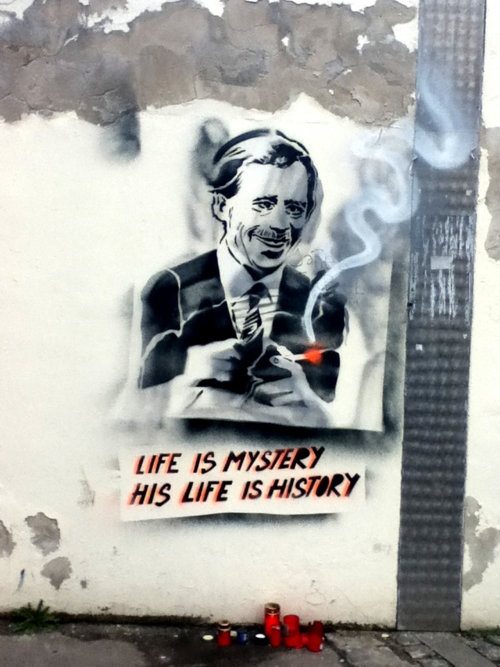
Stefany Anne Golberg offers her own take on the importance of Havel's life:
"Today," he said in a 1994 speech in Philadelphia titled "The Need for Transcendence in the Postmodern World," "we may know immeasurably more about the universe than our ancestors did, and yet, it increasingly seems they knew something more essential about it than we do, something that escapes us. The same thing is true of nature and of ourselves."
A deeper sense of individual responsibility toward the world would only be awakened in people when they directed themselves toward some kind of higher moral authority. In other words, unity and freedom will not be achieved unless people undergo a metaphysical transformation. This is what differentiates real unity from totalitarianism.
(Photo via the tumblr M?sto)

