Christian Caryl runs down the possibilities for the near future:
2012 is a year of elections. By the end of this year the citizens of 59 countries – one-third of the world's countries — will have gone to the polls to choose national, state, and local leaders. This would seem to bolster the claim that the overwhelming majority of Earth's inhabitants now implicitly accept the principles of democracy. By this argument, the Universal Declaration of Human Rights now embodies a global standard to which all people — and not just Westerners — aspire. That may be true. But it hardly means that the triumph of democracy is ensured. If history has taught us anything, it is that nothing in human affairs is inevitable.
Francis Fukuyama sees a universal quest for dignity as the underlying motivation for pro-democracy movements. Jacqueline Hale and POMED look, respectively, at the role Europe and the US can play in promoting democracy globally. Walter Russell Mead spotlights hopeful developments in Burma:
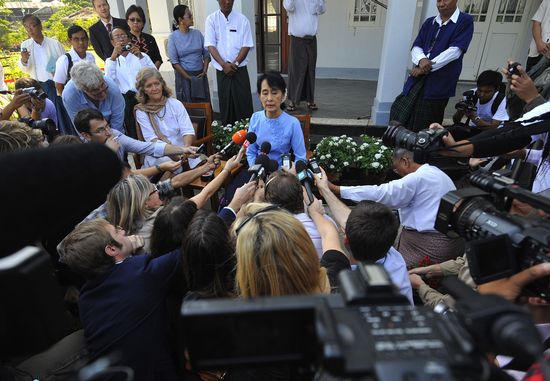
[T]he government signed a peace agreement with the Karen rebel group, which was part of a decades-long insurgency. Earlier [last] week, opposition leader Aung Sun Suu Kyi announced she would run for Parliament in April. Her party was excluded from politics for twenty years, until two weeks ago. These are hopeful signs. Reinforcing political openness will bring this once-pariah state into the international community and out of China’s tight embrace.
Aung Zaw goes in-depth on the strange country. Andreas Umland shifts the focus to Russia.
(Photo: Burmese democracy icon Aung San Suu Kyi addresses reporters following a meeting with French foreign minister Alain Juppe at her residence in Yangon on January 15, 2012. Following talks with Juppe, the highest-level French diplomat ever to visit the country, Suu Kyi said that she did not rule out taking a government position if she wins a parliamentary seat in upcoming by-elections. By Soe Than Win/AFP/Getty Images)

