The Journalists’ Candidate

Ryan Lizza lists "electoral outcomes journalists are secretly rooting for." A Huntsman upset in New Hampshire is among them:

[T]he press loves Huntsman. Jacob Weisberg wrote an excellent and mostly positive profile for Vogue. Joe Klein says Huntsman "refuses to pander to the know-nothing zealots who’ve overrun his party" and has "proposed the most thoughtful roster of policy initiatives of any candidate in the race." A number of reporters have become quite taken with Huntsman’s charming daughters. No candidate with Huntsman’s poll numbers has ever received more admiring coverage. Part of the reason for this is that, for many journalists, credentials matter. Huntsman may not be doing well in the polls, but there is a sense among the meritocrats of the press corps that a former two-term governor and ambassador who has served in Washington under three different Presidents should be doing better. There is something off-kilter about a system that doesn’t reward someone like Huntsman. If Romney demolishes his competition in Iowa, don’t be surprised if Huntsman gets elevated as the new anti-Romney.

What The Hell Is Happening In Iowa?

Iowa_GOP

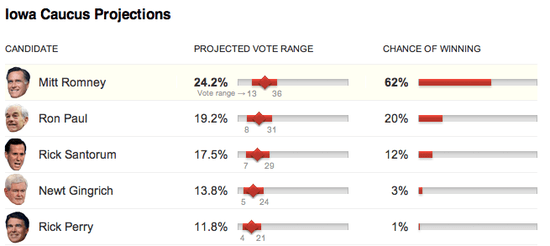
Nate Silver says that Romney may win with a relatively small percentage of the vote:

The lowest winning percentage in previous caucuses belongs to Bob Dole, who won with 26 percent of the vote in the Republican caucuses in 1996. There’s a good chance that this year’s winner will poll less than that and break the record.

Larry Sabato, Kyle Kondik, and Geoffrey Skelley wonder how the media will react if Romney underperforms:

If Romney finishes even a close third in Iowa, even if that third-place finish is only a few percentage points short of first, he may lose the expectations game in Iowa and leave looking like a loser. Romney finished second in Iowa to Mike Huckabee in 2008, but given the resources he spent there, the chattering classes viewed him as a failure. The conventional wisdom stuck: Romney never won a truly significant contest during the 2008 nomination fight.

Jonathan Bernstein thinks Santorum will beat expectations:

If in fact Romney, Paul, and Santorum grab the top three spots, it probably doesn't matter at all which order they'll finish in. The big story out of Iowa will be Santorum, who has received practically zero media coverage until this week and even now not much. That's going to be true whether the former Pennsylvania Senator finishes first, second, or third. He'll certainly (assuming nothing else happens) zoom up to at least fourth in New Hampshire the following Tuesday, and I'd bet he winds up higher than that — perhaps a lot higher.

Amy Sullivan notes that Santorum has almost no cash to compete past Iowa:

Huckabee’s 2008 campaign looks like a well-funded behemoth compared with Santorum’s 2012 outfit. Though donations have likely picked up over the past week, as of Sept. 30, the Santorum campaign had less than $200,000 on hand and was more than $71,000 in debt.

Charles Franklin analyzes the Des Moines Register poll, the most respected and trusted Iowa caucus poll, which was released last night. Dave Weigel puts the Santorum surge in context:

Santorum is surging after spending 101 days in Iowa. Iowa has roughly 3 million people. To play out this retail campaign in Florida, with its 19 million people, Santorum would need to spend 639 days on the ground. I'm being silly, of course — Florida will play out after Santorum gets a ticket out of Iowa and at least one candidate, probably three, drop out. But on record, on economic conservative credibility, on ties to big donors, Santorum's not the opponent Romney feared most.

And Joe Klein reports that Gingrich and Perry will likely stick around:

The word today is that Iowa may not fulfill its only plausible function: winnowing the field. It seems that both Rick Perry and Newt Gingrich will stagger on. Neither candidate seems to have much hope in New Hampshire. Perry may wind up owing votes there. But they will hang on to test their mettle in South Carolina, a real southern state, the deepest crimson of red states. 

Screenshot from 538's Iowa projection.
Is Israel’s Orthodox Problem Due To Arab Exclusion?

GT_ISRAELIORTHODOX_111229

That's Peter Beinart's read on the harrowing stories of sexism within the ultra-Orthodox community, including a young girl spat upon while walking to school because she wasn't dressed properly: 

[U]ltra-Orthodox coercion stems in large part from ultra-Orthodox control of key ministries in the Israeli government. Israeli prime ministers give the ultra-Orthodox control over these ministries in return for the Knesset votes that keep them in power. And why must Israeli prime ministers include ultra-Orthodox parties in their governments? In large measure because they will not include Israel’s Arab parties. …

What gives the ultra-Orthodox the ability to oppress women, in other words, is partly a political system in which Israel’s Arab citizens are largely barred from power. What the protesters in Beit Shemesh and their supporters in the United States need to remember is the fundamental interconnectedness of equal citizenship. When you deny it to one group, you produce ripple effects that undermine the equality of others as well.

Marc Tracy is on the same page

Prime Minister Netanyahu has decried the "religious extremists." Right-wing minister Uzi Landau added, "Haredi extremists should be dealt with like leftist anarchists and right-wing settler youth—decisively." Presumably, however, they should not be treated the way Palestinian protesters are. Hopes that religious settlers who have vandalized mosques and even attacked an IDF base in the West Bank would face similar consequences to Palestinians who break laws protesting the occupation appear to be dashed now that the IDF has argued against trying the settlers in military courts (admittedly, the IDF is more concerned with dividing the army, which has a large religious-settler contingent).

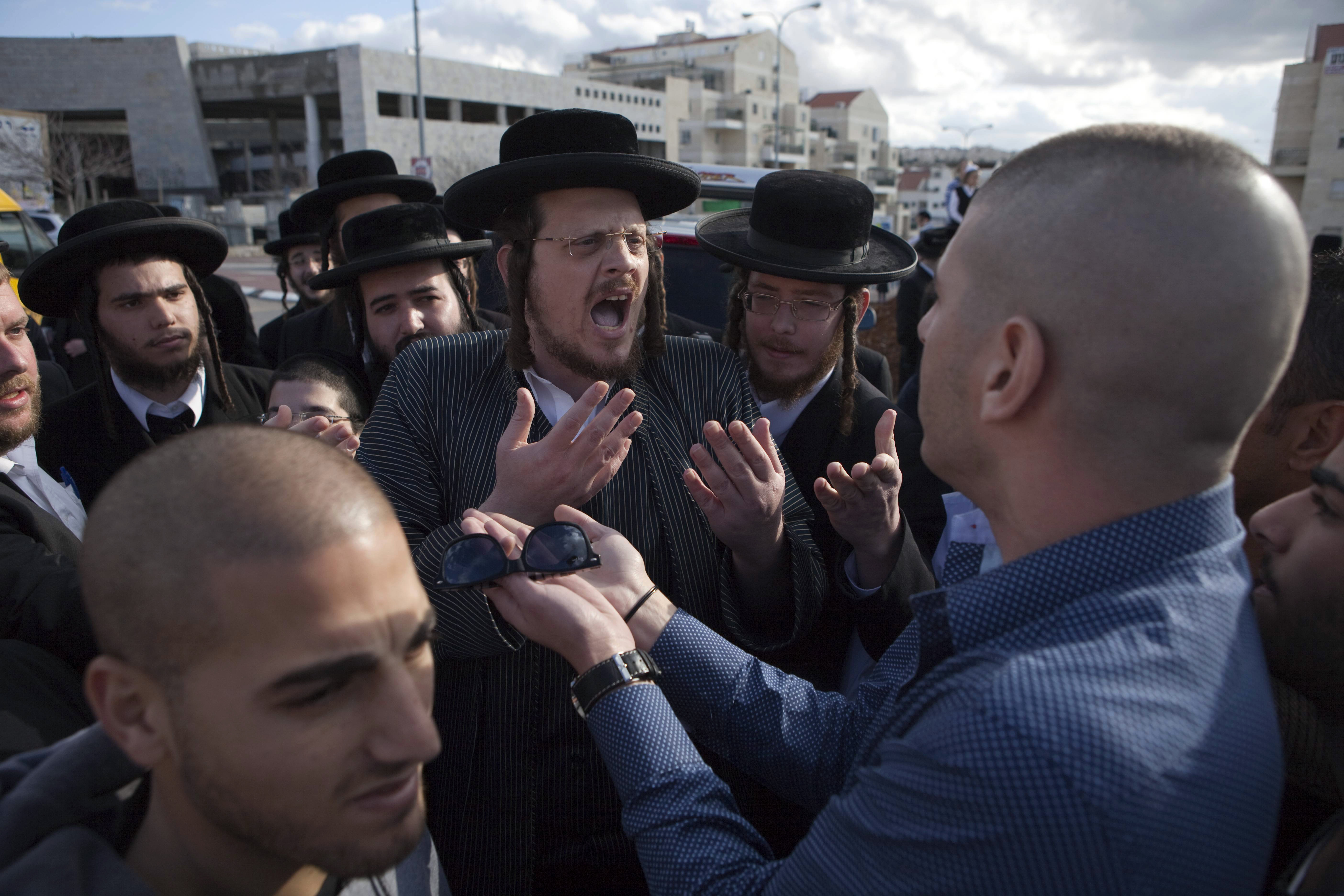
(Photo: Secular Israelis (R) argue with ultra-Orthodox Jewish protesters in the central town of Beit Shemesh, near Jerusalem, on December 26, 2011. Extra Israeli police patrolled the streets of Beit Shemesh after a campaign by ultra-Orthodox Jews to segregate men and women erupted into violence. By Menahem Kahana/AFP/Getty Images.)

Is Religion A Threat To Democracy?

Olivier Roy shakes his head:

Secularization is no more a prerequisite for democracy than a “reformation” of Islam is a condition for rooting democracy in the Middle East. Fundamentalism and individualization can go together, which explains why a democratic movement can surge amid a wave of “re-Islamization” in Arab societies. It is the new primacy of the individual, not a liberal theological reformation that allows the new generation to combine faith and democracy. 

Havel’s Legacy

Matt Welch reflects on it after attending the former Czech president's funeral:

"Many ridiculed Havel for his words about truth and love," [Foreign Minister Karel Schwarzenberg] said. "Yet it is the essence of the human struggle. And we must never Havel give up that struggle….Only love makes us listen to the truth of others." This may sound like some weird fusion between hippie claptrap and Mitteleuropean navel-gazing, but there was a resonance there for the Czech ear that's worth a listen ourselves. Czech politics (like American politics, only moreso) has been a dreary back-and-forth between mostly corrupt politicos making transparently cynical claims on the "truth" since at least 1997, when Klaus was impelled to resign as prime minister after a campaign finance/privatization scandal…

But there was an important point there, one that was resurrected during the National Days of Mourning: Truth without love is like facts without context, like music without passion, like a sermon without faith. That is to say, it is finally not truth at all. Parsing words to gain momentary self-advantage at the expense of deeper understanding spreads a kind of moral rot, one that inhibits development and blunts joy.

Stefany Anne Golberg offers her own take on the importance of Havel's life:

"Today," he said in a 1994 speech in Philadelphia titled "The Need for Transcendence in the Postmodern World," "we may know immeasurably more about the universe than our ancestors did, and yet, it increasingly seems they knew something more essential about it than we do, something that escapes us. The same thing is true of nature and of ourselves."

A deeper sense of individual responsibility toward the world would only be awakened in people when they directed themselves toward some kind of higher moral authority. In other words, unity and freedom will not be achieved unless people undergo a metaphysical transformation. This is what differentiates real unity from totalitarianism.

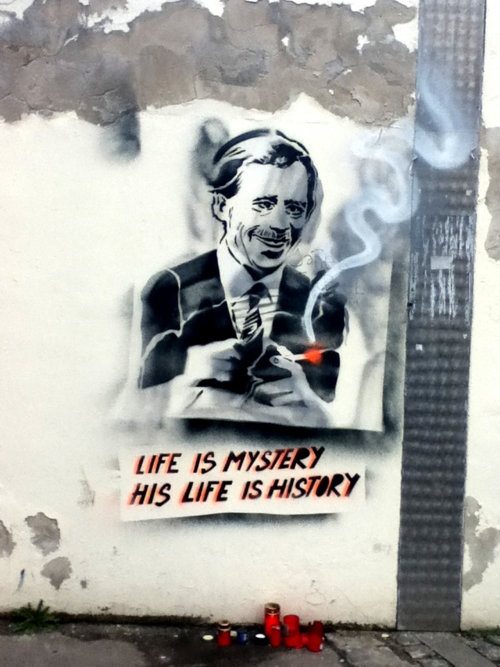
(Photo via the tumblr M?sto)

Embracing The Unknown

Stuart Kauffman's philosophy on life:

Not only do you not know what will happen, you don't even know what can happen … Radical emergence occurs all the time, Turing machine to the Web to Google, Facebook and the Arab Spring. Taken together this suggests something I'm falling in love with: Live the well discovered life. Here you do not know, as you live your life forward, as Kierkegard said, even what new opportunities will open before you affording unexpected virtues you can perfect.

Is There A Slippery Slope To Assisted Suicides?

Doesn't look like it, according to the Royal Society of Canada, which released a report (pdf) last month showing that the euthanasia rate has remained steady in the Netherlands; in both 1990 and 2005, 1.7 percent of Dutch deaths were assisted:

Some slippery-slope arguments that can be found in the literature about assisted dying are good examples of fear-mongering rather than of a realistic assessment of the risks that might accompany the decriminalization of assisted dying. For instance, there is no evidentiary basis for the fear that the decriminalization of assisted dying would relax the inhibitions that medical professionals presently feel for resorting to assisted dying in all but the most extreme of contexts.

Peter Singer wonders if these facts will continue to be ignored.