Hollywood’s Condescension On Race, Ctd

84403051

A reader cringed at the roundtable discussion:

How awful for Viola Davis. She's an actress in Hollywood who just got nominated for an Oscar. She acts for a living. She probably has a nice big house and a nice expensive car, all from acting. She's "made it." 

As for "[black actresses] are rarely cast as ideals of beauty or objects of desire. On the odd occasion that they are, only a certain look will do." Uh, yeah, no shit. That goes for every white actress as well. Or have you not heard of the plight of the actress that's always cast as the best friend and never the lead? Why would that be? Maybe cause they don't have the right look.

Bottom line: if you're able to support yourself by living out your dreams, and get nominated for Oscars to boot, and go to hot parties and get your ass kissed by fans and other actors and even journalists, no one should give a crap about your "plight."

Another:

"Halle Berry is having a hard time." ????

Black culture actually has an incredibly disproportionate influence and representation within American pop culture as a whole. R&B and hiphop dominate popular music. Urban (code for black) culture is ubiquitous and influences how people dress, act, and speak – across most demographic lines. As far as Hollywood goes, I'm sure that immensely talented people are always overlooked and Davis' contention that it's political frankly doesn't make sense.

Two words prove this: Tyler Perry. Hollywood follows the money – that's not political, or racist. Tyler Perry movies make a shitload of money, whereas high-quality black-lead drama's don't. I would in fact argue that Hollywood is one of the places where we see market forces most directly!

Another drops some data:

The notion that African Americans are underrepresented in television and movies is one of the enduring myths of Hollywood. The Screen Actors Guild keeps casting data that measures diversity in casting. For instance, in 2008 (the last year SAG published the full data set), African Americans represented 13.3% of all TV and film roles cast under SAG contacts.  The year before they represented 14.8%.  (African Americans comprise 12.6% of the population.)  If you examine the data, you'll see the story is quite different for Latinos, seniors, people with disabilities – they're all underrepresented on the big and small screen.

Now admittedly, the data doesn't tell you anything about the quality of the roles, but the notion that African Americans only play maids and drug dealers is based on notions that longer withstand even casual scrutiny.  (If anyone has a right to complain about being typecast as baddies, it's white Englishmen over 40.)  

Finally, I think the fact that Viola Davis has had a hard time finding roles has more to do with being a 46-year-old female than is does with being black.

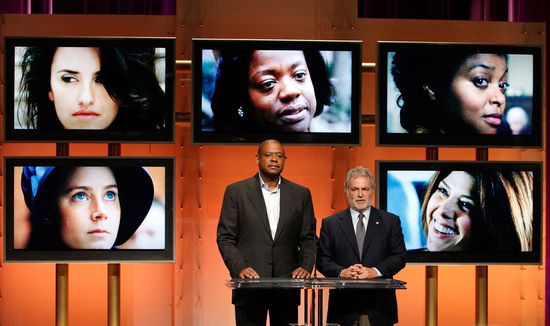
(Photo: Actor Forest Whitaker and Academy of Motion Picture Arts and Sciences President Sid Ganis announce the nominations for the Best Performance by an Actress in a Supporting Role: Amy Adams for 'Doubt', Penelope Cruz for 'Vicky Cristina Barcelona', Viola Davis for 'Doubt', Taraji P. Henson for 'The Curious Case of Benjamin Button' and Marisa Tomei for 'The Wrestler' at the 81st Academy Awards Nominations on January 22, 2008 in Beverly Hills, California. By Kevin Winter/Getty Images. Cruz won the award. The Wiki page for African-Americans nominated for Oscars here.)
Narcissism’s Weight

GT_GINGRICHCLOUDS_120125

A new study explores the connection between narcissism and stress: 

The researchers found that men with high levels of unhealthy narcissism also had higher cortisol levels. Unhealthily narcissistic ladies had higher levels too, but the effect was much smaller. Higher levels of cortisol mean narcissistic dudes have a more active stress response, which could lead to cardiovascular problems — the study authors note that "future work might examine [whether] high narcissism in earlier life predicts poor health outcomes in later life." Though hanging out with a narcissistic person is certainly stressful, it's not obvious why narcissists themselves would be freaked out. Reinhard et al, however, note that previous research has shown that "narcissists are susceptible to a host of unrealistic self-views that are difficult and stressful to continuously maintain." Translation: convincing yourself that you're the most important person in the world is actually a lot of work.

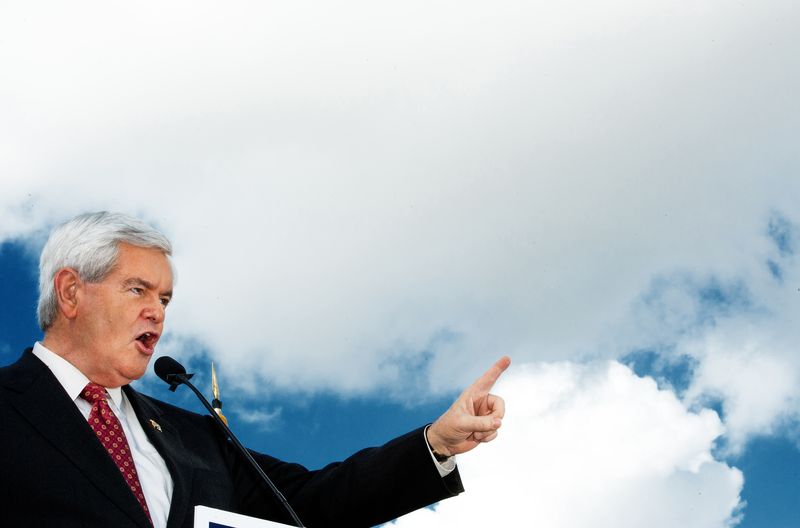
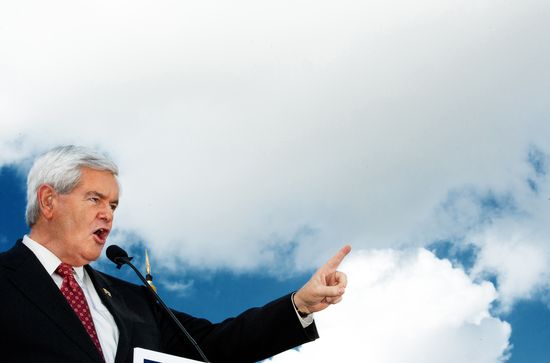
(Photo: Republican presidential hopeful former Speaker Newt Gingrich fires back at a protester in the crowd as he speaks in the parking lot of the Wings Plus restaurant January 25, 2012 in Coral Springs, Florida. By Paul J. Richards/AFP/Getty Images.)

The Terms Of The Grand Bargain

Scott Galupo insists that long-term deficit reduction hinges on a proposal we've seen before: 

[T]he terms of the Grand Bargain—entitlement cuts in exchange for higher taxes on the wealthy—remain the crux of our paralyzed deficit-reduction politics. Even if Obama loses in November, Democrats in Congress are going to continue insisting on those terms. And with the power of the routine filibuster on their side, as well as public sentiment in favor of hiking taxes on the rich, Democrats won't need control of the White House or either house of Congress in order to hold out for the Grand Bargain.

Cool Ad Watch

Fresh from an incredible year rounded off by his immensely popular 'The Long Wait' for John Lewis, [director] Dougal [Wilson] lends his uniquely charming touch to a good cause: getting people to eat more vegetables. Celebrating cooking in its most vibrant form, we're reminded that healthy food doesn't have to be boring.

What Do Elites Know Of Ordinary Americans?

Ilya Somin dissects Charles Murray's claim that "the people who have so much influence on the course of the nation have little direct experience with the lives of ordinary Americans":

[T]here is an important sense in which elite ignorance reduces the quality of public policy. In a complex society where people have a wide variety of preferences, not even the most knowledgeable elite experts can really have enough information to impose efficient paternalistic regulations that preempt individual choice. But this problem would persist even if all our elites had a deep and extensive knowledge of non-elite culture. The solution is not so much an elite that is better-informed about the culture of the masses, but an elite whose power over those masses is more limited and decentralized.

That said, I’m certainly open to the possibility that diminishing some types of elite ignorance would improve our society. But I’m skeptical that what we need to have a better elite is the kind of knowledge Murray emphasizes.

Why Is US Economic Mobility So Low?

MOBILITY-GRAPH

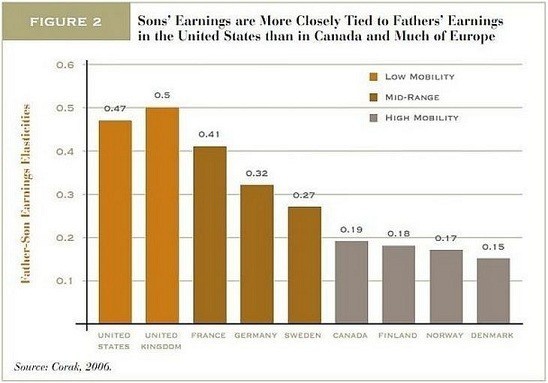
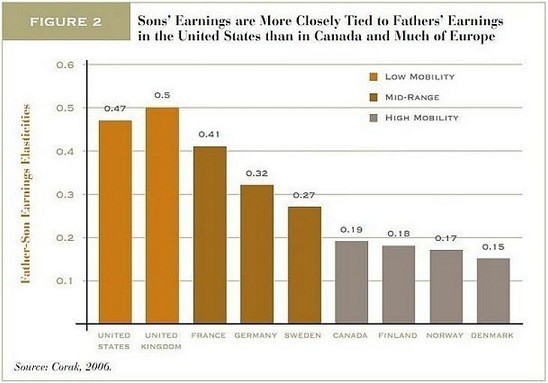
Tyler Cowen takes issue with the Europe comparison:

Why do many European nations have higher mobility?  Putting ethnic and demographic issues aside, here is one mechanism.  Lots of smart Europeans decide to be not so ambitious, to enjoy their public goods, to work for the government, to avoid high marginal tax rates, to travel a lot, and so on.  That approach makes more sense in a lot of Europe than here.  Some of the children of those families have comparable smarts but higher ambition and so they rise quite a bit in income relative to their peers.  (The opposite may occur as well, with the children choosing more leisure.)  That is a less likely scenario for the United States, where smart people realize this is a country geared toward higher earners and so fewer smart parents play the “tend the garden” strategy. 

Quiggin isn't persuaded:

Cowen’s post is an exercise in defending the indefensible, and its weaknesses reflect that. As Mitt Romney’s tax returns show, wealthy Americans have the rules rigged in their favor from day one. And that’s assuming they obey the rules. Unlike the poor, they can mostly cheat with impunity. In these circumstances, it’s unsurprising that US inequality is so deeply entrenched. The only surprise is the suddenness with which the facts have become common knowledge.

(Chart via Jason Linkins)

Paterno’s Legacy – And Ours, Ctd

Screen shot 2012-01-26 at 1.50.47 PM

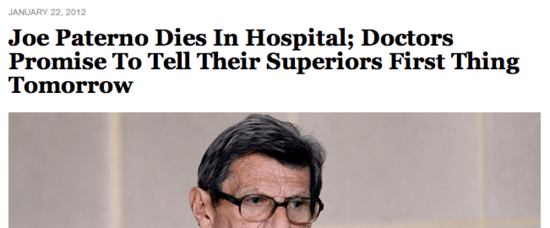
A reader comments on another's praise of Paterno:

I understand the desire to not throw away decades of idol worship over one scandal, but the argument is a bit lacking. Sure he made a lot of great coaching decisions, but when confronted with one of the most important decisions a person could possibly be confronted with, the decision to stop the possible endangerment of a child, he failed miserably. It seems society should require this to be part of his legacy. It lets others know it doesn't matter how successful you are – if you allow the endangerment of a child, none of your accomplishments matter. If it keeps kids safer from these sorts of acts, I'm ok with it.

Another is a bit more blunt:

Your reader's email about Paterno's legacy at Penn State and his personal thrill at receiving a thank you note from the Paternos was downright sickening.

Basically, the reader is impressed and personally touched by the fact that the Paternos went out of their way, in a time of great stress, to research his/her address, write a thank you note and mail it to him in a very timely fashion. If only Joe Pa had devoted a fraction of the diligence to reporting a crime against a child (and preventing future abuses) that he and/or his wife put into adhering to Emily Post. Your reader went on to say "Joe never missed an opportunity to remind us that success is only valuable when it comes with honor". Am I to assume there is more honor in etiquette than in preventing child rape?

Another reader:

I live in Central PA, and am currently a grad student at Penn State. Unlike nearly everyone else at PSU, I actively dislike their football team. (I grew up a fan of, and eventually attended, a university that Penn State fans consider a rival.) I couldn't agree more with your first reader's take that "The need to classify him into a category of 'good' or 'evil' seems like folly to [him or her]." Although I don't like the team, I respect that he tried to run his program the right way (no mean accomplishment, to be sure) and by all accounts he was a genuinely kind and decent guy.

Your second reader, however, trotted out a canard that I keep hearing from my many PSU alum friends and people in the area. The reader claims that Paterno "had been mistreated by the University and the press (based on incomplete information and misinformation)." These Gingrichian (or are they Palinesque?) claims that JoePa was a victim of the "national media" and the Board of Trustees are absurd, and I'm getting tired of hearing it.

First off, what do these people think would have been an appropriate response by the media and the Board? I frequently hear that he should have been allowed to retire at the end of the season, but let's unpack that one a bit. If Paterno had still been on the sidelines for the last three games of the season, can you imagine the shitshow that would have ensued?

He was fired Nov. 10, and they had a home game with Nebraska that weekend. That might have been manageable enough in the friendly confines of the Happy Valley, but the next two weeks were road games at Ohio State and Wisconsin. How would those schools have felt about all the extra security they would have had to hire, and the protesters who undoubtedly would have descended on both Camp Randall and the Horseshoe. For that matter, at that point in the season, Penn State had a chance to make it to the inaugural Big 10 championship game. (Conference title games are huge moneymakers, and it was only this season that the Big 10 finally had enough schools to be allowed to hold one.) How would the other member institutions have felt about having a child sex abuse scandal hanging over their biggest game of the year? (Here's a hint: they took Paterno's name off the championship trophy when he was fired.)

Big 10 membership is a HUGE deal for Penn State. My professors are always talking about how the school uses other Big 10 institutions as benchmarks for literally everything. Also, from what I understand, it was the money Penn State got from joining the Big 10 in the '90s that has enabled it to become (I believe) a top 50 research university worldwide, at least by one measure. People like to say how Penn State is "more than just football," but the fact is that if their football brand were destroyed (which can happen, just ask SMU) Penn State might just find itself viewed as a "cow college" again. Letting Paterno stay on would have been malpractice on the part of the Board.

Also, is there a going concern in the world (aside from the Catholic Church, bien sur) that would allow its chief executive to remain in place under similar circumstances?

And let's not forget the dread "national media." What, exactly, is it that these people would have had the press do? There was certainly no lack of media criticism of Penn State or JoePa (or McQueary for that matter) in the wake of the revelations, and some of it could certainly be described as inflammatory. Here's the thing though. Penn State fans who embrace the "national media" narrative seem to be saying that these incendiary commentaries in the press are the reason why so many people were so pissed off about what happened. Seriously? It was the commentary? I can't speak for anyone else, but "raping 10 year olds" was really all I myself needed to get fully pissed, and that seems to have been the reaction of everyone who isn't emotionally invested in PSU football. Is it really so impossible to believe that child rape can piss people off without some talking head telling them that that's how they should feel? Fuck that.

Finally, if Joe wanted to clear his name, he had every opportunity in the world. I didn't watch his WaPo interview, but from the accounts I read, it doesn't sound like the reporter really pressed him on details; I'm pretty sure the biggest news the interview generated was the fact that he "wished he had done more," or some such cliche. Since he'll never face cross examination under oath, it is highly unlikely that we will ever be able to completely judge Paterno's moral complicity in these alleged crimes, but that's on Joe; I'm sure the national media would have been happy to give him all the airtime he wanted to try and rescue his legacy.

(Screenshot from The Onion)

The Manufacturing Jobs Aren’t Coming Back

Nicholas Thompson wants Obama to focus on software rather than hardware:

What really makes the iPhone work isn’t the hardware. Sure, the glass—designed by Corning in upstate New York and manufactured in China—is beautiful. But the transformative part of the phone is the software. The code behind the touch-screen was written here; the iOS operating system was written here; most of the apps that we use are written here. Thousands of companies, in fact, have been started here to write apps for Apple’s iOS and Google’s Android. Software remains a great American expertise, and it’s only becoming more important as processors shrink into ever more powerful forms.

A Vision Of Home

Newearth_custom

Some calm and perspective in this intense political season. Robert T. Gonzalez explains how NASA made its newest awe-inspiring photo of Earth, "Blue Marble 2012:"

The camera on board [new satellite] Suomi NPP can only photograph small sections of Earth at a time, so the image you see here is actually something of a mosaic — a patchwork piece that collects photos taken from Suomi NPP over the course of January 4, 2012 and stitches them together.  Of course, when I say that Suomi photographs "small sections" of the Earth's surface, what I mean is that they're smaller than an absurdly hi-res photo of the entire planet; in actuality, they're still mind-numbingly enormous — like the true-color image of the Southeastern United States featured here.

Go here for a comparison of the image to the previous "Blue Marbles," including the 1972 original.

Should Obama Campaign On Clean Energy?

David Roberts makes the case:

Clean energy isolates the Republican base from the broad mass of American opinion and, in particular, from swing-state independents. It’s a wedge issue and an electoral winner for Democrats if they can quit playing defense and go on the attack. The appropriate response to threats from the U.S. Chamber of Commerce is a well-administered ass kicking.

Ed Kilgore situates the argument in a broader context of Democratic unwillingness to sell its own agenda:

It’s true that some sub-issues in this area remain tough – there’s no question progressives have lost ground with the public on dealing with global climate change during the last few years, and will always have trouble with policy prescriptions that deliberately aim at raising energy prices. But while it’s always appropriate to emphasize or de-emphasize this or that issue on strategic or tactical grounds at some particular moment, there’s something fundamentally wrong about an ideology or a political party that is unwilling to offer its own distinctive "take" on subjects the public cares about. David’s right there is a progressive opportunity on "clean energy" that ought to be fully exploited. Even if he was wrong, though, it’s a terrible habit to shut down thinking and talking about major national challenges just because "the other side" seems to have an advantage.