Too perfect it had to have been scripted:
Month: January 2012
Quote For The Day
"I sometimes wonder if the Republican Party has become the receding roar of white America as it pines for a way of life that will never return," – David Brooks. Me too.
The Odd Lies Of Sarah Palin LV: The Tweet
Well, I got someone's attention:
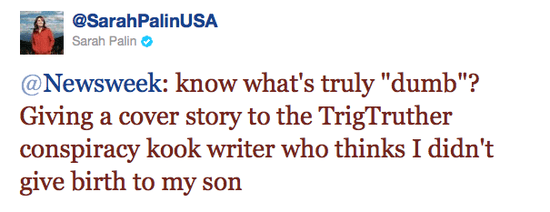
I have no idea, as I have said time and time again, whether Sarah Palin gave birth to Trig, and have never written such a thing. All I ever asked for a person who could become president was some basic evidence for her insane story, like medical records that most candidates have no problem providing. She never provided any, and preferred to withdraw from seeking public office rather than do so.
Of course, no response to the substance. She doesn't do substance. Neither, it seems, does much of the rightwing blogosphere.
The President Isn’t A CEO
Last week, Josh Barro pointed out that "understanding how a private firm should interact with the economy is different from understanding how the government should interact with the economy":
Romney is right to insist that it is not the job of business leaders to hold workers harmless—it is to make profits for shareholders. But while the human effects of these economic shifts are not properly the concern of business executives, they are the concern of government officials, and Romney wants to be president. The question he should be asked, then, is what policy implications arise from the economic shifts of the last few decades, driven (in small part) by private equity.
Does rising income inequality mean that fiscal policy should be more redistributive? Does a reduction in job security call for a stronger safety net? Do new workforce needs mean we need a shift in education and training policies? It’s worth noting that, as Governor of Massachusetts, Romney’s signature policy achievement was a universal health care program—that is, a safety net program that reduces the cost of job loss or income loss.
Matt Steinglass is more focused on how out tax system encourages Bain-style takeovers:
[Maybe] private equity really is overwhelmingly creating new efficiencies and generating value in the economy, rather than exploiting a tax feature that delivers money to owners while depriving the government of revenue and making otherwise healthy firms more vulnerable to bankruptcy. But this is certainly a debate we should be having. Because for many people, it's clear that "capitalism" as represented by post-1980s Wall Street is a different beast than capitalism as represented by 1950s Detroit.
What Are Romney’s Chances?
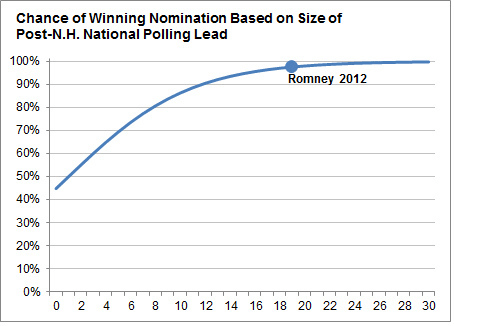
Nate Silver puts Romney's lead in context:
One way to evaluate the data is through logistic regression analysis, which gives an estimate of how likely a candidate was to win the nomination based on the size of his national polling lead after New Hampshire. The analysis suggests that a 19-point lead in national polls at this stage of the race translates into roughly a 98 percent chance of winning the nomination.
Silver later hedges and concludes that Romney has a better than 90 percent chance at the nomination.
When A Woman Rapes A Man
James A. Landrith recounts his experience:
I had trouble being alone with a woman in a confined space like an office or elevator. Some days, I didn’t even want to stand next to a woman in line for a cup of coffee. Remember the controversy in the feminist blogosphere over strange men talking to women in an elevator? Reverse the sexes and I lived it. For me, the issue wasn’t hypothetical or used to demonstrate which gender has it worse with regard to potential sexual violence. It was based on an actual trauma response. The back and forth over why men should expect to be viewed as rapists by women in elevators took on a whole new level of offensive when viewed through the lens of my own experience.
Living In Lamb Chop’s Shadow
Matt Weinstock considers the career of ventriloquist Shari Lewis:
[T]he profession of ventriloquism was assurance that Lewis would never have to interact onscreen with anyone other than herself. I recently watched her 1996 guest appearance on Sesame Street; the episode is ostensibly about a kittenish Lamb Chop learning how to meet new people, but what struck me was how furiously Lamb Chop and Lewis kept their eyes on each other throughout. Big Bird, Lamb Chop’s “new friend,” just stood there like a lug while the two of them sang. A new friend, of course, would throw their rhythm off. Their shtick is self-sufficient.
The Shrinking GOP Field
John Sides and Lynn Vavreck believe it will help Romney:
Romney is the second choice of a quarter of the electorate who did not rank him as a first choice. Nearly 40% of Gingrich voters list Romney as their second choice. More than half of Huntsman voters do so. This suggests that as the field narrows, Romney’s support will grow, in contrast to the notion that the “anti-Romney” vote could coalesce around another, apparently more conservative candidate if there weren’t so many conservatives in the race.
Your Digital Identity
Visualized:
Maria Popova summarizes the video:
28,000 MMS messages — multimedia pieces of communication like photos, videos, and voice communication — are sent into the world every second, and cell phone companies record much of the metadata that travels with them, like location, identity of the receiver, amount of data transferred, and the cost of the transmission. The average user has 736 pieces of this personal data collected every day …
Pete Warden, a programmer who created that awesome VFYW globe for the Dish, offers a historical parallel in support of data collection and open data:
We actually know more about everyday life in Sumeria five millenia back than we do in Europe fifteen hundred years ago. The Sumerians recorded everything on stone or clay tablets, most of which were discarded after use with no thought for posterity. As it happened, the clay tablets proved remarkably resilient and so archaeologists and scholars have found and decoded hundreds of thousands of them. This data exhaust gives a rich view into trade, worship, life, death, medicine and almost every other aspect of the Sumerian's world. This is a big reason why I'm so fanatical about opening up data sources.
Doc Searls wants customers to regain control of their data.
History Of The Facial
Hugo Schwyzer says the act wasn't always seen as degrading:
[Sex educator Charlie Glickman] suggests that the AIDS crisis and the concern with safer sex was what made the facial popular. "Cum on me, not in me" was a popular sex educator slogan as far back as the late 1980s.
Ejaculating on a woman's stomach, however, usually meant that the camera wouldn't let the audience see the actress' expression. But if the male actor came on her face, the viewer could see two things at once: evidence of male pleasure (symbolized by the ejaculation) and the equally important sign that a woman's reaction to that pleasure mattered. With sex now so dangerous — and HIV particularly likely to be spread through semen — facials were relatively "safe." But in the era of AIDS, they were also compelling visual evidence that a woman wasn't threatened by a man's semen. In that sense facials were, almost from the start, more about women's acceptance of men's bodies than about women's degradation.
 The Dish