The Economics Of Snow

Snowdata copy_

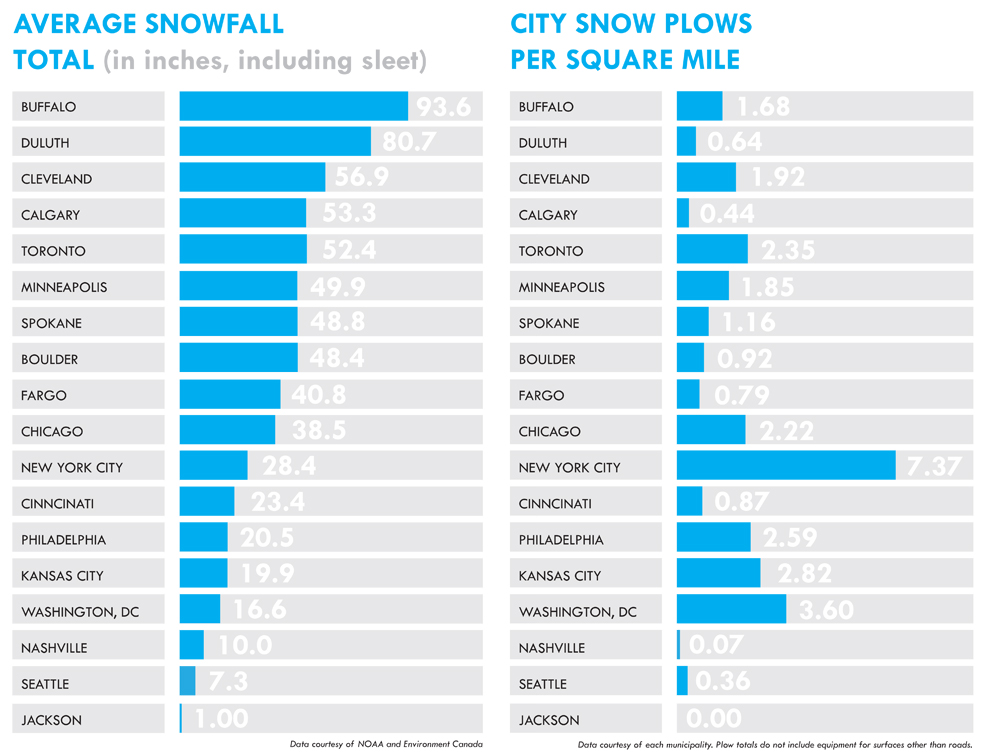
Emily Badger researched how various cities determine how many snow plows they need:

Here is the challenge: People in Nashville freak out when there are two inches of snow. People in Buffalo freak out when there are two feet. Washington, D.C. gets about 16 inches a year on average, but once every seven years or so, something really wild happens. Seattle averages only about 7 inches, but Spokane – at the same longitude but on the other side of the mountains – gets nearly 50.

Weather is unpredictable, and so is how people react to it. A public works official steps into this world and has to weigh the factors that are unknowable (freak storms) against the ones that are (city budgets) and then hope for the best.

On a related note, Stephen Gandel reports on the bizarre history of weather derivatives and how the lack of snow this year could provide a windfall for financial firms:

Financial contracts based on the weather have been around since at least the late 1990s. The contracts, many of which trade like stocks, are typically pegged to such things as rainfall and temperatures. But in the past few years, contracts specifically tied to snowfall have started to take off in popularity. The contacts essentially act like insurance, allowing, say, retailers or ski mountains to insure against too much snow or too little. Wall Street sells the contracts, matching buyers and sellers and pocketing a small commission. Typically, it’s a good business, but this year it could be a real moneymaker.


The Definition Of Job Security

Charles Nevin runs some numbers on the Queen of England:

She has made over 300 state visits abroad, some 25,000 visits around Britain to greet, meet, open and tour, hosted more than 100 state banquets for foreign heads of state, including Robert Mugabe and Nicolae Ceausescu, conferred 400,000 honours, dealt with around 150 prime ministers in Britain and the Commonwealth, received 3.5m pieces of correspondence and attended to daily red boxes containing various matters of state, cabinet minutes, appointments, legislation. According to a new biography, “Our Queen” by Robert Hardman, she has fallen asleep at work once, very briefly, in 2004, during a lecture on new insights into biology and medicine with the use of magnets at the Heinrich Heine University, Dusseldorf.

Does Age Make Us More Conservative?

Perhaps not:

Overall, what's happening in society at large as people come of age seems to matter most in determining the starting point for their core beliefs, said Karl Pillemer, a sociologist and gerontologist at Cornell University, who conducted more than 1,000 in-depth interviews with seniors for his book, "30 Lessons for Living: Tried and True Advice from the Wisest Americans." … Late in life, his research shows, people often become more open, more tolerant, and more appreciative of compassion. Even if they started out conservative, they may become less extreme in their conservatism.

What Caused The Salem Witch Trials?

Ben Shattuck investigates various theories, including that the girls ate hallucinogens:

The take-home from the trials shouldn’t be that poisonous plants can make you hallucinate, but that a perfectly capable, religious, and law-abiding community that laid the roots for American justice legally and conscientiously executed 20 of its own innocent citizens; that over 150 people in Salem that year who were charged as having consorted with the Devil. In [the jimsonweed] theory, the girls went crazy. In [historian Mary Beth Norton]’s, the town went crazy.

Still Holding Out For A Brokered Convention?

GOP+4+SC+all+crossed+out

Ed Morrissey dismisses the Republican dream: 

[L]et’s say for the sake of argument that no one candidate has a majority of the delegates, and none manages to wangle a majority on the first ballot at the convention.  How does this benefit conservatives, who have fought the "establishment" that has pushed Romney for the nomination?  The nominating process will then fall into the hands of the Republican National Committee, comprised of state party chairs and other power brokers, where the Tea Party has little or no influence. The fantasy in this case will be that the assembled party bosses and delegates, many of whom are part of state-party establishments, will crown a completely new candidate. … [C]onsider the hole from which this nominee would start. Ten weeks from the election, the party would have a nominee for which no one had cast a ballot in a primary, who has raised no money, who has built no organization, and who has articulated no platform before getting drafted at the convention.  

Matt Lewis has more. Earlier Dish speculation here.

(Image via politicalbetting.com)

Romney’s Envy “Rosebud”

Noam Scheiber contrasts Mitt with his father George:

“I was kicked out of Mexico when I was five years old, because the Mexicans were envious of the fact that my people, who, when they went down there, were just as poor as the Mexicans, … became prosperous,”[George Romney]  said in a speech in 1961. “The Mexicans thought, if they could just take it away from the Mormon settlers, it would be paradise. It just didn’t work that way, of course.” …

[T]he elder Romney’s response to this slightly stunted analysis was admirably progressive. It was one of the reasons he favored foreign aid, an end to discrimination, and subsidized preschool and summer school. He was the model of a ’60s-era, liberal Republican. Romney fils, on the other hand, has responded to the same analysis in a strikingly different way. Like his father, Mitt Romney worries about those who would demonize wealth and success. But, whereas George sought to ease their plight, Mitt seeks to demonize the demonizers. It’s as though Mitt inherited all of his father’s noblesse, but none of the oblige.

Reihan makes an important distinction:

The political tendency Romney is criticizing is not a “politics of envy” driven by “the frustrations of the down-and-out.” Rather, he is, I suspect, criticizing a “politics of envy” driven by relatively privileged people who tend to be more concerned about the competition for positional goods in dense metropolitan areas than about chronic unemployment and underemployment in marginalized communities.

Florida Looks Done. Sigh.

Screen shot 2012-01-29 at 7.28.22 PM

Newt's mystifyingly bad debate performance seems to have sealed his fate in the state. But he is still in the lead nationally, and Shelly looks set to keep financing him. Nate Silver has a good guide to what will then be a long month without binding primaries. It's striking that Romney's leads in heavily Mormon Arizona and his home state of Michigan are rather shallow.

Here's the weird thing. I find myself rooting for Gingrich now, one of the most repulsive, nasty and delusional men in American public life. This primary season – when it hasn't eaten deep into my soul – has driven me to all sorts of strange emotions. There were a few nanoseconds when I even wanted Santorum to rally after Iowa. That's a horse race for you, I guess.

“The Moral Scandal Of American Life”

GT_Prison

That's Adam Gopnik's view of mass incarceration in the US:

Every day, at least fifty thousand men—a full house at Yankee Stadium—wake in solitary confinement, often in “supermax” prisons or prison wings, in which men are locked in small cells, where they see no one, cannot freely read and write, and are allowed out just once a day for an hour’s solo “exercise.” (Lock yourself in your bathroom and then imagine you have to stay there for the next ten years, and you will have some sense of the experience.)

Prison rape is so endemic—more than seventy thousand prisoners are raped each year—that it is routinely held out as a threat, part of the punishment to be expected. The subject is standard fodder for comedy, and an uncoöperative suspect being threatened with rape in prison is now represented, every night on television, as an ordinary and rather lovable bit of policing. The normalization of prison rape—like eighteenth-century japery about watching men struggle as they die on the gallows—will surely strike our descendants as chillingly sadistic, incomprehensible on the part of people who thought themselves civilized. Though we avoid looking directly at prisons, they seep obliquely into our fashions and manners. Wealthy white teen-agers in baggy jeans and laceless shoes and multiple tattoos show, unconsciously, the reality of incarceration that acts as a hidden foundation for the country.

(Photo: Timothy A. Clary/AFP/Getty Images)