Do Atheists Need To Come Out?

Julian Sanchez wonders if the rise of politicians like Rick Santorum is related to the increasing awareness that atheists are among us:

Previously faith could more or less be taken for granted—maybe the candidate makes a passing reference to the church they regularly attend—and that’s all there is to it, really, because of course everyone’s a believer of one stripe or another. Increasingly, isn’t so—that there are actually quite a lot of unbelievers, many of them effectively operating in stealth mode. This was probably always the case, but outside the academy and a few urban enclaves, nobody was terribly vocal about it—you certainly didn’t have anything like a visible public “movement.” Suddenly, if you’re someone who thinks of faith as a minimal prerequisite for decency, what was previously tacitly understood has to be signaled with extra vigor.

He thinks this might be a reason for "closeted" atheists to come out:

[T]here’s a case for being a little more vocal—for coming out secular—at this particular historical moment, in the interest of hastening the journey across the valley between invisibility and normalcy.
Iran Isn’t The Evil Empire

David Slungaard worries that there are fundamental differences between deterring the Soviets and deterring a nuclear Iran:

Should Iran cross the nuclear threshold, attempts by the U.S. to construct effective deterrence strategies will require accurate information regarding Iran’s strategic capabilities and signals. Therefore, attempts by Iran to camouflage, project, or distort their capabilities will likely further frustrate the ability of Tehran and Washington to communicate clearly and decipher deterrence ‘signals’ correctly. Without the presence of ‘communication hotlines’ or effective signaling – both critical pieces of crisis management during the Cold War – the likelihood of conflict rises dramatically.

Checking Hollywood’s Math

The Motion Picture Association of America claims copyright theft has cost the economy $58 billion in economic losses. Rob Reid isn't buying it:

Reid calculated the music industry’s revenues in 1999 (when Napster debuted) and in 2010 (the most recent available data) and found sales dropped $8 billion but total movie and TV revenues are up:

So where is the missing $50 billion in piracy? It’s hard to accept that it’s foregone growth in markets that have grown in line with, or (in the case of the giant TV/ satellite/ cable market) far faster than historic norms. So we’re left looking for a market that has no historic norms. Because in such a case, one can tenuously argue that but for piracy, it might have grown at such a blistering rate as to make $50 billion in foregone sales at least hypothetically possible. So what significant American media market literally didn’t exist at all in the ’90s?

The best I could come up with was downloadable ringtones, which were first launched in Japan and Finland in 1998, and didn’t appear on these shores until later. Sure, citing ringtones was a punch line. But if the MPAA can document $50 billion in other pirated media, I’d love to hear about it.

Why Atheists Can’t Organize

Because they aren't a community:

[I]t won't be easy for secular Americans to become better organized as a political force, even as they increase in number. The major impediment to that kind of organization is the fact that it is very difficult for secularists to conceive of themselves in tribal terms. Most tribes, whether of nations or ethnicities or sports fandom, can easily demarcate their membership—it's the people who look like us, or talk like us, or dress like us. Tribes organized around religious belief have rituals, sacred texts, and physical spaces that all serve to bind the participants together. Atheism has none of these things—most of the time it's an individual choice, made and kept alone.

A Cure To The Common Virus

Carl Zimmer updates us on recent anti-virals research:

Virologists … are still waiting for their Penicillin Moment. But they might not have to wait forever. Buoyed by advances in molecular biology, a handful of researchers in labs around the US and Canada are homing in on strategies that could eliminate not just individual viruses but any virus, wiping out viral infections with the same wide-spectrum efficiency that penicillin and Cipro bring to the fight against bacteria. If these scientists succeed, future generations may struggle to imagine a time when we were at the mercy of viruses, just as we struggle to imagine a time before antibiotics.

But a breakthrough could have downsides:

Even success might bring unanticipated problems. That’s certainly the lesson from the story of broad-spectrum antibiotics. If you swallow a Cipro pill for a salmonella infection, it will wipe out not just the salmonella but many other beneficial bacteria in your gut. Once the salmonella is gone, it may take weeks, months, or even years for the microbial ecosystem to return to something resembling its former state. This disruption can, ironically, allow other pathogens to sneak in and establish themselves.

Who Made #StopKony Go Viral?

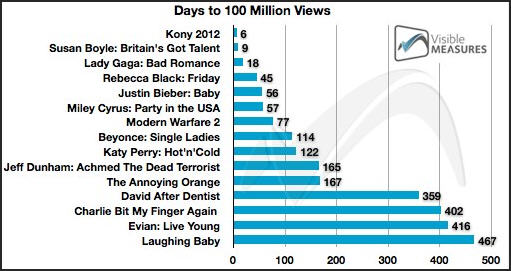
Kony-100m-views

Martin Gurri breaks down the demographic that propelled Kony 2012 to super-viral status. Turns out the popularity was thanks to teenage Southern girls:

[F]emales aged 13 to 17 lead the charge, followed by males aged 18-34. … The dominant means of diffusion, predictably for this age group, were mobile phones, Facebook, and Twitter (where #StopKony trended for several days). A deeper probe into the character of the Kony network begins to turn up surprises. 

Gilad Lotan parsed the first 5,000 posters to the #StopKony hashtag, and found they clustered around mid-sized cities in the South and heartland:  Birmingham, Alabama; Pittsburgh, Pennsylvania; Oklahoma City; Dayton, Ohio; Noblesville, Indiana.  Lotan then produced a tagcloud from the user profiles of these vanguard posters.  “We easily identify prominent words,” he writes, “such as Jesus, God, Christ, University, and Student.”

Meanwhile, Mark A. Drumbl contrasts the reality of child soldiers to the doctored portrayal sold in Kony 2012.

Politics Rewards The Old

Stephen Marche examines the state of affairs:

There may be no white America and no black America, no blue-state America and no red-state America, but one thing is clear: There is a young America and there is an old America, and they don't form a community of interest. One takes from the other. The federal government spends $480 billion on Medicare and $68 billion on education. Prescription drugs: $62 billion. Head Start: $8 billion. Across the board, the money flows not to helping the young grow up, but helping the old die comfortably. According to a 2009 Brookings Institution study, "The United States spends 2.4 times as much on the elderly as on children, measured on a per capita basis, with the ratio rising to 7 to 1 if looking just at the federal budget."

Noah Kristula-Green wishes this weren't so:

Speaking for myself, I suspect the American political system is too slow to really change its priorities and redirect its focus on my generation, but there is always time to refocus on the next one. We now know that the first two years of life are the most consequential for child's development. I would consider reduced Medicare spending now coupled with an increase in efforts to ensure adequate early childhood nutrition to be a successful policy trade-off. Or we can just make the Ryan Budget law and protect the baby boomers with a firewall to preserves their benefits.

The Etymology Of “Dude”

Its use has changed dramatically over the decades:

[O]ne of its first written appearances came in 1883, in the American magazine, which referred to "the social ‘dude’ who affects English dress and the English drawl". The teenage American republic was already a growing power, with the economy booming and the conquest of the West well under way. But Americans in cities often aped the dress and ways of Europe, especially Britain. Hence dude as a dismissive term: a dandy, someone so insecure in his Americanness that he felt the need to act British. 

More on the word's origin here. If that isn't enough "dude" for you, watch this supercut.

The Importance Of Low-Quality Products

Yglesias recounts the history of the frozen bagel:

The fundamental story of Lender’s Frozen Bagels is that the winning product isn’t always the best one. Like Ikea for furniture, H&M for clothing, or the Olive Garden for Italian food, Lender’s innovated by finding a way to compromise on quality and reap huge gains in other spheres. To an extent, it’s thankless work. Nobody wants to stand up and proudly proclaim, “I changed the world with my inferior products.” But often this is how the world changes. And if you look at the health care and higher education corners of the American economy where spiraling costs are bankrupting the middle class, you see sectors that are largely untouched by this kind of low-end innovation. The world could probably use a few more Murray Lenders.