The Roots Of “Meh”

Meh

Ben Zimmer studies up:

Yiddish appears to be the ultimate source. I checked with Ben Sadock, a Yiddish expert in New York, and he turned up a tantalizing early example. In the 1928 edition of his Yiddish-English-Hebrew dictionary, Alexander Harkavy included the word meh (written in the corresponding Hebrew letters) and glossed it as an interjection meaning "be it as it may" and an adjective meaning "so-so." (Meh is also used in Yiddish to represent the bleating of goats, but Sadock doesn’t think the two types of meh are necessarily related.)

From Zimmer's blog:

["The Simpsons" writer John] Swartzwelder did have a memory of where he first came across meh, though it wasn't in Mad. "I had originally heard the word from an advertising writer named Howie Krakow back in 1970 or 1971 who insisted it was the funniest word in the world," he told me.

(Image from the Meh Romney tumblr)

Libya Still Has Potential?

George Grant returns [pdf] from the country with a rare upbeat report about progress there:

It is not for nothing that a recent poll found incredible optimism for the future amongst Libyans. More than 90 per cent of those surveyed said they felt last year’s revolution was a positive development. Most just seem glad for the opportunity to express their opinions and to go about their business without constant fear of the consequences. For now freedom is enough, but nobody is under any illusions as to the need to turn that into something more. The collective will is certainly there, as are the raw economic resources and the potential of a comparatively literate workforce. With the right level of international support, technocratic as much as economic, Libya can succeed. Nobody should be writing this remarkable country off as another failed state in-waiting just yet.

The Gaza Mess

Matt Duss reports on how Israel's border restrictions have reshaped society in the Palestinian enclave:

The result of the policy of closure … has been the development of a sizable black market economy based upon illegal tunnel trade. This has been accompanied by the growth of influential constituencies in both Egypt and Gaza that oppose any effort to shut down the tunnels, and will lobby hard against  the creation of a more open, regulated border. By empowering a large new merchant class that profits from the tunnels, the closure policy has effectively created another stumbling block to normalization of relations between Israel and the Palestinians.

And that wasn't the point?

American Soldiers Handing Out Korans

Koran

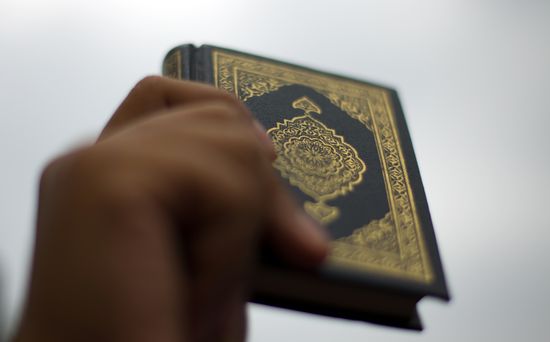
That is Richard Miniter's recommendation for repairing the US military's reputation in the wake of the Koran-burning controversy:

The American-distributed Qurans would be gratefully received. Americans, who come from a country awash in books, simply don’t realize how important books (especially "the book" for Afghanistan’s Muslims) are to a people that has very few of them. Even prayer leaders and imams often do not have a copy of the Quran, especially in remote regions. Instead, they memorize. Indeed, people who memorize the entire Quran are revered in Afghanistan and other Muslim-majority lands. And these people, these legendary memorizers, are not as rare as you might think. I’ve met several in my travels across the region.

Why he thinks this will help calm the country:

When you add the traditions surrounding a holy book to the perceived rarity of that book, you have an explosive combination. No, that doesn’t excuse murder and violence. But these traditions and perceptions of rarity, which combined to cause the current crisis, can be used to undo it. Passing out Qurans to Afghan civilians, if done reverently, would work to build trust and restore order. 

(Photo: A protester holds up a copy of the the Koran during a demonstration in front of the US embassy after Friday prayers in Kuala Lumpur on February 24, 2012 following the news over the burning of Korans at a US-run base in Afghanistan. By Mohd Rasfan/AFP/Getty Images)

Fearing Food

Nina Strochlic sympathizes with people suffering from extreme picky eating, classified as Selective Eating Disorder or food neophobia:

For most of her childhood, Jenna (not her real name) spent dinnertime staring at a plate of food that she refused to touch. She often was sent to bed hungry, or her parents caved and let her eat the only thing she could get down: French fries. Dinnertime hasn’t changed much for the 30-year-old dance teacher, who estimates that fries still constitute 90 percent of her meals.

In the last 15 years, the only addition to Jenna’s diet has been pancakes, which she says took more than a year to work up the courage to taste. When she tried an orange for the first time at age 18, she immediately threw up. But Jenna doesn’t restrict her diet because she loves fried potatoes—in truth, she doesn’t enjoy them at all. Jenna suffers from an unusual eating sensitivity, which has compelled her to eat almost nothing but French fries, cheese pizza, and spaghetti ever since she graduated from Gerber baby food as a toddler.

Ad War Update

The DNC pits Romney and the Blunt amendment against women: 

In a pretty mundane ad below, Romney's Super PAC takes aim at Santorum in Ohio, Oklahoma and Tennessee:

Previous Ad War Updates: Feb 29Feb 28Feb 27Feb 23Feb 22Feb 21, Feb 17, Feb 16, Feb 15, Feb 14, Feb 13, Feb 9, Feb 8, Feb 7, Feb 6, Feb 3, Feb 2, Feb 1, Jan 30, Jan 29, Jan 27, Jan 26, Jan 25, Jan 24, Jan 22, Jan 20, Jan 19, Jan 18, Jan 17, Jan 16 and Jan 12.

Romney’s Impossible Tax Plan

Howard Gleckman tries to make sense of it:

Romney’s promise to make his new system as progressive as today’s puts him in a difficult policy box. Which tax preferences aimed at upper-income households could he dump to keep the code progressive while not adding hundreds of billions to the deficit?   

Raising rates on capital gains and dividends might help, but he’s already promised to cut them to zero for those making $200,000 or less and hold them at 15 percent for everyone else. Eliminating or restructuring tax breaks for retirement savings, mortgage interest, and employer-sponsored health insurance could make Romney’s low-rate system more progressive, but these changes would be hugely controversial.

The Daily Wrap

GT_BREITBART_120301

Today on the Dish, Andrew appreciated the late Andrew Breitbart in spite of left-wing nastiness (medical details here), responded to some reader dissents on the topic (Frum's thoughts here), and rethought his Romney/Huckabee idea. We profiled Romney's Virginia edge on Super Tuesday, looked at historical evidence that his favorables weren't likely to get much better, pegged Mitt as the "candidate of the 1%" with some quantitative support, watched him play Newt, aired a rebuttal to the "demographic catastrophe" thesis about the GOP, and noted both the incompetence of the GOP electoral establishment and the coolness of President Obama. Ad War Update here.

Andrew also floated a new Urtak poll on the Cannabis Closet, lambasted Limbaugh's sexist crassness (follow-up gross here), was infuriated by "the sickness on the right," poured cold water on the idea that airstrikes could guarantee a non-nuclear Iran, found evidence that Israelis weren't all that supportive of an attack, and flagged a foul proposal to turn Iran into North Korea. We parsed the signs that might suggest war wasn't coming, sparked debate about Tehran's cabs, worried about Syria after the fall of Baba Amr, discovered that war hurt the earth, explained the importance of the Russian vote, and located Americans firmly in the global 1%.

Maryland joined the marriage equality ranks (perhaps for reasons predicted by Dan Savage), the tax-breaks-for-children debate raged on, ignoring Obamacare's rules ceded power to the feds, the economy seemed capable of surviving high gas prices, the war on medical pot killed, and spending food stamps for soda created controversy. Technology caused panic, HBO stayed offline, and the jury duty thread continued. Malkin Nominee here, Hewitt Nominee here, Quote for the Day here, VFYW here, MHB here, and FOTD here.

Z.B.

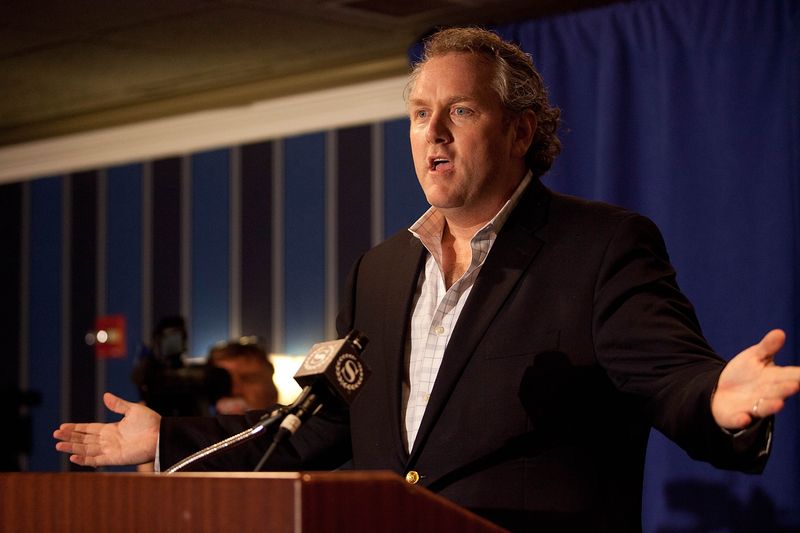
(Photo: Andrew Breitbart, who ran BigGovernment.com, speaks to members of the media before a press conference held by Rep. Anthony Weiner (D-NY), in which Weiner both admitted to having numerous sexual relationships online while married, and apologized to Breitbart, at the Sheraton Hotel on 7th Avenue on June 6, 2011 in New York City. Breitbart, whose publication was one of the first to break the story of Weiner's sexual conduct, was accused of lying. By Andrew Burton/Getty Images)

Breitbart – And Us

112771411

Two small thoughts that came to me today, as I absorbed the news some more. This is how Andrew spent his last hours – a two hour argument in a bar with a total stranger. It wasn't heated, apparently, just lively, even fun. But it shows how utterly absorbed Breitbart seemed to be in the game. This nugget leapt out:

"He wasn’t drinking excessively," Sando recalls. "He was on his BlackBerry a lot."

Ah, yes, the Blackberry. Limbaugh notes:

Over the years, the whole thing he was involved in seemed to lose some of the fun factor as the intensity and the seriousness of it picked up. And this loops back to the notion that we all only have one life. I hope that that didn't have anything to do with it. I mean, he was very intense. He was profoundly intense, and at times he'd get very mad, very angry — as we all do — and very frustrated. Everybody wants to matter. Everybody wants to be effective. He was far more effective than he probably ever dreamed, but probably wanted to be even more so.

Toby Harnden adds to the picture:

Andrew also said [one] night that he had recently gone to the hospital emergency room with a tightness in his chest. When a nurse had "freaked out" at how high his blood pressure was, he had responded: "Don't tell me that – you'll make it even higher."

Breitbart had looked overweight and stressed that night. I and the others with us told him he needed to ease up on his insane travel schedule and he talked about trying to exercise more, taking downtime with his family and getting a personal assistant to take charge of his diary. But he always seemed to be on Twitter, on TV, on the phone or on a plane – and sometimes seemingly two or three of these at once.

In the new 24/7 mediaverse, in a brutal, unending culture war, with the web unleashed and news and opinion flashing every few seconds, you can very easily lose yourself, and forget how and why you got here in the first place. There have been times writing and editing this blog on that kind of insane schedule for more than a decade when I have wondered who this new frantic way of life would kill first. I do not doubt that Andrew tried to keep a balance, and stay healthy, but like the rest of us, became consumed with and overwhelmed by this twittering, unending bloghorreic chatter. It takes a much bigger physical, emotional and spiritual toll than most realize, and I've spent some time over the years worrying it could destroy me. Here I am, after all, at 9.30 pm, still blogging, having just filed another column, and checking the traffic stats, and glancing feverishly at every new item at Memeorandum.

Human beings were not created for that kind of constant unending stress, and the one thing you can say about Andrew is that he had fewer boundaries than others. He took it all so seriously, almost manically, in the end. The fight was everything. He felt. His anger was not feigned. He wanted to bleed and show the world the wounds. He wanted to scream. And he often did. And when you are on that much, and angry to that extent, and absorbed with that kind of constant mania, and obviously needing more and more validation, and on the online and real stage all the time, day and night, weekends and weekdays … well, it's a frightening and dangerous way to live in the end.

He is in that sense our first new-media culture-war fatality. I fear he won't be the last.

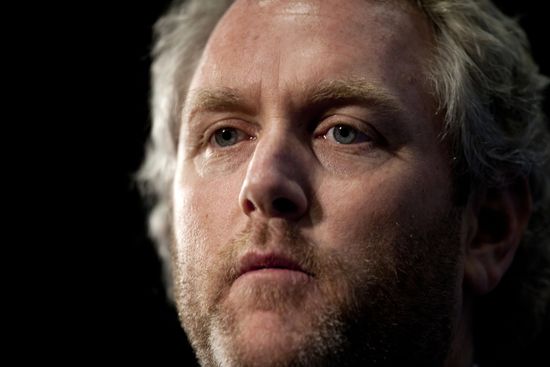
(Photo: Brendan Smialowski/Getty Images.)