Can Dating Sites Spot True Love?

Steven Leckart and his happily married wife signed up for various dating sites to see if they would get matched to one another. The results from one of the sites:

Although it's strange that OkCupid never connected us, we're rated an 85 percent match. That's comforting, especially since OkCupid's own CEO admits that he and his wife of 8 years are a 75 percent match.

But he also expressed concern:

A typical online dater spends an average of 12 hours a week screening but only 2 hours dating. Not a good return. So Linda devised a system—you know, to maximize her cost-benefit ratio. We had agreed at the outset to construct our profiles honestly—not to simply enter intel we think will point to each other. She focuses on guys with beards (just like me!) who hold "solid jobs" (not me) and who mention her specific interests, like old country music (me again).

I'm annoyed.

All my wife's likes and dislikes—the ones I've had to learn over time—are right there on the screen for some other guy to capitalize on. To make her short list, all he has to do is declare, "Me too!" More troublesome is the fact that I don't satisfy all her requirements. I'm a full-time freelancer. I haven't held a traditionally "solid" job for years. If Linda were to stumble onto my online profile as a single woman today, she might pass.
Why Sober Up In Secret?

Paul Carr thinks Alcoholics Anonymous misses an important element of quitting alcohol for most people. From an excerpt of his new book, Sober Is My New Drunk:

What is the good in confiding your weakness for booze to a roomful of people who are sworn not to utter a word of it to the outside world? How does that help when you’re at an office party and your boss insists you toast this month’s sales figures with a glass of cold beer? Your boss isn’t psychic.

When I decided to quit drinking, and when I realized that AA wasn’t for me, I knew I’d have to find a route to sobriety that was as public as possible. I knew that the only way I’d be able to reverse my reputation as a boozer would be to tell the whole world—or at least the part of the world I lived in—that I was quitting. … The key is for people you encounter on a day-to-day basis to be aware that you have a problem and are trying to fix it. Those people—not a group of well-meaning strangers in AA—are the ones who will be your greatest allies in quitting.

Carr previously wrote about his strategy for The Fix. Kevin Gray examines the success rate of AA and finds that others treatments, such as cognitive behavioral therapy, are often just as effective.

The Tyranny Of Endings

Tim Parks wonders if you can love a book you don't finish:

Doesn’t a novel that is plotted require that we reach the end, because then the solution to the tale will throw meaning back across the entire work. So the critics tell us. No doubt I’ve made this claim myself in some review or other. But this is not really my experience as I read. … What matters is the conundrum of the plot, the forces put in play and the tensions between them. The Italians have a nice word here. They call plot trama, a word whose primary meaning is weft, woof or weave. It is the pattern of the weave that we most savor in a plot—Hamlet’s dilemma, perhaps, or the awesome unsustainability of Dorothea’s marriage to Casaubon—but not its solution. Indeed, the best we can hope from the end of a good plot is that it not ruin what came before.

Civilizing The Pub

James Nicholls traces the takeover of wine in Britain:

When William Gladstone reduced tariffs on French wine imports in 1860, it was sold as an opportunity to "civilize" British drinking habits by making wine more widely available. To reinforce the point, Gladstone introduced legislation making the sale of wine for home consumption and in restaurants much easier. Wine sales rocketed in the following decade — but then, so did sales of all other alcohol and the civilizing claim remained questionable. …

Since the 1960s, wine consumption has increased enormously.

Supermarket sales have been key to this, but so too has been increased foreign travel, the globalization of the wine market, and the rise of aspirational drinking among an expanded middle class. The rise in British wine drinking has mirrored the decline of the British pub. Today, sales of alcohol for home consumption (including beer) outweigh sales in licensed premises.

Gladstone's vision of Britain as a nation of domestic wine drinkers has been achieved. We have, at last, caught up with the French, and — alors! — now have liver disease rates to match as well. 

If the above ad is any indication, there's still hope for beer lovers in New Zealand.

A Chemical Critique

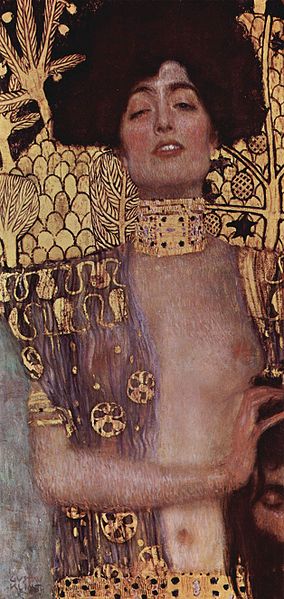
In his new book The Age of Insight, Nobel-winning neuroscientist Eric Kandel explains why we love a painting like Klimt's "Judith," the famous depiction of the beheading of Holofernes. An excerpt via Alexander Kafka:

At a base level, the aesthetics of the image's luminous gold surface, the soft rendering of the body, and the overall harmonious combination of colors could activate the 284px-Gustav_Klimt_039 pleasure circuits, triggering the release of dopamine. If Judith's smooth skin and exposed breast trigger the release of endorphins, oxytocin, and vasopressin, one might feel sexual excitement. The latent violence of Holofernes's decapitated head, as well as Judith's own sadistic gaze and upturned lip, could cause the release of norepinephrine, resulting in increased heart rate and blood pressure and triggering the fight-or-flight response. In contrast, the soft brushwork and repetitive, almost meditative, patterning may stimulate the release of serotonin. As the beholder takes in the image and its multifaceted emotional content, the release of acetylcholine to the hippocampus contributes to the storing of the image in the viewer's memory. What ultimately makes an image like Klimt's 'Judith' so irresistible and dynamic is its complexity, the way it activates a number of distinct and often conflicting emotional signals in the brain and combines them to produce a staggeringly complex and fascinating swirl of emotions.

Kafka surveys Kandel's place in the field of neuroaesthetics: 

Neuroaesthetics isn't, its pioneers say, just an elaborate parlor trick: Hey, look at this nude, or this Henry Moore sculpture, and this circuit over here lights up. Rather, it is fundamental to an understanding of human cognition and motivation. Art isn't, as Kandel paraphrases a concept from the late philosopher of art Denis Dutton, "a byproduct of evolution, but rather an evolutionary adaptation—an instinctual trait—that helps us survive because it is crucial to our well-being." The arts encode information, stories, and perspectives that allow us to appraise courses of action and the feelings and motives of others in a palatable, low-risk way.

(Image via Wikimedia Commons)

Cool Ad Watch

Marina Galperina digs the new ad from Good Books, an online bookseller that gives all of its profits to Oxfam:

Check this metamorphosing animation of Hunter S. Thompson scrambling ’round a bursting, peeling, dripping mindscape, tapping away at his typewriter, ranting for Franz Kafka and contemplating having making tea with bong water. Only, you don’t know that it’s bong water unless you watch the other, narrated version

E-Book Amnesia

Neuroscientist Mark Changizi explains how e-books, like much of the web, lack spatial navigability, which can be key to remembering information:

We don't navigate the web so much as beam hither and thither within it. Can't find your way to the ticket site? No matter, you can Google-beam directly there by typing in the name. And not only is the web not spatial or navigable, but the new reading experiences within documents have lost their spatial sense as well. … Need to jump to that part of the book where they discussed cliff jumping? You will get no help from the local topography, but you can beam yourself directly there via a within-document text search. 

Screen size also matters:

[Jakob Nielsen, a web "usability" expert,] says that studies show that smaller screens also make material less memorable. "The bigger the screen, the more people can remember and the smaller, the less they can remember," he says. "The most dramatic example is reading from mobile phones. [You] lose almost all context."

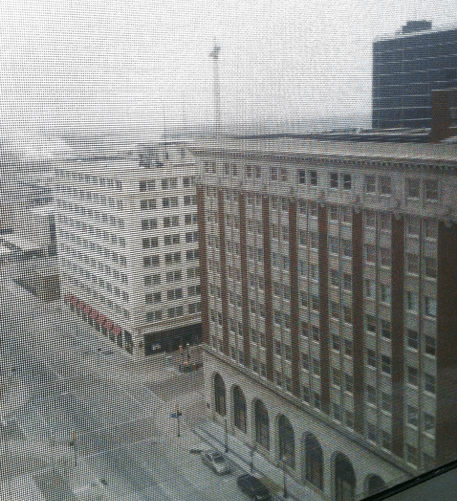
The View From Your Window Contest

Vfyw_3-17

You have until noon on Tuesday to guess it. City and/or state first, then country. Please put the location in the subject heading, along with any description within the email. If no one guesses the exact location, proximity counts.  Be sure to email entries to VFYWcontest@gmail.com. Winner gets a free The View From Your Window book. Have at it.