An LD50 (median lethal dose) has not been established in dogs or cats. Research in dogs and monkeys showed that oral doses of delta 9-THC and delta 8-THC ranging from 3,000 to 9,000 mg/kg were not lethal, and all dogs recovered within 24 hours of ingestion.
The paper does list a number of adverse affects of marijuana on animals, including depression, ataxia, agitation, and vomiting. And despite the small number of animals sampled (250, not all of them dogs), these symptoms are widely supported by anecdotal evidence from veterinarians and pet owners. No reasonable person would argue that feeding your dog weed is in his best interest, but the dog is likely to suffer more from raiding your chocolate stash.
Another speaks from experience:
I don't know what Metzger is talking about when he says weed is toxic to dogs. Is it the amount they need to ingest that's the problem because my friend gives one of her dogs (he's about 60 pounds) a small, mild, homemade pot cracker to help him with his severe separation anxiety when they host large parties. The dog, who got shuttled around to four homes before ending up permanently in hers, also has no comprehension of personal space and is a remorseless counter surfer – basically, someone who shouldn't be invited to parties.
But then again, nothing is ever going to kill this dog. He's downed prescription medication and bags of chocolate, so he could be an outlier.
I wondered why the avowed anti-socialist and Greater Israel fanatic would not consider backing the least socialist GOP candidate, Ron Paul. A reader asks:
Traditionally, the kibbutz was an agricultural settlement founded on Zionist-socialist principles, where everyone worked the land and shared income and possessions. The first collective farm was founded in 1909. Besides initially being a practical venture in group living, the kibbutz played a central role in Zionist settlement of the land before and after the founding of the Jewish state.
In 20 years, Israel has whiplashed from being essentially a socialist state to a place with one of the world's biggest gaps between rich and poor. That's partly because Israel's poor are getting poorer, but also largely because incomes of the super-rich have soared to new levels, bolstered by tax cuts, deregulation and an influx of Russian entrepreneurs who brought money with them when they immigrated. The number of Israeli billionaires doubled over the last two years to 16 while their combined wealth tripled to $45 billion, according to Forbes magazine.
Health care in Israel is universal and participation in a medical insurance plan is compulsory. Health care coverage is administered by a small number of organizations, with funding from the government. All Israeli citizens are entitled to the same Uniform Benefits Package, regardless of which organization they are a member of, and treatment under this package is funded for all citizens regardless of their financial means.
And the top income tax rate in Israel is 48%, compared to 35% in the US and 39.6% under Obama's plan to get rid of the Bush tax cuts. Another reader:
So this guy was at his financial nadir three years ago and is now worth $20 billion? Sounds like he should be on his knees thanking President Obama for keeping the country from going off the deep end in 2009. Socialism my ass.
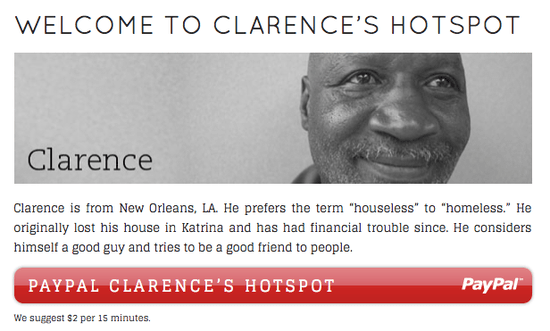
At the SXSW festival/conference in Austin, technology firm BBW is paying homeless people to carry wireless devices and wear shirts saying "I am a homeless hotspot," prompting an online outcry. Sam Biddle blusters:
Although this is ostensibly about giving the homeless money—BBH says they keep all the proceeds from those who pay for 4G access—it’s categorically awful, and all for the convenience of SXSW’s widely well-off patrons. But it gives the homeless jobs! Yes, as would using them as human coffee tables, or hunting them as game, or having them dance for pennies in Superman outfits at your next dinner party. Working as hotspot is worse than not working at all.
Hunting them as game? Yglesias counters the uproar:
[T]he negative reaction to this sort of thing always drives the more literal-minded of us slightly crazy.
Think about all the companies involved in one way or another in SXSW who did absolutely nothing at all for Austin's homeless population. How much condemnation did they get? None. BBH's stunt here offends our sense of human dignity, but the real offense is that people were languishing in such poor conditions that they would find this to be an attractive job offer. The sin they're being punished for is less any harm they've done to homeless people than the way they broke decorum by shoving the reality of human misery amidst material plenty into the faces of convention-goers. The polite thing to do is to let suffering take place off stage and unremarked upon.
Update from a reader:
Sadly we can't all make money writing for Gizmodo like Sam Biddle, and this is a far cry from acting as a human coffee table. It sounds to me like a crappy job an Austin high school kid on spring break might have. The problem is the "LOL, they're homeless" attitude evident in the cutesy alliterative "Homeless Hotspot" name, the t-shirts and the rest of it. Delete the loaded word 'homeless' and BBH actually is giving destitute people jobs providing a legitimate service people want. The cruelty is in the sneer, not the job itself, which is where Biddle's fulminating breaks down logically.
Another reader piles on:
Discomfort turns to outright paternalism when Sam Biddle declares that "Working as hotspot is worse than not working at all." Oh really? Why don’t we ask Clarence what he thinks of that? Oh, wait! We know what Clarence thinks – because if he thought it "worse than not working at all," he wouldn’t have taken the job.
David Graham finds PPP's line of questioning in Mississippi and Alabama problematic. Michelle Cottle considers the poll "cultural profiling":
[I]nterracial marriage—since when is this a relevant topic in American politics? Similarly, why do we need to know respondents’ views on evolution? Last time I checked, not even Santorum was waving the creationism (or intelligent design) banner in this race. Which could explain why, when I went back and looked through the rest of PPP’s polls from this year, I couldn’t find any other states that were asked about evolution. Ditto questions about whether Obama is a Muslim. And in only one other state did I see voters being asked about interracial marriage: South Carolina.
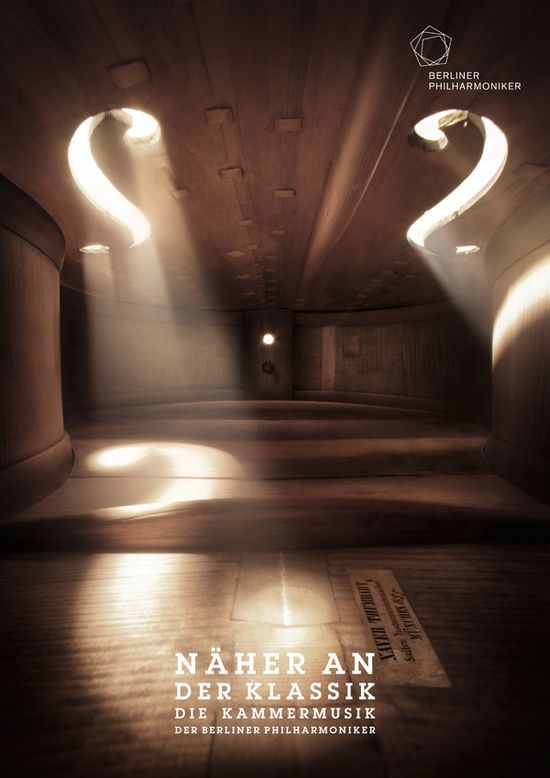
These stunning ads for the Berlin Philharmonic have been pinging around the blogosphere. Colossal captions:
This print campaign for the Berlin Philharmonic orchestra uses macro photographs taken inside the cramped spaces of instruments making the inner workings of a violin, cello, flute, and pipe organ appear vast and spacious, almost as if you could walk around inside them.
Rory Stewart begs the British government to come to its senses:
Did our mission go wrong because Nato had too few troops; or because it sent too many? Could a different strategy have fixed the situation; or was it always impossible? The reason no longer matters. Whatever the explanation, things will not improve: Nato will not “solve the relationship with Pakistan”; it will never create “an effective, credible, legitimate Afghan government”; and in most parts of the country it has already lost “the hearts and minds” of the Afghan people.
Question for ministers and generals alike: what part of Stewart's analysis is wrong or even merely unpersuasive?
No serviceman should die in a "war" that is unwinnable in a country that is unchangeable. In retrospect, Obama's decision to ramp up the war to wipe out al Qaeda and find and kill bin Laden was the right one. It allows us to say that we succeeded in the core mission – to get the perpetrators of 9/11 and destroy as much of their organization as we could. But nation-building on behalf of a corrupt government whose officials are now squirrelling their resources into foreign bank accounts?
What that soldier did was unconscionable evil. But the grueling whack-a-mole war he had served four tours on is unconscionably pointless:
He suffered traumatic brain injury in 2010 after a vehicle rollover accident in Iraq, though he later was deemed "fit for duty," a senior U.S. official said. Sources also said the suspect had "family problems," possibly related to trouble in his marriage, before deploying for the fourth time.
Sometimes the real insanity is, well, in front of one's nose.
My friend and I are submitting separate entries because we can't agree. Definitely Germany. To me this feels like a pic of Frankfurt in the 1980s (because of the graffiti), perhaps from close to the Gerichtshof looking west or northwest, but we can't get the tall buildings to match any we know today. My friend says that suggests Berlin, which is one German city poor enough that it might choose to let its graffiti stand and modern enough to have mini-skyscrapers. I'm going with my gut and go with Frankfurt.
Another writes:
The combination of centuries-old buildings with skyscrapers makes me think that the view should be from a North American city. I choose Quebec because the skyline is very open (Montreal would have a much crowded space). On the other hand, it could be other small North American city, as usual – so hard to make a guess with the VFYW.
Another:
Easy-peasy: Vienna, the Heldenplatz, by the Hofburg palace. Scene of a vicious speech by Hitler in 1938 to hundreds of thousands of people. Oh, I see: he made the speech on March 12 – 74 years ago this week. I assume the picture is taken from a window of the Museum für Völkerkunde. I bet there are a number of former volunteers from the American Bar Association's Central Europe and Eurasia Initiative who know the spot. Vienna was a common R&R destination for those of us working in the Balkans in the 1990s, and one of the cheapest pensions in the city was located on the other side of the passageway.
Another:
Daily reader, but I've never participated in VFYW contest before. Last May we went to Prague for the first time, and this picture immediately looked familiar. However, I am not a good sleuth online, so I am sending a picture of the one place in Prague that it reminded me of.
Another:
This is my first and probably last submission for a long time. I have a three year old and my wife is to be induced on Monday with our second boy. So I'll be lucky to sleep and sit down, let alone spend time on this. Anyway, the yellow building and graffiti led my to Zagreb. I believe the building to the right of the one straight ahead is the new building for the Zagreb stock exchange. I can't get Google streetviews, but this is my best guess.
Another:
HOLY SHIT I GOT ONE!
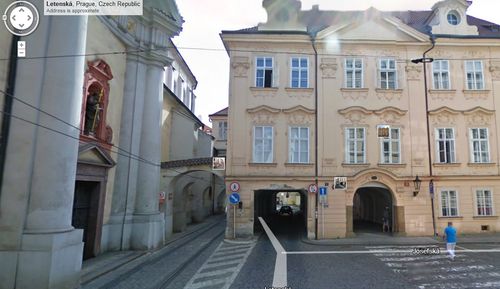
This contest has been a constant puzzle to me. Every now I then I got close but never really have the time to invest, especially since most of the images are complete mysteries to me. However, this one was easy: Warsaw, Poland. Being from the Czech Republic, I have a good eye for recognizing post-Soviet cities. What gave it away was a "Pica" graffiti sign on the picture – a common Slavic word for the female genitalia. The street sign graphic after some googling indicated that the location is in Poland. The rest was easy, especially since the giant Palace of Culture and Sports is visible in the back. The Street name is Kubusia Puchatka.
I have lived abroad extensively in various countries, yet I have never been to Poland. I will put it on my list to celebrate my first correct guess! Unfortunately since it took me less than 15 minutes to guess it, I would say that another 284 people were faster. Oh well, still made my day.
Closer to 150 actually – one of our easiest contests yet. Another correct entry:
The shock and delight of recognition! It's Warsaw – a city I visited often while teaching English in Poland in the '90s. Delighted to see the sign for the dentist's office – Lekarska-Stomatologiczna – is still there, just below the street sign. A small detail I remember from when I took a picture of this very same street sign 15 years ago, trying in vain to frame the photo without it. Yup, still there, as is the ever-present graffiti.
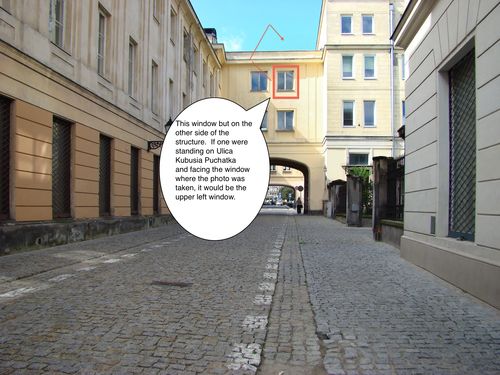
The photo is taken from just above the southern end of Ulica Kubusia Puchatek – Winnie the Pooh Street. The view is to the west, southwest along ulica Warecka as it passes under two symmetrical pre-war apartment buildings, painted that wonderful old-world faded gold color, that anchor the lower end of the Winnie the Pooh Street. The photo must be taken from the 3rd floor apartment, northern window, of the bridge part of the identical building that it is facing. Just up the street is the Museum for the History of Polish Jews. The location is just west of ulica Nowy Swiat – New World Street – an elegant street of cafes and luxury shops. The old Vienna Café – sadly now gone, but both elegant and sordid in its day – was just a few steps away on the corner of ulica Swietokryszka and Nowy Swiat. The Blikle Café, with its wonderful glazed donuts, stuffed with rose petal preserves, is just a 100 yards away. Here's the street sign from the VFYW photo in close-up.
Another:
I figured this out by starting with the road signs. Obviously Europe, but the parking sign with the little rectangle (at first I thought it was an envelope) is a reserved parking spot sign that seems to be uniquely Polish. The street sign on the building to the right of the street has a band of red underneath. This indicates the neighborhood, and seems to be found only in Warsaw. After that, it was a matter of looking up skyscrapers in Warsaw to identify what turned out to be the Intercontinental. I poked around in Google Earth for the rest.
Another who poked around:
Another:
This is the first one I've ever gotten, so I imagine many others got it too, and even so I needed a bit of luck, it being in my country of birth. My hometown (?ód?) has the same style of street signs – I guess it's standard in all of Poland. In the shot, you can see two of Warsaw's most prominent buildings, the massive Stalinist "masterpiece" of the Palace of Culture and Science, and the decidedly more modern Intercontinental Hotel. From there I just followed the apparent sight line East until I saw an overhang, or rather two, on Warecka St: the one in the shot, and the one from which the shot was taken (and when I realised the building was the Polish Institute for International Affairs, I knew it had to be right).
Another:
The spire in the middle of the photo is the Palace of Culture, that Stalinist abomination which planners have been trying to hide for the last two decades by building around it.
Another:
Knew this one straight away – I staggered drunkenly with the girlfriend through the very archway shown in the picture whilst on a trip to Warsaw just before last Christmas, and I remember her pointing out the Winnie the Pooh plaque to me. That night was pretty crazy – we wound up at an underground gay bar (not just underground, but with a disguised entrance) listening to drag queens singing Polish Christmas classics. Thanks for the memories.
Another:
It's probably too easy this week for me to actually win it. So now I know how to say Winnie the Pooh in Polish. Happy birthday, me.
From a multimedia entry:
Another reader nails the exact location:
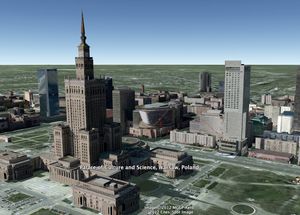
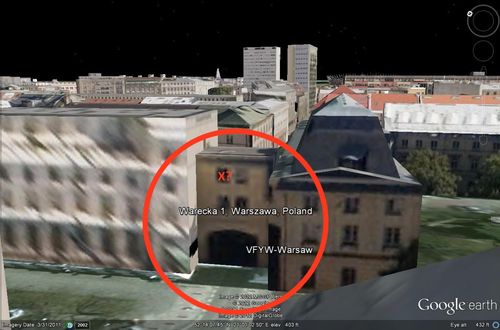
I think this will go down as your easiest VFYW yet. First of all, there is a clock tower in the picture, and when you search "clock towers" in google images this building is the first result. The clock tower is the Warsaw Palace of Science and Culture. The other tall building on the right side is the Intercontinental Warsaw. A little triangulation led me to the address: Warecka 4; 01-001 Warszawa, Poland. This looks like its part of (or connected to) the Polish Institute for International Affairs, with which your reader is probably associated. Here is my guess on Google Maps.
A visual version:
A photo version:
Dozens of readers have similarly accurate entries. But the winner this week is the reader who has gotten several difficult views in the past without yet clinching the prize:
Won it with a bank shot. One more reader:
So much to like in this contest: some history, some Warsaw, some Winnie the Pooh. But let me start in November 1937, when my father was born in Poland's capital.
It was not a propitious time to be born a Jew in Warsaw. That he and his immediate family managed to step out of the city two years later and head east just as the Germans were stepping in from the west was due to some foresight and a great deal of luck. The rest of his extended clan was not so fortunate; dozens of aunts, uncles, and cousins died anonymously in the death camps.
The next time my father saw Warsaw was about 60 years later. He had no memory of the city – not that it would have mattered, for it had been completely destroyed during the war and rebuilt afterwards. One of its grand new buildings was the Palace of Culture and Science, erected in the 1950s as a "gift" from the Soviet Union. It was essentially a Stalinist showpiece, an unwelcome symbol of domination by a historical enemy, but it still remains towering above the city as its tallest building.
I would not have recognized this location had it not been for the Palace of Culture and Science. The first thing I noted in the photo was the stately, classical building – Europe, right? But what about all that graffiti? Someplace where a little urban grime goes unnoticed even on beautiful buildings – OK, Eastern Europe. And I would never have tried harder had I not spotted the clock face and spire jutting above the building in the foreground.
I have not been to Warsaw since 2001. But this is why a little bit of intuition sometimes can go a long way. I wonder how many other successful VFYW contestants can credit a tiny spark of recognition or intuition for a correct identification. That spire, for whatever reason, gnawed at my memory for a moment until Warsaw popped into my head. A photo online confirmed that it was the Palace of Culture and Science. I continued searching until I discovered that the tower in the distance to the right is the Warsaw InterContinental hotel. Based on the location of these two buildings in the photo and the perspective, I estimated that the location in question had to be mostly east of the Palace and a bit north, maybe half a mile to a mile away. And so it is.
This photo is taken from the third floor of the Polish Institute of International Affairs, which sits directly next to the present headquarters of the Museum of the History of Polish Jews. I say current because until this year, the museum was only an idea. It will officially open sometime in the coming months in a new building located where the former Jewish ghetto stood, maybe not far from where my father was born.
Lastly, a message to an 87-year-old Polish reader recovering from surgery but who managed to help out with the contest this week: Szybkiego powrotu do zdrowia!
The 2010 uprising of the Tea Party issued a stern brushback to GOP elites who sought to influence the process: Anything they said only made it worse. From badmouthing Christine O'Donnell to doubting Sharron Angle, each pronouncement of the Washington establishment was greeted with jeers and pitchforks. This time around, Sarah Palin has explicitly framed her vote for Newt Gingrich as a matter not of actual support for Gingrich, but of defying the establishment's prerogatives and expectations. In the face of this sort of blowback, the voices of the institutional GOP would just as soon sit on their hands and let nature take its course. But it's hard to imagine them waiting all the way through August.
perspective. Money quote:


 mysteries to me. However, this one was easy: Warsaw, Poland. Being from the Czech Republic, I have a good eye for recognizing post-Soviet cities. What gave it away was a "Pica" graffiti sign on the picture – a common Slavic word for the female genitalia. The street sign graphic after some googling indicated that the location is in Poland. The rest was easy, especially since the giant Palace of Culture and Sports is visible in the back. The Street name is Kubusia Puchatka.
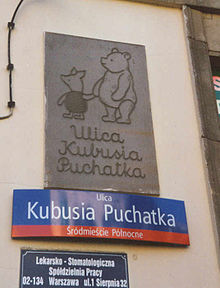 The photo is taken from just above the southern end of Ulica Kubusia Puchatek – Winnie the Pooh Street. The view is to the west, southwest along ulica Warecka as it passes under two symmetrical pre-war apartment buildings, painted that wonderful old-world faded gold color, that anchor the lower end of the Winnie the Pooh Street. The photo must be taken from the 3rd floor apartment, northern window, of the bridge part of the identical building that it is facing. Just up the street is the Museum for the History of Polish Jews. The location is just west of ulica Nowy Swiat – New World Street – an elegant street of cafes and luxury shops. The old Vienna Café – sadly now gone, but both elegant and sordid in its day – was just a few steps away on the corner of ulica Swietokryszka and Nowy Swiat. The Blikle Café, with its wonderful glazed donuts, stuffed with rose petal preserves, is just a 100 yards away. Here's the street sign from the VFYW photo in close-up.

 The Dish