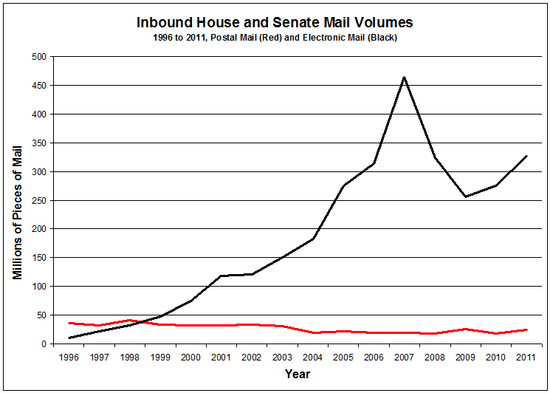
Matt Glassman takes a close look at congressional inboxes:
With postal mail, it was always easy to know if you were being written to by a constituent or by someone from outside your district. The rule of thumb for sorting such mail is typically something like this: if it’s a constituent or interest group from our district, put it in the pile for things that we will promptly respond to; if it’s a constituent from outside our district, put it in another pile for things that we will promptly deliver to the correct office; if it’s a interest group from outside our district, look through it quickly and see if it’s personal or a form letter / mass spamming. If it’s the former, consider responding. If it’s the latter, definitely trash it. The problem with email, though, is that you can’t tell if the sender is from the district or not.
And there are quite obvious incentives to not exclude anyone who might be a constituent. And so the incoming email has a tendency to nationalize the constituent communications techniques used in most Member offices; there’s just isn’t a sorting algorithm that lets you separate your constituents from other citizens. Which means that the information context Members are facing in their offices is much more national in scope, even after they’ve tried to filter it. This has consequences. For one, it forces a complete rethinking of an office communications strategy. But it also distorts one’s perspective of district opinion, and tends to orient Members toward national public policy; people from outside the district are much more likely to communicate about policy issues than distributive politics such as grants or earmarks.
In a follow-up post, Glassman tracks mail going the other direction.
 The Dish