Google isn't the only one working on driverless cars:
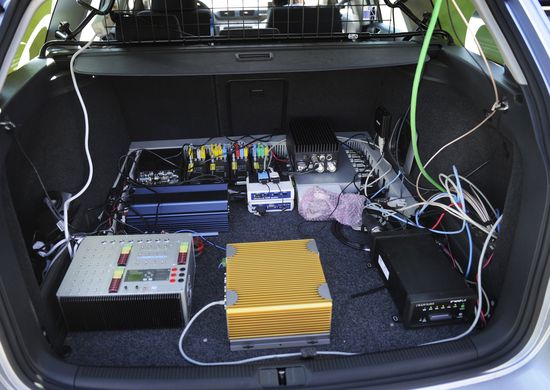
[Tinosch Ganjineh, leader of a driverless car research team in Germany] agrees that driverless technology has to be refined. "The size and price of these systems needs to come down. Today, half a trunk of equipment is needed for autonomous driving," he says. Another challenge, says [Paul Newman, a robotics engineer at the University of Oxford whose team is developing autonomous cars,] is getting the cars to recognise the precursors to risky events – like sudden bright sun reflections on the road, truck spray, which may blind some sensors, or simply a burst tyre.
Adam Ozimek expects the hurdles to be overcome:
Skeptics cite our deep aversion to handing over control to a computer as an impediment to the driverless car. But it need not be the case that the first time you hand control to a robot it will have you barreling down the interstate at 70 miles-per-hour. Autonomous driving might first be used for slow moving, stop-and-go traffic. You can see a precursor to this in cars that are already parking themselves. We can ease our way into comfort with it. We should have little doubt: driverless cars are in our future.
(Photo: A view of the trunk containing the electronic brain of the driver less car 'Made in Germany' (MIG), which from the outside looks like a regular Volkswagen Passat with a camera on top, as it is being put through its paces at Berlin's disused Tempelhof airport , October 13, 2010. By Odd Andersen/AFP/Getty Images)
 The Dish