Except if you're Colbert or a Palin:
Month: April 2012
The Strange Persistence Of Islamophobia
Patrick Glennon studies it:
What makes right-wing alarmism difficult to grasp is its timing: The recent uptick of Islamophobia coincides with a steady decline in domestic terror plots connected to Muslims. A study by the Triangle Center of Terrorism and Homeland Security found that the number of Muslim Americans involved in terror plots fell for a third year in a row, from 49 in 2009 to 20 in 2011. Of the 14,000 murders that occurred in the United States last year, none were connected to Islamic extremism. In Crusade 2.0, [John] Feffer argues that Islamophobia is "sustained by U.S. government [foreign] policy" as well as the "growing economic, political and global influence of modern Islam." In other words, having grown accustomed to the Muslim character of America’s global enemies, Islamophobes instinctively view the ascendancy of Muslim nations and the prospect of Islam-inspired democracies with trepidation.
History In Burma
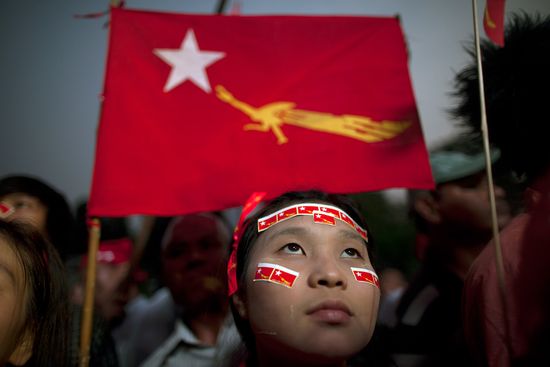
The democratic opposition in military-controlled Burma just won a landslide victory in parliamentary elections. Joshua Goldstein celebrates:
Democracy is a great force sweeping the world in slow motion. Today Burma (Myanmar) took an important step toward democracy with minor parliamentary elections that elected the Nobel laureate Aung San Suu Kyi to a seat after 20 years of harsh military rule. She may run for president in three years. The last elections, in 1990, were swept by her party and then ignored by a military government that kept her under house arrest for years at a time. The country has been isolated and under stiff international sanctions for decades. In 2007 the regime used massive lethal force to put down demonstrations led by Buddhist monks, just as it had shot protesting students in the streets in 1988. There is still a long way to go for Burma to reach real democracy — and end several long-running ethnic wars — but under its new reform-minded president it is moving vigorously forward.
Christian Caryl charts the road ahead:
[I]t is vitally important to keep the big picture in sight. As Aung San Suu Kyi and her colleagues know all too well, they are about to enter a parliament that has been carefully designed to prevent people like them from gaining much influence. According to the 2008 constitution that provided the ground rules for Burma's last general election two years ago, a full quarter of the seats in parliament are reserved for the armed forces. But an even larger number of seats are held by the Union Solidarity and Development Party (USDP), created by the military regime in 1993 as a counterweight to the pro-democracy movement. If Aung San Suu Kyi and her friends really want to amend the present constitution before the next election rolls around in 2015, as they have said they plan to do, they will have to find allies within these two groups.
(Photo: National League for Democracy [NLD] supporters celebrate their victory in the parliamentary elections outside the party headquarters April 1, 2012 in Yangon, Myanmar. The National League for Democracy declared Daw Aung San Suu Kyi had won a seat in Myanmar’s Parliament election. Aung San Suu Kyi stated that by-elections would not be completely free and fair because of irregularities during preparations. The historical by-elections are seen as an important vote of confidence for the country as it continues on the road to political and diplomatic reform.By Paula Bronstein/Getty Images.)
Who Will Win The Veepstakes? Ctd
Heilemann talks up Rob Portman:
A former congressman, U.S. trade representative, and head of the Office of Management and Budget under George W. Bush, Portman has as firm a grasp of fiscal issues as anyone in Washington.
He is solid and stolid, bland and boring, and as egregiously Caucasian as a potful of Uncle Ben’s. But he also won election to the senate in 2010—with 57 percent of the vote and carrying 82 of Ohio’s 88 counties—in what may be the most important battleground state on the map. His snoozy dependability and managerial affect would reinforce Romney’s argument that he and not Obama is capable of fixing what ails the capital and the economy. And, by comparison, Portman’s dishwatery demeanor might actually make Romney look like a bit of a spitfire. (No kidding—Portman really is that dull.)
But the paramount reason Portman would be Romney’s smartest and safest pick is this: He would both be and be immediately universally regarded as qualified for the gig.
Hathos Alert
An unintentionally hilarious look at the sitcom's most serious moments:
(Hat tip: Eliot Glazer)
Has Santorum Been Cyber-Bullied?
The argument can be made:
Perhaps, the best argument against the sort of online harassment that now passes for accepted political protest is that we are all models for our children. And these sort of tactics do really get innocent kids killed, while leaving thousands of others scarred for life. Perhaps one can make the case that it is wrong to plaster the locker of a fellow student with pornography, or to deface her Facebook page with comments about her slutiness, but okay to plaster a politician’s Facebook page with questions of a sexual nature that are aimed to embarrass, or to wear a t-shirt that equates a political opponents name with feces. But it would be better if we didn’t have to make the case at all.
Hillary And Feminism

A reader writes:
Recently when a reader challenged your criticism of Hillary Clinton, you replied that, "nepotism – especially when her prodigious talents required none of it – is not feminism." However, it is not opposed to feminism either, and that is where you have erred. Did Hillary fail at feminism simply because she didn't run for governor before her husband did? Because she didn't insist that he let her "catch up" in political achievement before he then ran for president?
Also, let's be careful what we attribute to "nepotism" in Hillary's career. I haven't noticed any other First Ladies becoming Senators and then Secretary of State, especially First Ladies who were as disliked and criticized as Clinton was at that time. No, she could not have become the First Lady without Bill, but to a lot of people's surprise she created her own successful political career after that. She has been a tremendous Secretary of State, and she is the first woman in my lifetime who ever had a strong chance of winning the presidency. Being married to Bill simply doesn't get her there, but you give her no credit for it. That's not feminism, either.
Another writes:
As to the notion that she is a benficiary of nepotism, sorry – I suspect her marriage to Bill has been a liability at least as often as a benefit. Or are you forgetting all the nastiness said about her, of all people, during the Lewinsky affair?
Another:
I don’t think it was necessarily an anti-feminist choice in their marriage for Bill, perhaps the most natural politician on earth, to be the front and center candidate for most of their partnership. That makes business sense to me – to put the stronger candidate front and center, particularly since women in politics was still a fairly new phenomenon. Is that her fault?
Neither do I think it’s reasonable to assume she would not be in politics but for Bill Clinton. Say what you will, but she is very smart and capable, and there is a dearth of women in her age group in politics, or in politics – period. Would it have been more feminist of her to never run for office, just because her husband had a successful political career?
I’m a member of a "power couple" myself. My husband and I practice law together. Besides sharing our law practice, we are raising three children. Every day of our lives is a juggling act and a dance of compromise and shuffling the schedule. I think you’d better leave this topic to the women who actually have to deal with trying to "have it all", because even now, it’s not so simple.
Another asks:
Did Hillary ever advertise herself as a "feminist"? Why isn't she just a powerful woman who deserved to get there as much as any of the other powerful Washington types? I don't think every powerful woman has to be emblematic of feminism just like every black politician doesn't need to embrace critical race theory.
(Photo: U.S. Secretary of State Hillary Clinton testifies before the Senate Foreign Relations Committee about the department's FY2013 international affairs budget February 28, 2012 in Washington, DC. Clinton faced questions ranging from the cost of embassies in Iraq and the Middle East to the START Treaty with Russia. By Chip Somodevilla/Getty Images.)
A Defense Of Judicial Activism
Will Wilkinson attempts one:
Were we to make slavish deference to precedent universal law, ala Kant, we'd end up with what a sort of path-dependent judicial drift–tiny but unavoidable interpretative mutations piling up until the law ends up in places no one finds desirable. Interpretative frameworks that push the law toward substantive ideals save us somewhat from the problem of arbitrary, path-dependent drift. But they create another kind of arbitrary drift, as rival frameworks push the interpretation of the laws in incompatible directions. This can, again, leave us in stupid places no one ever had in mind. The only rescue is the occasional "activist" saltative leap that either ignores or radically reinterprets precedent in order to restore to the law the coherence of principle, for a while at least.
Asking Anything
Just a note to underline what is now obvious. Our Ask Andrew Anything series is expanding to include others – kicking off with Jonah Lehrer, on how cannabis (and alcohol, for that matter) does indeed foster creativity. Charles Murray and Steven Pinker are already on board and recorded.
I like to think of this as a crowd-sourced interview – where you get to ask, select and vote on the questions, and we give the subject around three minutes to answer. Anyway, I'm psyched by the new feature's blend of webness, dishness and TV.
March In Iraq
The least deadly month since the US invaded. It may have something to do with the Arab summit and may change again of course. But count me pleasantly surprised.
 The Dish