What’s Next For Romney?

by Maisie Allison

Byron York outlines the challenges facing the presumptive nominee: 

At the same time he has to inspire the conservative base that has always viewed him with skepticism, he also has to win the support of moderate and independent women all across the country who view conservative Republicans with skepticism. A recent Gallup poll of a dozen swing states found Romney actually leading President Obama by one point among men but trailing the president by an astonishing 18 points among women. How does Romney do it?

Alec MacGillis homes in on class, rather than ideology: 

[P]retty much across the board, [Romney] did poorly among, well, poorer and more rural voters. It’s been said before but can’t be overstated: Romney’s chances this fall will hinge largely on whether he can win big among the working-class whites that have become the Republican base. John McCain held an 18-point edge among these voters, but as big a margin as that was, it was smaller than George W. Bush’s 23-point margin in 2004. A recent poll had Romney’s lead with these voters at 17 points—sizable, yes, but he will need to surpass McCain in this category, a category whose share is shrinking with every passing election.

Boxing On Ice, Ctd

by Chris Bodenner

A reader writes:

Some of the comments you’ve posted about the value of fighting to reduce the incidence of dirty hits are just ridiculous. There are other ways to do this, as other sports have demonstrated. If this argument were truly valid, we would be seeing a large number of dirty plays in professional basketball, where teams face each other multiple times per season yet fighting is not allowed. Professional basketball, particularly during the playoffs, is every bit as physical, especially under the basket, as hockey. Yet the flagrant foul rules, and the willingness of the league to hand out suspensions, have dramatically curbed the level of violence and increased the emphasis on skill and teamwork. And when was the last time you saw a fight break out in a football game that lasted more than five seconds before being broken up, often with the participants being ejected?

Another is more blunt:

Your first reader is full of the old-school propaganda about how enforcers keep the game clean.  What mooseshit that is!

Can you name another sport where the rules are "enforced" by the players instead of by the officials?  OK, maybe the brushback/hit batter that pitchers lay on after giving up a home run … but the officials penalize that these days.  In the NHL, a fight or a dirty hit might get you three minutes in the penalty box.  Three minutes!

Anyone who has thought about it, instead of hanging on to the good old ways, knows that big penalties will do more to stop the crap than all the boxers on ice put together. Pass a threshold and your penalty minutes get doubled.  Pass a larger threshold and start getting ejected from the game. Pass a larger threshold and start getting suspended from the next game. It will limit injuries to everyone, including the fighters, and it will make the fighters properly obsolete.

Besides, it's so damn boring to watch the fisticuffs.  First they drop their gloves.  Then they start bareknuckling on each others helmets. Then their feet come out from under them.  Hey, I like boxing! But this is just stupid.

Update from a reader:

Your "blunt" reader obviously does not know much about hockey.  There is no such thing as a three-minute penalty.  They are 2, 5 or 10 minutes. Players who throw a dirty hit that injures another player are usually thrown out of the game.  They are then subject to review by league disciplinarian Brendan Shanahan, who has the power to suspend players.  Here are some examples:

1.  Superstar Alex Ovechkin suspended 5 games, with Shanahan's explanation
2.  Dan Carcillo suspended 7 games for boarding.
3.  Bruins star Milan Lucic suspended 1 game for boarding.

These are just a few examples.  The hits in these clips would not have been penalties, let alone suspendible offenses, a mere 10 years ago. This system is actually working as the volume of dirty hits has been reduced.  More importantly to my eye is that when a player is in a compromised position (facing the boards, for example) other players often pull up rather than plow into them.  In the past that player would get blasted and consequences be damned.

Fighting is also way down from years past.  As an "old school" hockey fan, I have no problem with the odd fight when two guys have an issue.  I do find the line brawls ridiculous, they should be outlawed.

Another recommends some further reading:

Here [pdf] is a piece for Harper's magazine that addressed some of the questions lurking underneath hockey and fighting. I think it speaks pretty directly to the pressures placed on kids in junior hockey in Canada – and how socialized violence is such a huge rite of passage. It's a complex problem that reflects and creates the culture of Canada, real and imagined.

Never thought your site would get interested in this kind of subject. But come to think of it, not surprised at all.
An Alternative To Student Loans

by Patrick Appel

A novel idea:

Students in California have a proposal. Rather than charging tuition, they'd like public universities in California to take 5% of their salary for the first twenty years following graduation (for incomes between $30,000 and $200,000). Essentially, rather than taking on debt students would like to sell equity in their future earnings.

This means students who make more money after graduation will subsidise lower-earning peers. It is not clear if this will provide adequate revenue for the university. It also means the university bears more risk, because the tuition it will ultimately receive is uncertain. But the proposal will benefit some students and the principle is not so ridiculous.

Earlier looks at student loan debt here and here.

The Glass Half-Full Species

by Zack Beauchamp

Andrea Anderson reports on "optimism bias." Christopher Mims isn't happy about it:

[S]tudies have found that lacking the optimism bias is a reliable indicator of depression and anxiety. Humans, in other words, are built to see the world as a sunnier place than it is — it’s a survival instinct. This sort of reasoning made sense throughout most of our evolution, when the majority of causes of misfortune — bad weather, communicable diseases, freak accidents — were beyond our control. But now, for the first time in history, we can predict, at least in broad strokes, the decades-hence consequences of our actions. Too bad our brains aren’t constructed to do anything about that information.

Hathos Alert

by Maisie Allison

David Thomson is spellbound by the Lohan metamorphosis:

The way one face grows out of another and then into one more is the source of its beauty, its regret, and its sinister import. … It may be the most cogent imprint of celebrity we have had. It is a real movie, so as you watch it you feel a mixture of dread and desire. Should I be watching this? How can I stop? … I can’t believe Lohan will ever make a regular movie that has the impact of these 74 seconds.

Lunch Sounds Delicious

by Zoë Pollock

How noises amplify tastes:

Charles Spence is multisensory researcher in London, who has been messing around with how sounds modify flavor. "We’ve shown that if you take something with competing flavors, something like bacon-and-egg ice cream, we were able to change people’s perception of the dominant flavor—is it bacon, or egg?—simply by playing sizzling bacon sounds or farmyard chicken noises."

This might sound crazy, but the otherworldly ice cream makes one thing clear: The sound of food matters. So does the sound of the packaging and the atmospheric sounds we hear when we’re eating. We’re all synesthesiates when we sit down to dinner.

On a similar topic, Cassandra Willyard considers people who are highly sensitive to mealtime sounds:

My mom has always had weird issues with noise. Dinnertime was the worst. Forks scraped plates, mouths slurped, teeth crunched, lips smacked even when they didn’t mean to—something was always bothering my mother. I used to think she was just easily bugged.

But last week my mom forwarded me a New York Times article about a disorder called misophonia. The article begins like this: “For people with a condition that some scientists call misophonia, mealtime can be torture. The sounds of other people eating — chewing, chomping, slurping, gurgling — can send them into an instantaneous, blood-boiling rage.” She added a short note: “I think I have some form of this."

Drug Warrior Non Sequiturs

Screen shot 2012-04-10 at 10.58.33 AM

by Zack Beauchamp

Walter Russell Mead reads a Wall Street Journal report on prescription drug abuse as a cautionary tale about legalization:

Even if a drug is regulated, its consumption controlled through a system of medical prescriptions and taxed, it can easily find its way to the black market. Prescriptions don’t curb destructive behavior. Legalization doesn’t stop deaths or abuse, nor negate the necessity of prosecuting dealers. Legally prescribed drugs are now regulated the way many legalization advocates think illegal drugs should be. The flourishing black market in prescription painkillers and the thousands of deaths associated with their use demonstrate that drug use will not be magically fixed by regulating currently illegal drugs.

Perhaps this might be because recreational alternatives are…illegal! Criminalization creates incentives for doctors and patients alike to abuse the prescription system by artificially inflating the market price for, in this case, opiates, and then creating a mechanism by which people can get relatively easy accces to them. Why wouldn't this system be rife for abuse?

As for Mead's claim that legalization "doesn't stop deaths or abuse" and would cause "many more deaths from overdose" the evidence disagrees with him:

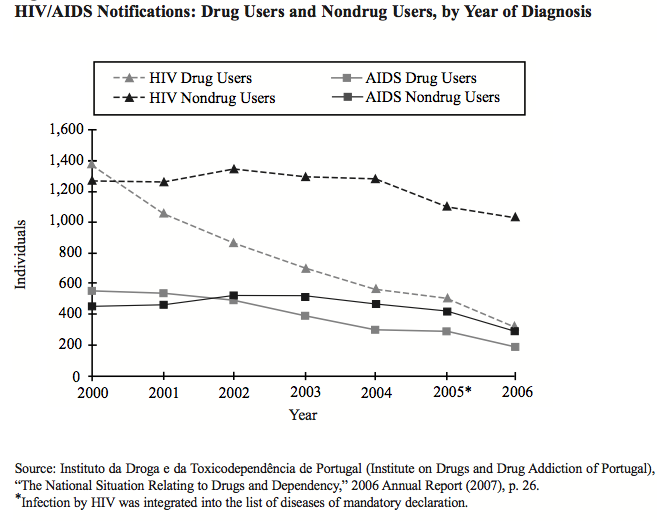
Portugal decriminalized possession of all drugs in 2001. The outcome, after nearly a decade, according to a study published in the November issue of the British Journal of Criminology: less teen drug use, fewer HIV infections, fewer AIDS cases and more drugs seized by law enforcement. Adult drug use rates did slightly increase — but this increase was not greater than that seen in nearby countries that did not change their drug policies. The use of drugs by injection declined.

And there's more:

Health experts in Portugal said … that Portugal's decision 10 years ago to decriminalise drug use and treat addicts rather than punishing them is an experiment that has worked. "There is no doubt that the phenomenon of addiction is in decline in Portugal," said Joao Goulao, President of the Institute of Drugs and Drugs Addiction, a press conference to mark the 10th anniversary of the law. The number of addicts considered "problematic" — those who repeatedly use "hard" drugs and intravenous users — had fallen by half since the early 1990s, when the figure was estimated at around 100,000 people, Goulao said.

Even if you're unwilling to accept that Portgual proves that legalize-and-treat will decrease drug abuse everywhere, it's overwhelmingly strong evidence that criminalization isn't the key variable in keeping drug abuse rates down. Given the horrific "externalities" associated with the drug war (read: mass murder), that should be reason enough to reconsider our failed drug policies.

(Chart of HIV/AIDS rates in Portugal by Greenwald [pdf].)

Does The Arab Public Fear Iran?

by Patrick Appel

Nope:

The vast majority of the Arab public does not believe that Iran poses a threat to the "security of the Arab homeland." Only 5 percent of respondents named Iran as a source of threat, versus 22 percent who named the U.S. The first place was reserved for Israel, which 51 percent of respondents named as a threat to Arab national security.

Arab societies differed modestly in their answers: The largest percentage viewing Iran as a threat was reported in Lebanon and Jordan (10 percent) and the lowest (1 percent or less) was reported in Egypt, Tunisia, Algeria, Mauritania, and the Sudan. Even when respondents were asked about the state that poses the greatest threat to their particular country, the pattern held: Iran (7 percent), U.S. (14 percent), and Israel (35 percent). Interestingly, while Saudi Arabia is often cited as the primary Arab state in support of belligerence against Iran, the data indicate that this view doesn't seem to extend to its public. In the Saudi Arabian sample, only 8 percent believed that Iran presents a threat — a lower percentage even than that which viewed the U.S. as a source of threat (13 percent).

Ad War Update

by Maisie Allison

The Romney campaign greets Obama in Florida: 

Ron Paul, who is still in the race, homes in on Texas, which doesn't vote until the end of next month:

Rove's group Crossroads GPS is putting $1.7 million behind this spot in Colorado, Florida, Iowa, Nevada, Ohio and Virginia:

More on the escalating general election Super PAC wars here.

Previous Ad War Updates: April 9Apr 5Apr 4Apr 3Apr 2Mar 30Mar 27Mar 26Mar 23Mar 22Mar 21Mar 20Mar 19Mar 16Mar 15Mar 14Mar 13Mar 12Mar 9Mar 8Mar 7Mar 6Mar 5Mar 2Mar 1Feb 29Feb 28Feb 27Feb 23Feb 22Feb 21, Feb 17, Feb 16, Feb 15, Feb 14, Feb 13, Feb 9, Feb 8, Feb 7, Feb 6, Feb 3, Feb 2, Feb 1, Jan 30, Jan 29, Jan 27, Jan 26, Jan 25, Jan 24, Jan 22, Jan 20, Jan 19, Jan 18, Jan 17, Jan 16 and Jan 12.

How Much Should You Spend On A Sick Dog?

by Patrick Appel

Hal Herzog sets some boundaries:

Spending $10,000 on chemotherapy for your beloved golden retriever is no more unethical than spending it on a two-week vacation in Tuscany. There are, however, exceptions. The first exception is when the money spent on your pet imposes a significant burden on the people in your life – for example, if it comes at the expense of feeding your children or paying the rent. The second is when the treatment is likely to be deleterious to your pet’s quality of life.