Jesus And Sex, Ctd

A reader writes:

Your response to Rod Dreher brought up an issue I had with Christianity that I finally resolved several years ago. As you point out, Jesus’s moral standards were higher than the Jewish law and much higher than any professing Christian I know or have known. The only way I could resolve it was: One, Jesus was just joking around. Two, He was mean. Or three, there was some way to do the things He said. I had lots of “instruction” from my evangelical brethren on the moral standards, but my life was not being transformed, so I stopped listening to the preaching, teaching tapes and TV and decided just to focus on the Gospels: Matthew, Mark, Luke and John.

This is what I discovered.

Most all of Jesus’s ministry focused on commands, “Take up your bed and walk”, “Go wash in the pool…”, “Woman, you are free from your sickness”. “Do not judge, lest you be judged”, “Bless those that curse you” to name just a few. In all of the cases involving healing or deliverance something supernatural happened, a healing or deliverance took place. What I have come to believe is that the same dynamic occurs when Jesus makes a moral command. “Woman, I do not condemn you, go and sin no more:” could it be that the woman walked away with the power to “sin no more”?

Could it be that when we hear Jesus saying to us, “Judge not” (also impossible) that if we see it as an empowering command rather than a moral standard, that then we can be empowered to do it? And could it be that religious guilt and condemnation actually hinders that empowerment? How do we receive that empowerment? I don’t believe there is a formula, because then it would depend on what we do, not on what He did. Perhaps that is the true meaning of Easter.

It is, I believe. And as a Catholic, I also believe this empowerment can come through the sacraments. Sometimes I have wondered if the miracles are merely ways to illustrate how Jesus transformed the people around him – in a way they simply could not explain. And then when I get to Lazarus, I give up. We are clearly compelled to believe that Jesus had the power to raise someone from the dead. And groaned in agony before he did it.

Jobs Report Reax: Is The Recovery Losing Steam?

Change_In_Jobs

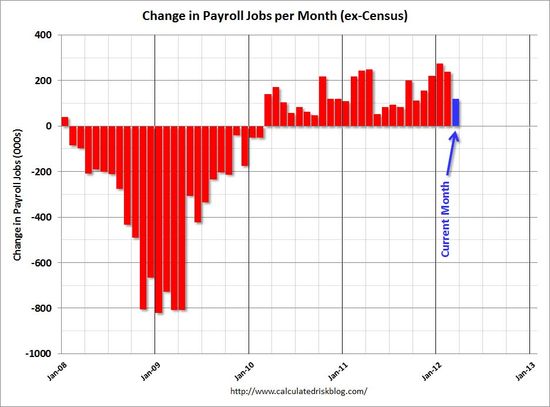
Jared Bernstein worries about today's dismal jobs report:

[W]e may be at the beginning of another downshift in job growth or March’s disappointing report could be an anomalous blip down in a better underlying trend.  There’s some reason to hope for the latter—I noted the seasonality issues caused by the mild winter—but we could also be seeing the impact of higher gas prices on growth, real incomes, and consumption.  

Felix Salmon is slightly more upbeat:

[T]here’s bad news here, which is that judging by this one report, some of the steam might have gone out of the recovery. And there’s a little bit of good news too, which is that it’s just one report, not a trend, and that it has a very wide margin of error; that the economy’s still creating jobs, even if it’s not creating them as fast as we had hoped; and that it wasn’t all that long ago that a +120,000 headline figure would have been taken as something decidedly encouraging. 

Daniel Gross notes that this report conflicts with other economic data:

Other labor market indicators have been trending in a more positive direction. Weekly first time unemployment claims are at a four-year low. In March, layoff announcements fell sharply from the previous month. At the end of January, there were 3.46 million job openings in the U.S., up 21 percent from the number of openings in January 2011. Ultimately, however, the monthly payroll jobs figure is the one that matters most — for the economy at large, and for the politicians whose electoral success will depend in large measure on the payroll jobs figures for the next several months. We'll have to wait 30 days to see if March's report was an anomaly or the beginning of a new, disappointing trend.

Greg Ip explains how the unemployment rate ticked down:

[T]he fact the unemployment rate continues to fall when underlying economic growth is an unimpressive 2.5% is troubling evidence that swaths of the working age population are permanently withdrawing from working life. It is too soon to count out the American economy’s cyclical recovery. But the structural problems linger.

Calculated Risk, while admitting that the report was "disappointing," points out that it "wasn't all bad news":

It looks like the drag from state and local layoffs is nearing the end, the unemployment rate declined (although partially because of workers leaving the labor force), the number of people working part time for economic reasons declined, and the number of people unemployed for more than 6 months declined – and hourly wages increased a little faster.

Yglesias looks at the parts of the economy that are underperforming:

This does in part seem to be about weather phaseout, as "construction of buildings" subtracted 10,000 jobs. But an even bigger change was in retail trade which saw 38,000 job losses as part of what I have to think is the structural decline of retailing.

He later claims that retail is "facing a persistent decline driven by e-commerce" and that the problem is only going to get worse. Ed Kilgore considers the political implications:

You may recall Nate Silver’s projection in February that Obama’s “magic number”for job creation between now and November in order to put himself in a very strong position for re-election was 150,000 jobs per month. The economy is still slightly ahead of that pace on average, but the latest figures obviously did not help.

(Chart on job losses and gains by month from Calculated Risk)

Escaping The Confines Of A Coffin, Ctd

A reader writes:

I was widowed fairly young (age 46) and struggled with both of these issues. I find them related. I decided to have Jane cremated but purchased a niche in a very beautiful nearby cemetery. I like having a dedicated place to go, with her name on it, on special occasions (her birthday, our anniversary, etc.). I don't know that I'd get the same positive feeling and connection if she had been scattered on San Francisco Bay, even though she loved sailing it.

Her niche is marked only with her married name (she took mine) and the years of her birth and death, for privacy's sake (and also because I had heard – I don't know if this is apocryphal – that having the full birth date "out there" can invite identity theft).

We weren't religious, though I think about faith and the afterlife quite a bit. What I've come to is this: Nothing I or anyone else does on earth can hurt or help her now. If she's in heaven, then she's so blissed out that she doesn't give a whit what I do; if she's in hell, she has bigger fish to fry than worrying about my actions; and if she simply vanished when she died, she's not even around to care.

Another also stakes a middle ground between cremation and burial:

A number of years ago, my parents talked with my father’s parents about their end of life wishes.  For all of them, being cremated was more appealing than burial, but they still liked the idea of having a dedicated spot where friends and families could go.

Instead of buying a cemetery plot, they donated money to the local university botanical garden endowing a cove in their amazing Japanese garden.  My father and my grandfather were both lifelong woodworkers and wanted to contribute something for the space.  They worked closely with the garden staff in order to identify something that would have the right feel for the space, and together they built a Japanese lantern and an amazing plank bench.  My grandfather was 82 at the time, and it was the best piece of woodworking he ever completed.

For years when I would come to visit we would all go to admire their cove; the azaleas growing nicely and the plantings maturing to leave a beautiful contemplative spot overlooking the garden’s pond.  When my grandfather died at 86, we had a standard memorial service, but the most memorable event was our immediate family (grandmother, sons, grandkids, and great-grandkids) going to the cove and one-by-one scattering his ashes.  It seems gruesome, but the most amazing part of that experience was realizing that within the ashes you could see the remnants of metal spiral aortic stents and pins from bones that had been reset; these ashes were definitely my grandfather.

I love that in perpetuity I have a beautiful space to go to remember the four of them, to sit on the bench built by their hands and watch the koi swim by.  Creating this space was a fantastic gift to their family, and to their community.

Do Gays Have Lower Divorce Rates Than Straights?

In Britain, they do, by quite a margin. There's some fascinating and counter-intuitive data that back it up (it's not apples to apples since civil partnerships do not carry the social status of civil marriages, but it's not far off, since British CPs are identical in rights to CMs.) But this is a striking result:

The most recent evidence from the UK Office of National Statistics finds that homosexual couples that joined in 2005 were significantly less likely to have filed for dissolution four years later than heterosexual couples were to have filed for divorce: 2.5% compared to 5.5%. As Hattersley points out, however, male couples were much less likely to dissolve their relationship than were female couples: By the end of 2010, 1.6 % of male civil partnerships had ended in dissolution compared to 3.3 % of female partnerships.

This data may shift again over time. But who predicted that gay marriages would have lower divorce rates than straight marriages? Not me. And who predicted that gay men would last longer in marriage than lesbians? No one. So the one thing Jesus insisted on in marriage – no divorce – is now best upheld by gay male marriages. (Cut to Gary Bauer's head exploding.)

But why the higher lesbian number? Aren't women supposed to be the more stable of the genders? Marina Adshade airs many possible explanations, including this one:

[P]eople who have been divorced in the past are far more likely to divorce in the future. In the UK in 2010, 19% of male civil unions were between a previously single man and a previously married man while 27% of female civil unions were between a previously single woman and a previously married women. If lesbian women are more likely to have been in a heterosexual relationship in the past that ended in divorce (which appears to be true) than are gay men, then there is nothing surprising about their higher divorce rates in that gender group.

Obviously we need more studies to come to a better understanding, but Occam's razor points to this, it seems to me:

Women who want out of their heterosexual marriages file for divorce much sooner than do men who want out of their heterosexual marriages.

The Full Paterno Story

GT_CORBETT_120405

Don Van Notta reveals the nasty politics that surrounded the Sandusky scandal – including the details of current PA Governor Thomas W. Corbett's failure to prosecute Sandusky when he was Attorney General:

The untold story, though, is about bare-knuckle Pennsylvania politics, old grudges and perceived slights. It involves a stagnated child sexual abuse investigation that, to some, took a backseat to higher-profile cases and a gubernatorial campaign. It involves a head football coach who knew too little and, still, failed to do enough. It includes a passive school board of trustees that for months ignored a lurking controversy and then, under pressure to preserve Penn State's reputation, quickly fired its legendary coach without ever talking with him. Through it all, the central character was Corbett. 

(Photo: Penn State Board of Trustees member Pennsylvania Governor Tom Corbett listens the board holds an open public meeting in the wake of the Jerry Sandusky scandal at the Nittany Lion Inn, November 11, 2011 in State College, Pennsylvania. By Patrick Smith/Getty Images.)

Cool Ad Watch

Enhanced-buzz-10954-1333649258-55

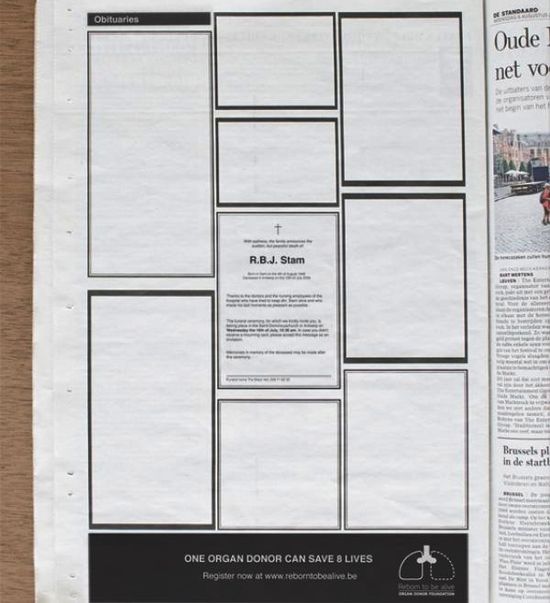
Copyranter calls it "the best organ donor ad you'll ever see":

It ran on the first page of obituary sections in Belgian newspapers back in 2008. It's for the organization Reborn To Be Alive. The ad won a national press award that year. It's not over-the-top visually like most of the ads produced in this category. But it's starkly emotional and effective.

By the way, Copyranter, aka Mark Duffy, hit the blog big-time this week by joining Buzzfeed, in another savvy acquisition by Ben Smith. Mark's double-fisted greeting here. And read how he wants to give a Business Insider blogger a fist to the face.

The Almost Alcoholic

You may have a drinking problem, even if you never hit rock bottom: 

Under consideration is a paradigm shift in the way we view mental illness, including substance use. At the core of this new paradigm is the idea that some conditions might be better thought of as existing on a spectrum rather than in terms of discrete categories such as alcohol abuse and dependence. … The almost alcoholic zone is actually quite large. The people who occupy it are not alcoholics. Rather, they are men and women whose drinking habits range from barely qualifying as almost alcoholics to those whose drinking borders on abuse. 

Joyner thinks the authors define almost alcoholics too broadly.