Is Running Against SCOTUS Dangerous?

Jon Meacham warns Obama against going to war with the Supreme Court:

The big thing experience shows is that you should not declare war on the court. More in sadness than in anger, just mention the issues on which you feel stymied by the justices. From health care to campaign finance, those independent voters will get the message without being frightened off by an unsettling rhetorical attack on the judiciary. That’s what FDR got wrong. Obama may well have a chance to get it right.

Silver dissects another Obamacare talking point:

[T]he argument that the bill being struck down would actually help Mr. Obama seems to have little grounding in the evidence — nor, frankly, in common sense. Among the voters that are most critical to Mr. Obama’s re-election prospects, the Supreme Court is more popular than the health care bill. If the justices declare one of the president’s signature accomplishments to be unconstitutional, it would not be a boon to him. 

I agree on both counts, unless the court's ruling appears so baldly political and partisan it discredits itself, or unless the implications of the ruling mean a rollback of federal power to before the 1930s.

Nonetheless, I do see an evolution in the president these last few months.

As the GOP intransigence builds, as the Court moves to undo the president's signature domestic achievement, after stabilizing the incipient depression, he's getting more liberal. By this fall, we may have a very clear choice between a candidate seeking to reassert the middle way on debt and spending (i.e. allowing for revenue increases along with defense and entitlement cuts) and a candidate pledging to attack the debt by actually cutting taxes again, and then slashing the welfare state for the old and repealing one for the working poor and sick.

My view is that revenues have to be raised if we are to bridge the budget gap. I'm a Simpson-Bowles supporter/Cameron Tory in that I put the need for urgent fiscal balance in a divided country over the ideological push for a radically smaller government. I don't want a bigger government, but I think if we have one, and clearly do not have a consensus on how to reduce it, we should pay for it. And given the urgency, a balanced approach that is not ideologically tilted to either wing of either party is the best way.

Obama offered that path. The GOP chose politics and ideology. So now Obama has moved left – at least rhetorically. He once told the restive base of his party: Make Me Do It. It's one of history's great ironies that the base that has forced him into a more aggressive liberal position is the GOP's.
Life As A Gay Doctor

Mark Schuster, a gay pediatrician who's now a tenured professor at Harvard Medical, reflects on what it used to be like:

I was on a consult service that helped diagnose a man with AIDS. His case hit home. He had just moved across the country with his boyfriend, who was a first-year Harvard medical student. The pulmonary fellow on our team, a generally kind man, grumbled to me that he hated having to go into this patient’s room. And so we didn’t go in much. The patient’s intern also avoided him, even managing to find herself too busy to perform a timed blood draw one night for a key lab test. I was still there writing my consult note, so after several attempts to gently remind her to take a break from having a light evening and chatting with staff, I just did it myself. This patient was not unlike any number of patients at hospitals around the country, wondering why the clinicians who were supposed to provide care and comfort appeared to be avoiding and even judging them.

The whole piece is worth reading.

Romney’s Future Base: Moderate Cynics

Stu Rothenberg notes an irony in the GOP primary:

What’s interesting about Romney and his supporters is that, despite his conservative rhetoric, moderates and country club conservatives continue to support his candidacy. Think about it. Romney, who stresses his opposition to abortion, talks tough on immigration and rules out a tax increase even to help cut the deficit, continues to get the support of pragmatic conservatives who reject former Pennsylvania Sen. Rick Santorum’s ideological rigidity, thought Rep. Michele Bachmann (Minn.) was too conservative and viewed Texas Gov. Rick Perry as a bomb thrower.

Clearly, establishment Republicans also don’t believe Romney when he talks about his views and his agenda. If they did, they probably would feel about him the same way they feel about Santorum or Bachmann. Romney’s great asset is that these voters figure he is merely pandering to evangelicals and the most conservative element of the GOP when he talks about cultural issues, immigration and taxes. The bottom line, of course, is that nobody — not his critics and not his allies — really believes Mitt Romney.

Ed Kilgore extrapolates to the general election:

For all the differences in personality and background, that’s why I’ve always thought of Mitt as the New Nixon. He may succeed politically because people with money figure he’ll do what it takes for him—and them—to win, because he’s a safer bet than his opponents, and even because people are cynical enough about him to assume he won’t let principles get in the way of doing things the country obviously needs. But (with the obvious exception of LDS folk) he’s not going to inspire much of anybody, and can ascend to a victory over Barack Obama only on the dark wings of an exceptionally nasty negative campaign reinforced by disheartening external events.

Yep: that'll do.

Jesus Without Politics

I'm not the only advocate of an apolitical Jesus:

At the culmination of Jesus's trial, Pilate presents the people with a choice between Jesus and Barabbas. One of the two will be released. But who was Barabbas? It is Jesus-paintingusually the words of John's Gospel that come to mind here: "Barabbas was a robber" (Jn 18:40). But the Greek word for "robber" had acquired a specific meaning in the political situation that obtained at the time in Palestine. It had become a synonym for "resistance fighter". Barabbas had taken part in an uprising (cf. Mk 15:7), and furthermore – in that context – had been accused of murder (cf. Lk 23:19, 25). When Matthew remarks that Barabbas was "a notorious prisoner" (Mt 27:16), this is evidence that he was one of the prominent resistance fighters, in fact probably the actual leader of that particular uprising.

In other words, Barabbas was a messianic figure.

The choice of Jesus versus Barabbas is not accidental; two messiah figures, two forms of messianic belief stand in opposition. This becomes even clearer when we consider that the name Bar-Abbas means "son of the father". This is a typically messianic appellation, the cultic name of a prominent leader of the messianic movement… So the choice is between a messiah who leads an armed struggle, promises freedom and a kingdom of one's own, and this mysterious Jesus who proclaims that losing oneself is the way to life. Is it any wonder that the crowds prefer Barabbas?

Yep, that's the Pope, in his book, Jesus of Nazareth. Benedict is adamant that Jesus is not about worldly power at all:

The Lord… declares that the concept of the Messiah has to be understood in terms of the entirety of the message of the Prophets – it means not worldly power, but the Cross, and the radically different community that comes into being through the Cross. But that is not what Peter has understood: "Peter took him and began to rebuke him, saying, 'God forbid, Lord! This shall never happen to you'" (Mt 16:22). Only when we read these words against the backdrop of the temptation scene – as its recurrence at the decisive moment [Peter's confession of Jesus as Son of God] – do we understand Jesus's unbelievably harsh answer: "Get behind me, Satan! You are a hindrance to me; for you are not on the side of God, but of men" (Mt 16:23).

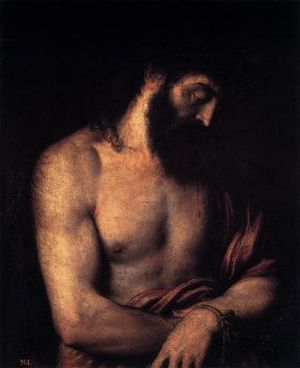
(Painting: Titian's Ecce Homo, depicting Christ after the trial, and mockery of his "kingdom" by giving him a purple robe and a crown of thorns.)

The Right’s Obama, Ctd

Instead of simply assailing him for a political pre-emptive strike against the Supreme Court, they actually think he has no idea what Marbury vs Madison is.

Either that, or they're pretending to think that – to curry a base convinced that the first black president must be an ignoramus. Or maybe what they actually think and what they pretend to think have simply merged into a Romneyesque slime.

Are Apps The Future Of Books?

Maybe:

Perhaps the most wildly divergent book app I’ve encountered so far is Chopsticks, which is another Penguin book, but one that’s vastly different than their amplified editions. It’s described as a novel, but it’s vastly different than a traditional novel. As you turn the pages, you aren’t confronted with a traditional narrative, but rather interact with different pieces of the lives of Glory, a teen piano player, and the boy who moves in next door. The story’s told through newspaper clippings, pictures, songs, and more. It’s a rather fascinating way to tell a story.

Why Isn’t Suicide Prevention Improving?

Because no one will fund the research:

Most psychiatric drug trials today—the majority of which are industry sponsored—exclude anyone expressing thoughts of suicide. This is for ethical as well as practical reasons: physicians consider it taboo to give people on the brink of suicide an experimental drug, let alone a placebo, if other options are available, and many additional safety precautions are required to run trials in this vulnerable population. To complicate matters, few mental health experts are trained in how to conduct suicide research, and those who do are often afraid of lawsuits.

Vaughan Bell nods:

Normally, if I want to develop a way of predicting who will develop depression or not, I can assess a group of people and I can return later and see whether my predictions were right or not. If I do the same with a suicide assessment and it suggests that several people are at high-risk of suicide, I have a moral duty to intervene and help them.