Getting Around The Guys

How social media is making the careers of many female comedy writers: 

Consider Ilana Glazer, a New York comedy writer who, when she and writing partner Abbi Jacobson didn’t make it into the improv groups they wanted at Upright Citizens Brigade, decided to take their brand of girl-centric comedy to the web. "We said, ‘Eff this, we’re going to make material for ourselves,'" enthuses Glazer, the co-creator of the Broad City web series. That was 2009. The duo now have a deal with FX.

"In the old days, if you got a spot on Carson, your life changed forever," says Lizz Winstead, co-creator of The Daily Show, who blogs at the Huffington Post. "That’s not true anymore. Do we even need those shows? I don’t think we do.” Women still represent just a fraction of writers on late-night comedy programs, and they only represent 8 percent of directors of Hollywood films. Any female comic knows the comedy industry is rife with sexism. But social media has opened up ways around these traditional paths.

The Paranoid Right’s Obama, Ctd

A reader tries to follow the logic:

Here's the thing I don't get about these nutball predictions for a second Obama term, which go hand-in-hand with the "not vetted" refrain we keep hearing: Obama's already been president for 3+ years. If his plan was to destroy America, then why didn't he do it when he was immensely popular and had 60 Democratic votes in the Senate? Why didn't he begin his inauguration speech with "Allahu Akbar" followed by a sinister laugh? And how much more "vetted" can you get than subjecting yourself to the daily scrutiny of, you know, being the president? To seize power and then just bide his time for four years while waiting for an uncertain second term to unleash his devious plan would have to make him the dumbest, most incompetent evil genius in history. In which case they don't really have much to worry about, right?

Another also scratches his head:

I'm sure you'll get many emails about this, but isn't the flag at around 1:29 in the trailer for D'Souza's film an example of the American flag with the stars replaced by corporate logos, itself a favourite among leftist political organisations? It flashes by pretty quickly, but you can clearly make out the logos for McDonald's, Merril Lynch, Walmart and the GOP itself. The flag is usually seen as a protest symbol against excessive corporate power in American politics: surely not what the producers intended.

Who knows at this point? Another:

All we need to know about the right's paranoid delusions about Obama:

1) They believe he didn't really kill Osama bin Laden
2) They believe he killed Andrew Breitbart

Enough said.

Reality Check

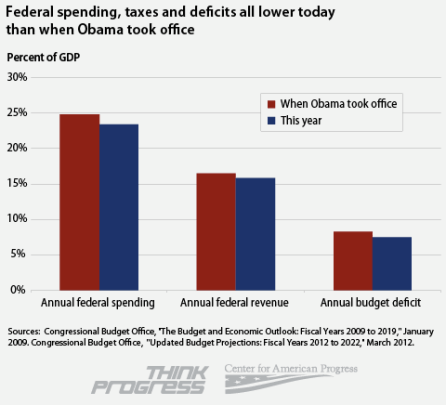
Courtesy of Think Progress:

Obamaspendingchart

Derek Thompson's take

This is an inconvenient truth. It is inconvenient for Mitt Romney that spending, taxes, and the deficit are all lower today than when President Obama took office. It is inconvenient for liberals (not to mention, really inconvenient for the unemployed) that we've been overly aggressive in paring down our deficits even with high unemployment and huge cuts to state and local government. It is inconvenient to tax reformers seeking to raise revenue, since Obama has compounded the extension of the Bush tax cuts with yet more tax credits and a payroll tax cut. 

Wait a minute. Is this still America? Sometimes the sheer Kenyan anti-colonial radicalism of this president is beyond belief. He just cuts and cuts taxes and shoves austerity down our throats. If only we'd listened to Dinesh D'Souza.

The Jock-Sniffing Of Nixon … And Obama

Bryan Curtis pens a beaut of a piece about two "sports fan" presidents. I loved this nugget:

Obama had his sports powwow with Bill Simmons. In 1968, Nixon had his sports powwow with — wait for it — Hunter S. Thompson. The good doctor, who'd been picked from the press pool because he was the only one "seriously addicted" to football, got an audience with Nixon on a bus ride during the New Hampshire primaries. Thompson mentioned a wide receiver that had caught a pass in Super Bowl II. Nixon stunned Thompson not only by naming the receiver but his alma mater. "Whatever else might be said about Nixon — and there is still serious doubt in my mind that he could pass for Human — he is a goddamn stone fanatic on every facet of pro football," Thompson marveled.

And the politics of this?

Nixon and Obama got something even bigger out of being sports freaks. It allowed them to go one-on-one with their most deadly caricatures. Before his 1968 campaign, Nixon was cast as an inhuman pile of ambition forever molting into a "new Nixon." Obama, way more slanderously, has been called a Kenyan-born, madrassa-schooled non-American. It's no wonder the POTUSes never shut up about sports. Nixon talked football and got to be part of the silent majority. When Obama talks sports, he shows America his birth certificate.

Why Don’t Voters Make Foreign Policy?

Benjamin Friedman puzzles over the gap between public opinion and policy:

In the latest edition of Political Science Quarterly, Joshua Busby and Jonathan Monten show that Republicans elites have long been more prone than Republican voters to favor high defense spending and long-term alliances. One explanation for this democracy deficit is what Busby and Monten call “dual slack,” the absence of restraint that either voters or international politics put on U.S. defense policy. Foreign-policy issues tend to rank low among voters’ concerns and to contribute little to their voting decisions. So politicians have little incentive to cater to voters’ foreign-policy views. They are relatively free to adopt principled (undemocratic) stances. And with few rivals restricting U.S. military deployments, foreign-policy makers can indulge ideological ambition and fancy.

Summer Lovin’ Ctd

A reader in San Francisco writes:

I remember when I pulled that issue of Newsweek out of the mailbox in suburban Cleveland and raced into the house to read it.  My first concert was to see Donna Summer when I was 13, and I'll never forget the gay couple in front of me sneaking a few pats and squeezes and holding hands.  It was the most open display of homosexuality that I'd ever seen, and the fact that those men had the courage to show themselves back in 1978 was a revelation, and a glimpse of the future.  I also remember the comment from her "Live and More" album when she sang "The Man I Love," and remarked that ladies in the audience would relate and added, "And some of you men, too."

These are tiny blips by today's standards, but back then they were a lifeline to a young gay boy like me.  They stand out as the few positive affirmations I got during a very lonely and difficult period in my life, and I'll always be grateful to Donna Summer for that.

Another writes:

Here's the thing about Donna Summer and her gay fans: She was never that into us.

Shit, we barely get a mention in her autobiography. And yet: She and an entire generation of gay fans shared their very souls. Our connection was real, it was abiding, and it had nothing to do with her look, her life or anyone's camp sensibility. It was entirely about the music – which simply couldn't have been any gayer.

Donna Summer fancied herself a rocker, but of course she wasn't, despite the guitars on "Hot Stuff." She grew up singing gospel music, but she hardly made it her focus as an adult. And – let's be honest – she didn't have an ounce of soul in her. But holy crap, Donna's gay sensibility was written into her DNA. She understood what her gay fans wanted on a cellular level. For all her discomfort with what she thought she knew about us, she made music that was so unbelievably, manifestly, pervasively extra gay, only a gay person – or a true kindred soul – could have made it.

And Donna never stopped making music like that. Just take a look at her dance releases over the last decade or so of her life. Check out the studio tracks that were added onto her VH-1 live album – songs like "Love Is the Healer" (omg gay!) and her version of "I Will Go With You." Listen to the "I Got Your Love" remixes or her ultra-gay two-EP set of songs, "To Paris With Love." Listen to "You're So Beautiful" or "It's Only Love" and tell me she wasn't a gay man trapped in a straight woman's body – as gay as Sylvester and Jimmy Somerville smooshed together by the Pet Shop Boys in a big gay sandwich.

To me, this is the paradox of Donna Summer. In one sense, she knew next to nothing about her most ardent fans, and was only too happy to keep her distance. But on the very deepest level – the music itself – she was ONE with us. And that's why we can forgive whatever statements she might have made about gay people. It's why we don't care about Donna Summer's indifference to us. And it's why we'll love her forever.
“Taking Money Out Of The Economy”

Several readers are echoing this one:

In the recent "Ask Manzi Anything: Increase Taxes to Fix the Deficit?" Mr. Manzi stated what seems to be one of the right's biggest fallacies concerning the U.S. economy. After lamenting that it takes until some time in May for an American worker to earn enough to pay his taxes, Mr. Manzi says, "(that's) a whole lot of money for the government to be taking out of the economy." The problem with that point of view is that it is 180 degrees from the truth.

Government doesn't take money out of the economy; it redistributes money taken in taxes back into the economy. In fact, since we are borrowing $0.40 of every $1.00 of government spending, the government is putting way more money into the economy than it is taking out in taxes. Now, one can be against redistribution, call it socialism, and demand an end to it, but that's not the same as assuming that money taken in taxes just disappears into some black hole of the Treasury Department.

I think this actually gets to the heart of the American conservative idea of how the economy works and why I find the prospect of turning the keys to the whole thing over to them frightening. In their view, since being made to pay taxes takes money from them, that money is then gone and not available to be used by the "job creators." Since the free market no longer has use of those moneys, they see this as a net loss that can only be resolved by cutting taxes. No credit is given to the government's use of the money. Government jobs don't count. Government workers have no worth to the economy and besides, we all know that government can't create jobs. Don't we?

As I said, Mr. Manzi has it backwards. It's not government that takes money out of the economy; it's private sector investment in foreign companies, outsourcing and just sitting on over $2 trillion in cash that takes money out of circulation.

The End Of IPOs?

Zuckerberg

Yglesias believes that economic changes have made "acquisition by an existing firm rather than an IPO the best route forward for most growing companies":

[T]he basic issue is clearly illustrated by Facebook’s recent $1 billion acquisition of Instagram. There’s just no way a company with literally $0 in revenue could obtain that kind of valuation as a stand-alone publicly traded company. But as a Facebook target, Instagram probably was worth $1 billion. Sharing photos is Facebook’s most popular use case. Mobile is the future of computing. And Instagram is the most popular and fastest-growing mobile photo-sharing service in the world. All billion-dollar investments are risky, but paying a premium to bring that technology in house rather than making the investment to try to build a competing service makes sense.

Henry Blodget puts Facebook's valuation in context:

For Facebook to actually be worth $125-$150 billion or more today, it will have to be worth, say, $300-$400 billion in a few years. Otherwise, the downside risk in ths stock simply isn't worth taking. And to actually be worth $300-$400 billion in a few years, Facebook will have to be earning about 10X-20X as much money as it earned last year.

Felix Salmon likewise deflates the Facebook IPO hype:

The press loves IPOs, because they’re one of the few occasions when the stock market delivers a significant news event which can be prepared for in advance. But the public? The whole investing-in-IPOs thing just feels so late-90s to me, and the performance of stocks like Groupon and Pandora is hardly likely to spark another feeding frenzy.

Kevin Drum's two cents.

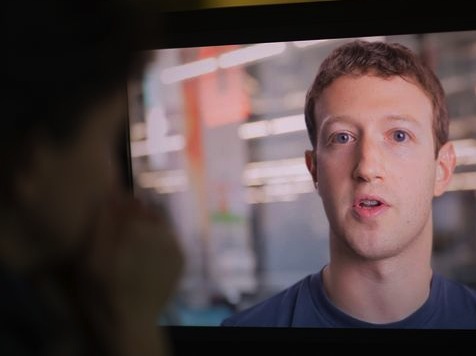
(Photo: A woman watches Facebook founder and CEO Mark Zuckerberg speaking in a promotional video ahead of the company's IPO, in Washington on May 8, 2012. By Mladen Antonov/AFP/GettyImages)