Ad War Update

A new positive ad from the Obama campaign:

Kornacki analyzes it:

The influence of “Morning in America” is clear in Obama’s new ad. But so is the very different nature of the challenge he faces.

American Crossroads plays off Obama's new slogan

The RNC simply invents another slogan: 

Meanwhile, the DNC prepares for Santorum's endorsement of Romney: 

Previous Ad War Updates: May 3May 2May 1Apr 30Apr 27Apr 26Apr 25Apr 24Apr 23Apr 18Apr 17Apr 16Apr 13Apr 11Apr 10Apr 9Apr 5Apr 4Apr 3Apr 2Mar 30Mar 27Mar 26Mar 23Mar 22Mar 21Mar 20Mar 19Mar 16Mar 15Mar 14Mar 13Mar 12Mar 9Mar 8Mar 7Mar 6Mar 5Mar 2Mar 1Feb 29Feb 28Feb 27Feb 23Feb 22Feb 21, Feb 17, Feb 16, Feb 15, Feb 14, Feb 13, Feb 9, Feb 8, Feb 7, Feb 6, Feb 3, Feb 2, Feb 1, Jan 30, Jan 29, Jan 27, Jan 26, Jan 25, Jan 24, Jan 22, Jan 20, Jan 19, Jan 18, Jan 17, Jan 16 and Jan 12.

Would Romney Pass A Stimulus?

To fix the economy, Krugman claims "all we need is to reverse the austerity policies of the past couple of years and temporarily boost spending." He believes that this is politically possible, no matter who wins the White House:

[I]f Romney adhered to Republican orthodoxy, he would of course reject any government action along the lines I’ve advocated. It’s not clear, however, whether Romney believes any of the things he is currently saying. His two chief economic advisers, Harvard’s N. Gregory Mankiw and Columbia’s Glenn Hubbard, are committed Republicans but also quite Keynesian in their views about macroeconomics.

Indeed, early in the crisis Mankiw argued for a sharp rise in the Fed’s target for inflation, a proposal that was and is anathema to most of his party. His proposal caused the predictable uproar, and he went silent on the issue. But we can at least hope that Romney’s inner circle holds views that are much more realistic than anything the candidate says in his speeches, and that once in office he would rip off his mask, revealing his true pragmatic, Keynesian nature.

In an interview with Ezra Klein, Krugman is more pessimistic:

Mankiw and Hubbard have not actually abandoned their analytical positions as far as I can tell. They have left themselves an out. John Taylor, same thing. He’s got all kinds of arguments about why this particular stimulus didn’t do anything, but he’s still living in an essentially Keynesian world. But I don’t think they’re going to be calling the shots. I think if a president Romney tried to do stuff that’s more or less Keynesian, Paul Ryan would cut him off at the knees. And beyond that, I don’t think he’s got the conviction. Someone said his slogan should be “Vote Romney: He doesn’t mean any of it.” But his party means it.

Greater Israel And “Soft Ethnic Cleansing”

I guess we should be grateful that congressman Joe Walsh did not get into specifics, when he unveiled his proposal for an Israel-Palestine settlement. But it's a disarmingly candid expression of what many in the GOP now believe:

The two-state solution has failed. Only a one-state solution – a single, undivided Israel – will bring peace, security and prosperity to Israelis and Palestinians alike.

What about the Palestinians? Bob Wright explains Walsh's project:

Give Palestinians who live in those territories "limited voting power" in the new, bigger Israel that they'll have suddenly become residents of. (Walsh doesn't define his euphemism, but no doubt the idea is that Jews get one-person-one-vote and Palestinians get something less, so that Israel can remain a Jewish state.) … Palestinians who don't like having "limited voting power" can move to Jordan.

Bob explains why this is more than troubling:

When you (1) tell members of an ethnic group that the land they live on is being given to another nation; (2) tell them that neither they nor their descendants will be allowed to vote in that nation's elections, even though next-door neighbors of a different ethnicity can; (3) tell them that the only way to avoid this fate is to go to another country–yeah, I'd call that ethnic cleansing, at least of a "soft" variety.

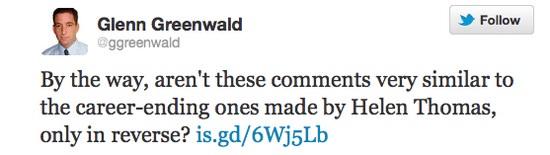
I think that's where Israel is eventually headed: ethnic cleansing by a variety of means, sealing its abandonment of the Western tradition for pure tribalism – and worse. I desperately hope I'm wrong, but the last few years are deeply discouraging for any serious two-state solution. Greenwald notes:

Screen shot 2012-05-07 at 12.00.34 PM

We all know the rules by now: it's okay to tell Palestinians to get out of Israel, but not Jews. Why? Er …

Quote For The Day III

“I don't hack, I just have a great rack," – Madeline Grant, a 19-year-old former model, running for the post of Librarian of the Oxford Union, where I was once President. She's been fined close to $200.

Seriously, old chaps, lighten up. Update from a reader:

For your rack-appreciating readers, you could’ve linked to a site that would include the relevant evidence to Ms. Grant’s political position, something the Telegraph story failed to do. So here you go. You’re welcome.

Greece In New Turmoil

The largest party after the elections has failed to form a coalition government. Next up: the far left Syriza party. Money quote:

We are the second biggest party. We are very aware of our responsibility towards the Greek people and will make good use of our mandate," Dimitris Stratoulis, a Syriza party official, has just told Mega TV. At no other time in the nation's modern history have radical leftists received a mandate to form a government. "Our aim is form a government of the left that will liberate the country from the shameful loan agreement it has signed up to."

Can Obama Be Swift-Boated?

Weigel shakes his head:

Some political attacks are twelfth-dimensional chess that only the pros understand at first. This feels more like venting by people who hate the fact that Obama can mention the OBL killing. 

I think there's a huge difference between veterans' attacking a fellow vet who is just a candidate, and active servicemembers maligning their president and commander-in-chief. Jonathan Bernstein agrees that swift-boating is unlikely to hurt Obama. His reason:

Swift Boating  – and the George W. Bush campaign in 2004 in general — was probably a dud. The most important thing to know about the 2004 election, when it comes to electioneering effects, is that Bush underperformed the "fundamentals" models.

Adam Weinstein has more on Veterans for a Strong America, the group behind the ad, which Karl Rove has called "powerful." 

All’s Fair In Love And Disappointed Animals?

Enhanced-buzz-8923-1331845868-4

Using Buzzfeed's list of "33 Animals Who Are Extremely Disappointed In You" as a case study, Alexis Madrigal interviewed the site's founder, Jonah Peretti, about photo memes and copyright issues:

[A] lot of what BuzzFeed traffics in — the fun stuff, that is — emerges on Tumblr or Pinterest or 4chan. Users of those sites surface photos that in some cases have been shared around the Internet for a decade. In those cases, even if BuzzFeed editors try to track down the creator, which Peretti assures me they do, they probably won't find whoever uploaded the photo of every obese cat. … With these kinds of posts, Peretti is willing to make a Fair Use argument that goes like this. First off, the Fair Use limitation and exception to exclusive copyright is notoriously fuzzy. Let's quote from Wikipedia on this one point because the explanation there is reasonable and understandable: 

To justify the use as fair, one must demonstrate how it either advances knowledge or the progress of the arts through the addition of something new. A key consideration is the extent to which the use is interpreted as transformative, as opposed to merely derivative.

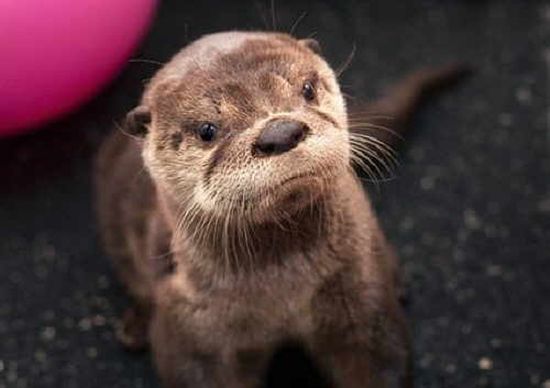
So, Peretti told me that he considers a BuzzFeed list — its sequencing, framing, etc — to be a transformative use of photos. That is to say, including that unattributed photo of the otter in that list was OK because its inclusion as an "extremely disappointed" animal transformed the nature of the photo. "It's a question," Peretti said, "of when lots of little things add up to a transformation as opposed to a copyright violation."

Jeremy Stahl questions Buzzfeed's understanding of copyright:

"I would expect an interesting response from a judge if I argued that putting a caption on a photo was transformative use for the purposes of fair use," says UVA professor, copyright expert, and occasional Slate contributor Thomas Nachbar. Nachbar adds that a fair use argument doesn’t simply come down to whether something is transformative—it can also depend on whether the use is commercial or nonprofit and educational, as well as the amount of the original work that’s being used and the likely effect the use has on the original work’s value. A legal proceeding would have to consider all those factors together.

(Photo of a disappointed otter by Carli Davidson, one of the Dish's favorite photogs.)

How Many Jobs For Obama To Keep His Job?

A few months ago, Nate Silver asserted that jobs reports "that come in at under 150,000 jobs could put [Obama] on a trajectory toward defeat." Nate has now lowered the bar to 125,000 jobs a month. He warns that the relationship isn't precise:

Certainly, if the economy creates 200,000 or more jobs per month throughout the rest of the year, as it did in January and February, then Mr. Obama is likely to be in pretty good shape. And if it averages 75,000 or fewer jobs per month — that’s about the point at which the rate of job growth will lag that of population growth — he is likely to be in some trouble. Anything between about 100,000 and 175,000 jobs per month, however, should leave both Mr. Obama and Mitt Romney with ample room to debate the nuances of job creation and the rest of the economy.