Reality Check

Mark Blumenthal observes that "the general sense of support or opposition to the [healthcare] law formed in the Spring of 2010 has largely persisted":

Obamacare_Opinion

An important caveat:

Another consistent finding is that a non-trivial portion of expressed opposition comes from more liberal Americans who say they are disappointed that the Affordable Care Act does not go far enough. The CNN/ORC polls conducted over the past two years, for example, have found that between 50 and 59 percent say they are generally opposed to the "bill that makes major changes to the country's health care system [that] became law in 2010." However, the same surveys also asked a follow-up question, showing that between 10 and 14 percent of all Americans oppose the health reform law because they think its approach "is not liberal enough."

The Pajama-Clad Workforce

A recent study found that many telecommuters watch TV, do chores, and take naps while working from home. But they are also more productive than office workers. Yglesias is unsurprised:

[T]here is … a compelling case to make that working at home makes people much more efficient, because it allows workers to take care of annoying little chores while still getting their jobs done. Remote working—at least occasional remote working—can be great precisely because of the opportunity it affords to get a certain amount of non-work stuff done.

It’s much faster to shop for groceries at a quarter to three than to stand in line during the after-work rush. Far too many people work similar schedules and want to eat dinner at dinnertime. My neighborhood supermarket turns into a nightmare from 6 p.m. to 8 p.m. Sunday late afternoon, another popular shopping time, is even worse, with the aisles often featuring Soviet-style shortages of key commodities. If you just start working a bit earlier (no commute, after all) and pop by the store during a lull when lines are short, you can get both more work and more shopping done in a fixed amount of time. 

Love And Hate In Uganda

A reader writes:

Thank you for the How to Survive a Plague recommendation. I have tickets to see it tomorrow. I want to strongly recommend the documentary Call Me Kuchu in case you have not already seen it or covered it.

It is about gay rights activism in Uganda and tells a highly personal story of the people there facing incredible (and indeed life-threatening) odds to live their lives and try to prevent a legal and cultural regime from growing even worse – especially the so-called homosexuality bill that would create a capital offense for LGBT activities and also outlaw providing HIV/AIDS treatment to gays or even knowing someone is LGBT and not reporting it within 24 hours.

I saw this film last night, and it moved me to tears. It raises so many issues, including the role of the US in spreading this type of hate. It is the most powerful film about love and hate that I have seen. I cannot imagine facing the type of oppressive hatred that the subjects of the film must wake up to every day.

Quote For The Day

"To the several Times readers who objected to my offhanded description of the French philosopher Michel Foucault as 'creepy,' a point of clarification. Foucault was indeed an influential thinker. His ruminations on power have launched thousands of undergraduate term papers, and my heart goes out to the professors who have to read them. The adjective in question was meant to refer specifically to his enthusiasm for the theory and practice of sadomasochism. According to James Miller’s adoring biography, Foucault himself wrote of his delight in 'the overwhelming, the unspeakable…the stupefying, the ecstatic' – and 'the creepy,'" – Bill Keller.

Why Does Baldness Exist? Ctd

Many readers are echoing this expert:

As an evolutionary biologist, I just had to add my two cents to the baldness discussion. Not every trait needs to be adaptive. In fact, many traits are invisible to natural (or sexual) selection because they don't appear until AFTER individuals have reproduced. Take many late-onset diseases like cancer or Huntington's disease. By the time a person is afflicted by the disease they've often already had children and their genes have been passed on. Remember, it was only after the advent of modern sanitation that humans in large numbers began living past the age of 40 or 50. Baldness may be a consequence of hormonal changes in older individuals that cannot be shaped by natural selection because, for all intents and purposes, that person is already genetically "dead" (i.e. post-reproductive).

Another writes:

I can offer a personal anecdote regarding the advantages of baldness:

I am a 25-year-old management consultant.  I spend most week days visiting clients across the US and Europe. I advise senior executives across a range of industries, on issues including where to invest and how to manage their businesses.  Again, I am 25 years old. I also, fortuitously, have a receding hairline and a growing bald spot.  My clients don't realize that I am 25. I suspect that most of them think that I am in my mid-30s.  There are plenty of 25-year-old consultants, but few are able to go as deep with clients into as trusted a relationship.  Pre-mature baldness allows me to fill the role a mature, time-wizened advisor.

Cologne’s Court Bans Infant Male Genital Mutilation

Including for religious reasons. Walter Russell Mead’s response is beyond self-parody:

To ban infant circumcision is essentially to make the practice of Judaism illegal in Germany; it is now once again a crime to be a Jew in the Reich … Perhaps those convicted of wrongful circumcision could be required to wear a yellow star?

But the case was brought in the case of a Muslim infant being mutilated without consent. And no doctor was convicted, and the Cologne court’s jurisdiction is not national. Yair Rosenberg touts the alleged medical benefits of the procedure (oddly, the German ruling allows circumcision for “medical” reasons). The Dish, of course, begs to differ. But the court does indeed get to a central issue: can parents permanently mutilate a child’s genitals to pursue their own religious goals? I have a rather expanisve view of religious liberty, so I would veer on the side of permissiveness here. But that it is an assault on a child seems obvious to me. If it were done not for religious reasons, it would be banned. And so I do not see making this mutilation as illegal as it is for girls to be somehow bigoted or intolerant.

And the religious liberty involved is obviously not the child’s. If he wants to, he can get his genitals mutilated later as a sign of his religious commitment – when he is old enough to be able to make such a choice of his own free will. At some point, one can only hope this barbarism disappears. And it will have nothing to do with anti-Semitism or Islamophobia; it will be about defending the religious liberty of Jewish and Muslim males to choose their religion, and not have it permanently marked as scar tissue on their dicks. It will be about the right not to be physically assaulted as an infant, to be able to grow up with the body you were born with. And that’s a pretty fundamental human right – more fundamental in my view than the parents’ right to express their own faith by mutilating another person’s body without his consent.

The Bain Of This Campaign, Ctd

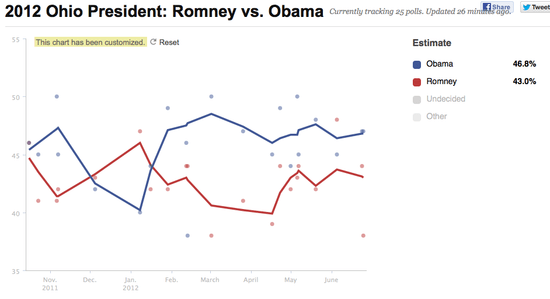
A lot of hand-wringers have pooh-poohed the Obama campaign's relentless focus on Mitt Romney as a vulture capitalist/out-sourcer-in-chief/suit-who-fired-your-dad etc. I find this strange since it's obvious that Romney's private sector experience as a man who made a fortune off private equity is relevant. Romney has made it a central piece of his appeal. And when pieces like the Washington Post's recent expose reveal an enthusiasm for out-sourcing jobs abroad to help profit margins, Obama would be guilty of electoral malpractice if he didn't jump on them. And so we have the above ad and others now showing in the swing states of Ohio, Virginia and Iowa.

And guess what? In so far as we can judge the impact of these anti-Bain ads in the swing states, they appear to be working, especially with the white working-class voters Romney desperately needs. Here's the data from the latest NBC/WSJ poll:

The president’s advantage widens in the states typically considered up for grabs — Obama leads by 8 points (50 percent to 42 percent) in a combined sample of voters in Colorado, Florida, Iowa, Michigan, Nevada, New Hampshire, New Mexico, North Carolina, Ohio, Pennsylvania, Virginia and Wisconsin.

"Also in these swing states, Romney’s favorability numbers have dropped, possibly reflecting the toll the negative Obama TV advertisements are having on the former Massachusetts governor in these battlegrounds," MSNBC’s FirstRead blog wrote. Those attacks include a sustained critique of Romney’s time at Bain Capital, the private equity firm that he co-founded.

The last month has, on the surface, been dreadful for the Obama campaign, and tomorrow's possible destruction of the ACA by SCOTUS would be the icing on a toxic cake. But, in fact:

The swing state results led Republican pollster Bill McInturff to conclude that "it's been more of a problematic month from May to June for Romney" (McInturff conducts the NBC/Wall Street Journal poll along with Democrat Peter Hart).

Hence this:
Screen shot 2012-06-27 at 12.06.07 PM

This is why most of the polling outfits show Obama with a solid electoral college lead, while the race is still nationally very tight in terms of the popular vote. Maybe the swing states will come more into line with the national averages over time. But Romney shouldn't be having favorables dropping at this point in key states, should he? And it would be nice if his favorables once managed to get above the unfavorables. But it appears he is being defined. Advantage: Obama.

The Torture Of Isolation

James Ridgeway argues against the absurd over-use of solitary confinement in America's jails:

Adam Cohen chimes in:

Rather than reserving solitary confinement for the most vicious, unrepentant criminals, American prisons dole it out in heaping portions – and often for no good reason. Some inmates are put in solitary confinement for repeated violations of minor prison rules. There was a report at the congressional hearing of a prisoner who was caught with 17 packs of cigarettes and given 15 days for each pack, or eight months. Worse still: many inmates are put in solitary not because they have done anything wrong, but for their own protection. This includes victims of in-prison attacks and sexual assaults, gay inmates, and children.

Human beings are social animals. To deprive someone of any human contact for long stretches of time does seem to me to be a form of torture – as psychologically disturbing as sleep deprivation, although not as punishing. I don't believe it should be abandoned tout court. In some rare circumstances, it may well be appropriate. But routine? As unthinkable to me as keeping prisoners in effective temperatures above 120.

The Fast And Not So Furious Scandal

Katherine Eban issues an epic debunking of the Fox News-hyped story:

Quite simply, there's a fundamental misconception at the heart of the Fast and Furious scandal. Nobody disputes that suspected straw purchasers under surveillance by the ATF repeatedly bought guns that eventually fell into criminal hands. Issa and others charge that the ATF intentionally allowed guns to walk as an operational tactic. But five law-enforcement agents directly involved in Fast and Furious tell Fortune that the ATF had no such tactic. They insist they never purposefully allowed guns to be illegally trafficked. Just the opposite: They say they seized weapons whenever they could but were hamstrung by prosecutors and weak laws, which stymied them at every turn.

Indeed, a six-month Fortune investigation reveals that the public case alleging that Voth and his colleagues walked guns is replete with distortions, errors, partial truths, and even some outright lies. Fortune reviewed more than 2,000 pages of confidential ATF documents and interviewed 39 people, including seven law-enforcement agents with direct knowledge of the case.