Depressed, With Children

Sarah Silverman recently confessed she won't have children partially because she fears passing on the depression that runs in her family. Maia Szalavitz tempers the debate:

People with a parent or sibling with major depression are two to three times more likely than average to develop it themselves. But what the commenters didn’t mention is that the same genes that can cause depression may also encourage the sensitivity and sensibility that gives Silverman her creative talent. Indeed, some research suggests that the same exact genetics that might lead to depression can also lead to mental superhealth, depending on whether a person endured high stress in early childhood or had a calmer, more nurturing environment.

Her bottom line:

By selecting against our “worst” genes, we may run the risk of losing our greatest gifts.
Will The Black Church Evolve On Marriage Equality?

GT_BLACKCHURCH_120606

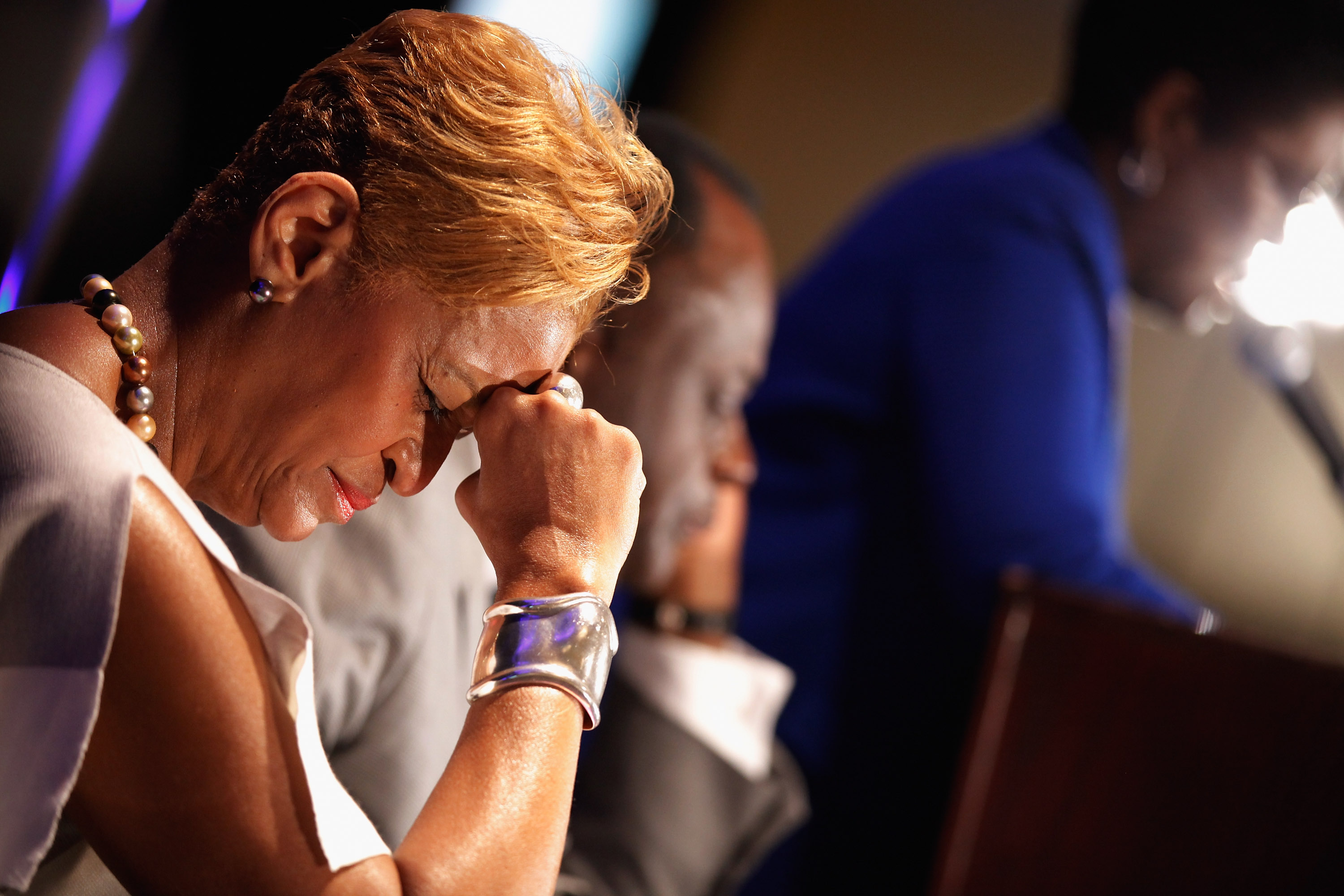
Reverend Oliver White lost two-thirds of his congregation after coming out in support of marriage equality in 2005. His answer to a question about whether Martin Luther King would support marriage equality were he alive today:

I believe that in his heart, [MLK] would support it. But as far as his church was concerned, he would not risk saying that because it would divide him from his people. And I guess I can understand why more ministers don't want to divide their flocks. Just look at what happened to me!

But this is how I've always been. Growing up, I was the first one to climb to the highest part of tree — and fall out. I'm always the first one to jump in the water, even if I can't swim. But I'm still in the water. And I think many more will follow.

NPR recently addressed how various black churches treat gays.

(Photo: Conference of National Black Churches President Jacqueline L. Burton bows her head in prayer during the Congressional Black Caucus's Faith Leaders Summit at the Renaissance Hotel May 30, 2012 in Washington, DC. By Chip Somodevilla/Getty Images.)

The Most Utopian Project Ever

… is poetry, according to Charles Simic. He explains:

"Poetry dwells in a perpetual utopia of its own," wrote William Hazlitt, the great British essayist of the Romantic Period. Despite everything I’ve been saying, I think he has a point. In relation to the future, a poem is like a note sealed in a bottle and thrown into the sea. Writing one is an act of immense, near-irrational hope that an image, a metaphor, some lines of verse and the voice embodied in them will have a long, posthumous life. "The poem wants to reach an Other, it needs this Other," Paul Celan has said. And it happens sometimes.

A Poem For Sunday

Street-art-Another-brick-in-the-wall-In-Gorzow-Poland

"Esthétique du Mal (XV)" by Wallace Stevens:

One might have thought of sight, but who could think
Of what it sees, for all the ill it sees?
Speech found the ear, for all the evil sound,
But the dark italics it could not propound,
And out of what one sees and hears and out
Of what one feels, who could have thought to make
So many selves, so many sensuous worlds,
As if the air, the mid-day air, was swarming
With the metaphysical changes that occur
Merely in living as and where we live.

Continued here. Referencing Stevens' poem, Mary Ruefle contemplates the dread of dying:

I wonder if the young are less afraid of dying, or more afraid of dying, than the old. I am no longer young. I am old enough to understand and know that it is not death I am afraid of, it’s dying. Dying is the act, most often painful, that leads to death, while death itself is as painless as the feeling you had before you were born—no feeling at all, you didn’t care one way or another (feeling is caring one way or another). But what do I know? Blessed Brother André, currently under investigation for sainthood, said, “If we knew the value of suffering, we would ask for it.”

 (Street art in Gorzow, Poland. Photo by Aga Sawala Doberschuetz via Street Art Utopia)

Death On A Schedule

In the first of a three-part series, Terry Teachout meditates on his mother's death:

What is true for the dying turns out to be no less true for those who love them. Set aside the language of hope and you soon start speaking in another tongue, one that is frank enough to horrify innocent outsiders who don't know what it's like to watch a parent die. I loved my mother no less after I accepted the awful fact of her coming death, but I also caught myself saying things out loud that not so long before I wouldn't have allowed myself even to think. First came It's time, then She'd be better off dead, and eventually If she dies tomorrow, I won't have to reschedule our flight to California. It was crass and callous and I hated myself for it, above all because I knew that it was nothing more than the plain truth.

Try as you will, you can't ignore the daily necessities. As W.H. Auden wrote of human suffering in Musée des Beaux Arts, "It takes place/While someone else is eating or opening a window or just walking dully along."

The full series is here. Michael Wolff's related meditation on watching his mother's end-of-life struggle here.

The Bubble We’ve Built

William Deresiewicz notices that no "one in the middle class imagines they could die at any minute":

Has there ever been another group of people, in all of human history, that’s possessed that kind of attitude? Of course, there are reasons it’s emerged when it has: our enormous modern life expectancy, our inconceivable prosperity, our overwhelming military power. But I wonder about its spiritual perils. My professor used to say that it was easy for Nietzsche or Sartre to do without God, because they had so much else to sustain them. (Or Dawkins, or Hitchens, or him, or me.) Which is not to say we need to let the little people have their God. It is only to remind us—to remind myself, which I need to do on a regular basis—that we live in a bubble, and that most people (in the world, in history, even in our own country) are on the outside. And also to wonder if it’s already bursting.

Annoy the Vatican. Read This Book, Ctd

Screen shot 2012-06-04 at 1.24.30 PM

An update on Sister Margaret Farley's Just Love:

Who, after all, would have read Sister Margaret Farley’s “Just Love” if the Vatican hadn’t censured it this week? The Catholic Church delivered the nun’s treatise on Christian sexual ethics from the wilderness of obscurity into the promised land of fame. For any book publicist, such denunciation is an answer to a prayer. On Amazon’s Web site, “Just Love” immediately ascended from No. 142,982 to No. 16.

Previous Dish coverage of the book here.

Does Love Conquer All?

Ron Rosenbaum explores how the poets W.H. Auden and Philip Larkin came to regret their more effusive invocations of love:

These two lines—Larkin’s “What will survive of us is love” and Auden’s “We must love one another or die”—may be the most well-known lines of poetry about love written in the past century. But what’s remarkable about them both is that the poets who wrote them agonized over them, were conflicted and critical of their own lines. Both Larkin and Auden eventually tried to distance themselves from their original unmediated utterances.

And yet perhaps those momentary affirmations were revealing:

And then there's the unanswered question that's been troubling me personally and is perhaps the reason I’ve been a bit obsessed with these lines. What happens to the love between two people when it’s over? Seriously, where does it go, all that feeling, all those memories—do they dissolve into the air or do they survive somewhere, in some way—perhaps in a parallel universe?

I think our two poets believed, but were too shy to say it outright:

Amor vincit omnia.

Recent Dish coverage of Larkin here, here, and here, and Auden here, here, and here

The Geography Of Sleep

Screen shot 2012-06-08 at 9.33.02 AM

It matters:

Comparing the behavior of people living in eastern and western Germany, [a recent study in Current Biology] shows that the average mid-sleep moment varies by four minutes for each degree of longitude. The consequence is that the mid-sleep moment for Germans who live near the western border happens 36 minutes after the midsleep moment of Germans who live along the eastern border.

This would seem to make sense, given that the sun takes exactly four minutes to move by each degree of longitude. The issue, though, is that time zones are not strictly based on this path. The time zone in eastern and western Germany is in fact the same. As a consequence, people who live on the western edge of a time zone suffer from sleep deprivation. The social jet leg is the exhaustion produced by this gap, and might lead to chronic disorders.

More Dish on social jet lag here

(Chart via Maria Popova)