How Much Do We Really Need Doctors?

The Economist anticipates the decline of docs:

Workers with a lot less training than doctors can still be highly effective. Physician assistants in America can do about 85% of the work of a general practitioner, according to James Cawley of George Washington University. A pilot programme of rural health-care workers in India—the type that the health ministry wants to expand—found that the workers were perfectly able to diagnose basic ailments and prescribe appropriate drugs. In some areas non-doctors actually look preferable. A review of studies of nurse practitioners in Britain, South Africa, America, Japan, Israel and Australia, published in the British Medical Journal, determined that patients treated by nurses were more satisfied and no less healthy than those treated by doctors.

On the other hand, newly-minted nurses are having a hard time finding jobs:

[M]ore than half of the unemployed nursing school graduates said they couldn’t find a job in the geographic region they preferred. In health reform, there’s a lot of talk about impending doctor and nurse "shortages." But some would argue our problem is less of a shortage and more of a poor distribution of resources: Health-care professionals end up concentrated in metropolitan areas, with few to serve those in rural communities.

That seems to be true for nurses. About 83 percent live in large metropolitan areas, according to the Health Resources and Service Administration. Graduates may encounter more demand looking in more rural areas, such as Nevada, which has 604 nurses for every 100,000 people (one of the country’s lowest rates). The nursing jobs may be available, but not necessarily where they’re desired by recent nursing graduates.

The Daily Wrap

Today on the Dish, Andrew compared Obama and Romney's records on jobs, rolled his eyes at Mitt's turnout strategy, discovered a "humbler American exceptionalism," found the apple of Fox Nation's eyes, and chuckled at Jonah Goldberg's new meme debut. We checked with the Presidential and Wisconsin Governor's races, figured an actual economic plan would be a political liability for Romney, explained why the recall Scott Walker drive appeared to be fizzling out, did the same for the Occupy movement, and theorized about why gay reporters got all the scoops. Ad War Update here.

Andrew also Eddy-550wiairing of evidence of his malfeasance, found a book the Vatican couldn't stand, called the Pope a poseur, and discovered the open embrace of bigotry by the North Carolina GOP. He further explained the morning's RSS weirdness and mined some good emails out of it. We learned about the Jewish origins of the trinity, noted an extraordinary Mormon gay solidarity march, and were impressed by Jason Alexander's apology for insensitive gay jokes. Reader ripped Matt Labash's response to the first round of criticisms on his anti-meme screed, YouTube made two young girls stars, curation appeared to be blogging, the great headphone debate carried on, and POV photography changed the way we retrospectively saw the world. Anesthesia lengthened surgery, overdiagnosis burdened the healthcare system, the military buckled under the financial weight of its own Tricare program, and Canada's move to single-payer levelled the social playing field.

Finally, Andrew enjoyed the snark surrounding the diamond jubilee and picked out a claim about America's alliances not-oft heard in officialdom. We worried about Russia's role in Syria, analyzed the Peter Beinart backlash, and gamed out the seriously terrible global economic scenarios we might be facing. One writer knew hope for the economic future and another connected food stamps to the economic difficulties of being a 20-something today. Cities bred mosquitos, living in good walking areas cost a pretty penny, cars had a place in NYC, GasPods saved gas money, and Starbucks played a critical "Third Place" urban role. Optimal cereal required precise engineering and researchers studied tomato hatred. Airline fashion evolved and unique creators fell into self-parody traps. Ask Eli Lake Anything here, Yglesias Award Nominee here, VFYW here, MHB here, and (really cute) FOTD here.

Z.B.

How To Think About Economic Risk

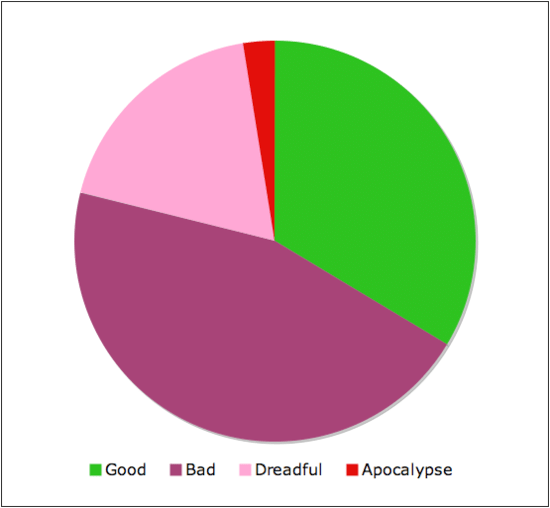
Economic_Scenarios

Grep Ip considers the risks to the Chinese, American and European economies. Felix Salmon charts the possibilies:

Ip puts the chance of a Chinese hard landing at 20%; of the euro falling apart at 40%; and of the US fiscal cliff actually happening at 30%. Individually, each of these risks is bearable. But make the reasonable assumption that they’re independent variables, and it turns out that if you put them all together, the chances of none of them happening are just one in three. But let’s go a bit further. Let’s say that if none of these things happen, that’s Good. If one of these things happen, that’s Bad. If two of these things happen, that’s Dreadful. And if all three of these things happen, that’s Apocalypse. Then this is the result that you get.

Who Are America’s Most Important Allies?

Robert E. Kelley lists the top 7. Canada and Mexico are tied for first:

Yes, Mexico is vastly more important to the US than Israel. However, the rest of Latin America, including that now-pointless embargo of Cuba, really isn’t. How damaging has Chavez really been to the US? Honestly, if we were really strapped for cash and over-committed, we could cut the Monroe Doctrine loose. Latin America doesn’t really need us or the fairly condescending ‘Roosevelt Corollary’ anymore. Strictly speaking, Canada does not need America commitment; Mexico does somewhat. But proximity alone means they are America’s most important allies. We can’t retrench from North America.

He follows up with a list of 8-11 and a longer justification for the rankings. This strikes me as the kind of truth you don't often hear in Washington:

America’s national security interest in Israel is not particularly obvious now – the Cold War is over, S Hussein is gone, Assad is on the ropes. Nor is it clear that Israel really needs us. It needed us to survive the Yom Kippur War, but now? Its got the best military in the region, plus nukes. The real ‘values’ link between Israel and the US now is more tribal (a Judeo-Christian struggle against Islam) rather than liberal.

Mile High Style

Threeuniforms

Sarah Rich takes stock of airline apparel and how it's changed over the decades:

In the 1960s and 70s, stewardess uniforms (indeed, they were all women) were designed to be overtly sexy and appealing to male passengers. Designers like Emilio Pucci were hired to bring current high-fashion cuts and patterns onto planes. "The airlines used bright colors and different psychedelic prints—stripes, flowers, dots," [flight attendant Cliff Muskiet] recalls, "Everything was possible!"

Today’s travel atmosphere is more about inspiring trust and calm than it is about giving people a thrill. … The addition of male flight attendants to the field, and the focus on comfort and safety, led to a less distracting and more gender-neutral look.

(Image: Uniforms for Pan Am (1969-1971), United (1968-1970), and Southwest (1995-2004) from Cliff Muskiet)

Driving Like A Whale

Deep-sea diver and inventor Bob Evans modeled his GasPods – attached to the roof of a car to improve mileage – on the "the tiny raised bumps that speckled the heads of whales" and lobsters: 

The pods—spaced four inches apart and located 10 inches from the lip of the roof— reduced aerodynamic drag by 5 percent when a two-door VW Golf was driven at 65 miles per hour. … Speaking personally, he said, “Driving at 60 miles an hour, we went from 19 to 20 miles a gallon to 24.5.” Evans calculated that translated to a savings of $6.19 per tank.

The Military’s Healthcare Bill

W. Jonathan Rue worries about the budgetary health of Tricare, the military healthcare system:

One Defense Business Board member, retired major general Arnold Punaro, has compared DoD to the auto industry: "General Motors did not start out to be a health care company that occasionally built an automobile. Today, we're on the path in the Department of Defense to turn it into a benefits company that may occasionally kill a terrorist."

Malkin Award Nominee

"Government should treat all citizens impartially, without regard to wealth, race, ethnicity, disability, religion, sex, political affiliation or national origin. We oppose all forms of invidious discrimination. Sexual orientation is not an appropriate category," – an open declaration of the need for the government to discriminate against its gay citizens, in North Carolina's GOP party platform.

You are already free to fire someone just because they are gay in North Carolina. But the active embrace of such discrimination, just like the recent constitutional amendment, rubs it in with twice the rawness.