Comparing Pay Stubs

Screen shot 2012-08-21 at 11.17.40 AM

David Brancaccio investigates why we're scared to reveal how much we make:

"The taboo around money may be our last standing taboo," said New York University financial sociologist Kate Zaloom. Zaloom says this explains one of the great mysteries: how it is that given wide gaps in income in America, everybody walks around thinking we're so equal.

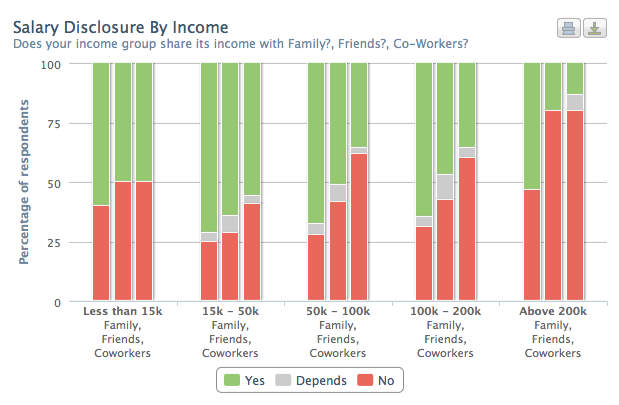
"Of course everyone in America thinks that they're middle class," Zaloom said. "But the only way that someone who makes $12,000 a year and someone who makes $200,000 a year can assume that they are all in the same social category is by never actually revealing what they make to each other."

(Graph from Marketplace's Public Insight Network query of 150 people.)

The Latest Ally Leaving Afghanistan

New Zealand just announced a withdrawal as quickly as possible. Though their contigent was small (less than 150 soldiers), their decision comes on the heels of similar announcements from France and South Korea. Since deploying to Afghanistan in 2001, ten Kiwi soldiers have been killed in the conflict, three in a roadside bomb attack last week. When the bodies of New Zealand's war dead are returned home, they are met with a traditional Maori war dance called a Haka:

Various actions are employed in the course of a [Haka], including facial contortions such as showing the whites of the eyes and the poking out of the tongue, and a wide variety of vigorous body actions such as slapping the hands against the body and stamping of the feet. As well as chanted words, a variety of cries and grunts are used. Haka may be understood as a kind of symphony in which the different parts of the body represent many instruments. The hands, arms, legs, feet, voice, eyes, tongue and the body as a whole combine to express courage, annoyance, joy or other feelings relevant to the purpose of the occasion.

New Zealand's military released a video of the funeral Haka performed for the three soldiers who were killed last week. It's a stirring scene:

Mental Health Break, Ctd

You can never win with some readers:

About "trying to be more sports-friendly": in one of the areas where US women have made the most progress in recent years, you posted a video with, perhaps, 3 women out of 40, for a total of around 6 seconds out of 6 minutes or so.  When you post clips like that, and when you respond to legitimate criticism of how you treated Sally Ride, I trust you do not still also wonder why there aren’t more women readers of the Dish.

Another takes the time to provide clips:

What about this video of Wilma Rudolph breaking the 200m world record in 1960, or this video of Brandi Chastain kicking the winning goal at the '99 World Cup, or of course this video of Kerri Strug landing that incredible vault in '96.

And from this year's Olympics, which the Dish covered extensively, there is this video of the US women's 100m relay smashing the world record, this video of Ye Shiwen beating Ryan Lochte's medley split, and this video from Gabby Douglas' historic performance, to name just a few.

Unconventional Bounces

Michael Barone notes that, while Republicans and Democrats both average five-point post-convention bounce, Dems have a higher degree of variation. However, the bounces can be deceptive:

Is there a correlation between the size of the bounce and the vote in November? Certainly there was for Clinton in 1992, and the no-bounce Democrats — McGovern and Kerry — both lost. But in five of the 12 races since 1964, the loser had the larger bounce.

Tom Holbrook goes into more detail:

Two things in particular seem to drive the size of the bumps. First, candidates who are running ahead of where they "should" be (based on the expected election outcome) tend to get smaller bumps, and those running behind their expected level of support get larger bumps. In this way, the conventions help bring the public closer to the expected outcome and help to make elections more predictable. A perfect example of this phenomenon is the 1964 conventions. Goldwater got a huge bump, in part because he was running 16 points behind his expected vote share, and Johnson got no bump, in part because he was running 6 points above his expected vote share prior to the Democratic convention.

John Sides adds his guess:

I would expect only small bumps for either party. Neither candidate is really polling above or below expectations at the moment. The fundamentals going into the race suggest an Obama victory, but by a relatively small margin — and that’s exactly where the polls are right now. Moreover, scheduling the convention late in the summer and back-to-back should mitigate their impact. And there is only a small number of self-described undecided voters, which may help explain why another high-profile event, the naming of Representative Paul D. Ryan as the running mate, has not really moved the national polls.

Purple Haze™

GT_MARIJUANABOTTLES_120823

Kal Raustiala and Chris Sprigman investigate whether marijuana brands can be trademarked:

First, names like Strawberry Kush are not necessarily brands, but more like plant varieties, such as Meyer lemon or Alphonso mangoes. Plant varieties in general cannot be trademarked. Instead, breeders essentially get a form of plant patent. … But other pot monikers – like “Charlie Sheen” – don’t refer to a plant variety, but to . . . well, how you might behave if you smoke it.  These labels could serve as trademarks – i.e., names or other symbols that identify the source of products.  But does what works for apples work for marijuana? In 2010, the federal Patent and Trademark Office created a medical marijuana category for trademark registration. After receiving a number of submissions, someone at the PTO—perhaps wise in the ways of Congress—thought better of this idea and killed it.

But as more states permit medical marijuana, Raustiala and Sprigman insist that "IP protection is sure to follow." With any luck, if sanity continues its winning streak on this, one day we'll have marijuana blends and crops as varied as wines – with different highs, emotions, tastes and after-effects. And some ancient, exhausted volcano of a blogger could get to end his life as a very mellow critic.

(Photo: A sample of various strains of medical marijuana in one-eigth ounce containers at PureLife Alternative Wellness Center on July 27, 2012 in Los Angeles, California. By Frederic J. Brown/AFP/Getty Images.)

The Welfare Weapon

The false claim that Obama is gutting welfare has clearly become Team Romney's attack of choice. Tom Edsall echoes Cohn in describing their logic:

Sharp criticism has done nothing to hold back the Romney campaign from continuing its offensive — in speeches and on the air — because the accuracy of the ads is irrelevant as far as the Republican presidential ticket is concerned. The goal is not to make a legitimate critique, but to portray Obama as willing to give the "undeserving" poor government handouts at the expense of hardworking taxpayers. Insofar as Romney can revive anti-welfare sentiments – which have been relatively quiescent since the enactment of the 1996 reforms – he may be able to increase voter motivation among whites whose enthusiasm for Romney has been dimmed by the barrage of Obama ads criticizing Bain Capital for firing workers and outsourcing jobs during Romney’s tenure as C.E.O. of the company.

In a recent WSJ interview, Steven Law, the president of Karl Rove's American Crossroads Super PAC, indicated their group was on board with the strategy:

Recent focus groups have convinced Mr. Law that the issue is "definitely resonating now with swing voters, including those who were Obama voters in 2008."

And yet, he adds, "We also picked up conflicting emotions: The economy is so lousy for middle-income Americans that the same people who chafe at the rise of welfare dependency under Obama don't automatically default to a 'get-a-job' attitude—because they know there are no jobs." Mr. Law concludes that welfare reform could be a "powerful issue to talk about this fall, but it needs to be done sensitively. Right now it may be more of an economic issue than a values issue: In other words, more people on welfare is another disturbing symptom of Obama's broken-down economy, rather than an indictment of those who are on welfare or the culture as a whole."

Ezra points to the racial effects of the ads:

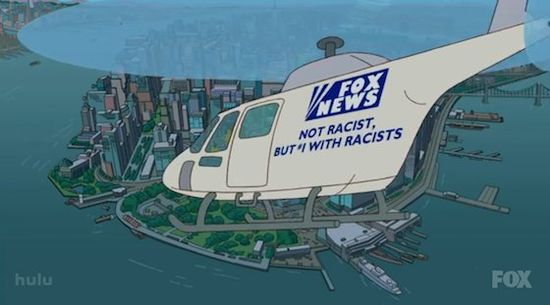
Romney’s welfare ads are not racist. But the evidence suggests that they work particularly well if the viewer is racist, or at least racially resentful. And these are the ads that are working so unexpectedly well that welfare is now the spine of Romney’s 2012 on-air message in the battleground states.

Which brings to mind this classic screenshot from the Simpsons:

SIMPSONSFOXNEWS

Champion Or Cheater … Or Both? Ctd

Buzz Bissinger mounts a vigorous defense of the cyclist:

I still believe in Lance Armstrong. I believe his decision had nothing to do with fear of being found guilty in a public setting before an arbitration panel, but the emotional and mental toll of years and years of fighting charges that have never been officially substantiated—despite stemming all the way back to 1999. "I am more at ease and at peace than I have been in 10 years," he told me in an exclusive phone interview with Newsweek.

Michael Specter, a former fan who wrote "my lengthy and adulatory Profile of Armstrong," feels betrayed:

He said he was tired of the fight. Tired? Really? Armstrong made it clear on several occasions he would fight to the death. (My favorite Lance quote about pain, clearly applicable to the accusations, is, "Pain is temporary. It may last a minute, or an hour, or a day, or a year, but eventually it will subside and something else will take its place. If I quit, however, it lasts forever.") Yes, quitting lasts forever. And he did not even have the decency to admit his guilt.

A silver lining to Armstrong's decision to quit the fight, via Buzz:

[B]etween Friday and the day before, the number of donors was up tenfold, the amount given up twenty-five-fold, and the amount of merchandise sold up two-and-a-half-fold.

Previous commentary here and here.

Character

Two thoughts about Ryan and Romney that have been buzzing around in my brain lately. The first is Ryan's response to the Akin matter, specifically his own name being on legislation built around the distinction between rape and "forcible rape". It was a legitimate question – "Should abortions be available to women who have been raped?" – and it gave us a revealing answer:

Ryan: "I’m proud of my pro-life record. And I stand by my pro-life record in Congress. It’s something I’m proud of. But Mitt Romney is the top of the ticket and Mitt Romney will be president and he will set the policy of the Romney administration."

KDKA Political Editor Jon Delano: "You sponsored legislation that has the language 'forcible rape,'" Delano noted. "What is forcible rape as opposed…"

Ryan: "Rape is rape. Rape is rape, period. End of story."

Delano: "So that forcible rape language meant nothing to you at the time?"

Ryan: "Rape is rape and there’s no splitting hairs over rape."

Notice how he didn't answer the question – on a matter he regards as one of conscience. Ryan is proud of a pro-life record that split hairs on rape and yet in the same answer says we shouldn't split hairs on rape. When challenged, he simply reiterates his new line. I'm inclined to believe in Ryan's sincerity on ending all abortion, but if he cannot back up his own previous positions or even explain why he has changed them, he is not a breath of fresh air; he is a halitosis-ridden belch. When it comes to risking political capital over a matter of moral principle, Ryan morphed immediately into Romney, an opportunist. Not a good sign – but not unexpected in an alleged deficit hawk who torpedoed the only, serious bipartisan chance for real reform in Bowles-Simpson.

Then Romney. I have no problem with his being rich – hugely rich in ways that ultimately cannot even be spent in one lifetime. Good for him. But if I earned $25 million a year for doing nothing, I don't think I'd be still ruthlessly, fanatically ensuring that no unnecessary taxes were paid on any single cent of it. It takes an army of accountants to do what Romney did: maximize to the most comprehensive degree a fortune of over $250 million to make sure it doesn't in any way go to the public purse.

Getting rich is one thing – and is nothing to be ashamed of, if achieved by honest hard work. But how you treat that money also matters. Romney has been very generous toward his church – and deserves huge credit for it. But the tax minimization? For someone who has more money than God? It's not a virtue in my book. It's greed.