
Chrissos, Greece, 9 am
Chrissos, Greece, 9 am
Daniel McCarthy expects the GOP coalition to come unglued:
Earlier this week the New Yorker’s John Cassidy asked, "Where are the real conservative intellectuals?" The short answer is that "conservative" once signified an intellectual tendency with partisan overtones, now it signifies a partisan tendency that would prefer not to have intellectual overtones — there are no votes in that….
The wings of the GOP coalition over the last half-century have not primarily been separated by "issues" social or economic; they were separated by class markers and style. The ideological differences were secondary to those. But now there’s a politically and economically successful, if brain dead, fusion of the classes. The rich sound like the poor, and the poor angrily demand policies that favor the rich. The only problem for the GOP is that external conditions — the real-world economy and the distaste younger people have for the Baby Boomers’ version of the Republican Party (and their version of Christianity) — are eventually going to overpower this mercenary fusionism.
The anti-intellectualism allows for Paul Ryan's little learning and huge gambles to seem temporarily smart. Dreher's take:
[I]t seems to me that conservative intellectuals have become so fossilized as a class because they responded to the two devastating shocks to the Standard Conservative Model by essentially doubling down on ideology. Just say the same old things, but louder and more insistently, and rely on tribalist instincts and hive-mindedness to marginalize dissenters, and that will carry the day. That, and the fact that liberalism hasn’t come up with a dynamic and compelling vision either for the post-Iraq, post-crash world — that is, a post-1980 world in which assumptions generally shared by both parties about American foreign policy and globalized capitalism have proven inadequate to the world as it is.
The song "Gangnam Style" (a former Mental Health Break), performed by Korean pop-artist Park Jaesang (aka Psy), has become a world-wide sensation, racking up 52 million views on YouTube in just over a month. Back home, however, the song has a hidden message, as Max Fisher explains:
Gangnam is a tony Seoul neighborhood, and Park's "Gangnam Style" video lampoons its self-importance and ostentatious wealth, with Psy playing a clownish caricature of a Gangnam man. That alone makes it practically operatic compared to most K-Pop. But I spoke with two regular observers of Korean culture to find out what I was missing, and it turns out that the video is rich with subtle references that, along with the song itself, suggest a subtext with a surprisingly subversive message about class and wealth in contemporary South Korean society. That message would be awfully mild by American standards — this is no "Born in the U.S.A." — but South Korea is a very different place, and it's a big deal that even this gentle social satire is breaking records on Korean pop charts long dominated by cotton candy.
The subtext includes such themes as Korea's massive credit card debt, the country's trust-funders, and their adoring poseurs. And then there's the focus on coffee:
Psy boasts that he's a real man who drinks a whole cup of coffee in one gulp, for example, insisting he wants a woman who drinks coffee. "I think some of you may be wondering why he's making such a big deal out of coffee, but it's not your ordinary coffee," U.S.-based Korean blogger Jea Kim wrote at her site, My Dear Korea. (Her English-subtitled translation of the video is [here].) "In Korea, there's a joke poking fun at women who eat 2,000-won (about $2) ramen for lunch and then spend 6,000 won on Starbucks coffee." They're called Doenjangnyeo, or "soybean paste women" for their propensity to crimp on essentials so they can over-spend on conspicuous luxuries, of which coffee is, believe it or not, one of the most common.

From my ever-sane and long-suffering hubby. Happy 5th Anniversary.
The American Academy of Pediatrics is now pro male genital mutilation [NYT]. Full report here. Yair Rosenberg celebrates:
The importance of this cannot be overstated. The AAP is a driving force behind health policy in America, and the experts involved in its new statement are already going on record in major media outlets to advocate that circumcision be covered on public health plans like Medicaid. The statement solidifies the scientific consensus behind the advisability of infant male circumcision (noting that complications are more likely to arise when the procedure is performed later in life) and places the traditional practice squarely within the realm of sound medical science.
The main advantage of permanently mutilating the infant penis is that studies claim to have shown that the subsequent scar tissue helps prevent HIV-infection from woman to man in heterosexual sex. This is a major issue in Africa, but is far less common in the US. Some details from the NYT:
Circumcision does not appear to reduce H.I.V. transmission among men who have sex with men, Dr. Diekema said. "The degree of benefit, or degree of impact, in a place like the U.S. will clearly be smaller than in a place like Africa," he said. Two studies have found that circumcision actually increases the risk of H.I.V. infection among sexually active men and women, the academy noted.
Other studies have linked male circumcision to lower rates of infection with human papillomavirus and herpes simplex Type 2. But male circumcision is not associated with lower rates of gonorrhea or chlamydia, and evidence for protection against syphilis is weak, the review said.
The Times also estimates that around 117 infant boys die in mutilation procedures in the US per year. So mercifully, the report is not as clear-cut as Rosenberg wants it to be. It doesn't mandate routine circumcision as has happened in the past – instead placing it clearly as an elective procedure to be decided by the parents. That would still mean millions of human beings involuntarily mutilated in ways that dull their sexual sensitivity for a small gain in not getting HIV from a woman – proven only in Africa under radically different circumstances.
I remain of the view that this is best decided by the human being whose body is being permanently mutilated – before he becomes sexually active. But the religious and cultural traditions are too deep to be banned in a free society. My goal is simply to raise awareness of this residual barbarism and its minimal benefits. Fortunately the numbers are dropping:
[R]oughly 79 percent of newborn boys had their biologically bestowed foreskins snipped and discarded like toenails [in the '70s and '80s]. Through the 90s, it seemed, America was averse to foreskin. In one famous Seinfeld episode, Elaine turned her nose up at the thought of an uncircumcised pecker, complaining that it "lacked personality" and "looked like a Martian." But rates had begun a freefall in the late 80s, due in part to the growing population of immigrant Hispanics who are less likely to circumcise their children, according to a 2007 CDC study. By 1999, the frequency had dipped to 63 percent—the same year the AAP, in its previous policy report, voiced a neutral stance on the procedure’s health benefits. Eighteen states have since eliminated Medicaid coverage for circumcision, a change that both the AAP and John Hopkins researchers say has largely contributed to an even further dip in the rate of the procedure. Today, fewer than 55 percent of newborn boys go under the knife.
Adam Frucci calls Fretter's analysis "god-awful":
One of the biggest problems with the piece, beyond its basic premise being completely flawed, is that the author seems to know very little about contemporary comedy. The whole thing is pegged to the death of Diller, and the main example used throughout is Tina Fey's Liz Lemon. But has Fetters watched any other comedies on TV besides 30 Rock? The women in, say, Community and Parks and Rec do nothing to play down their beauty, and are incredibly funny despite (?) this fact. After a season of TV in which it seemed that female leads in comedies were becoming the norm, it's amazing that someone could actually make the argument that funny women are all trying to look ugly, and that pretty women can't find success in comedy.
The biggest new hit comedy of the season was New Girl, and you'd be hard-pressed to find someone to argue that Zooey Deschanel was trying to look ugly in that. Or Kat Dennings and Beth Behrs were in 2 Broke Girls. Or Whitney Cummings was in Whitney. Or Sophia Vergara and Julie Bowen were in Modern Family. And so on — I could easily list over a dozen of other beautiful, funny women in comedies on network TV. Hell, she uses the example of Kristen Wiig in Bridesmaids as a beautiful women who made herself ugly in order to get laughs. Did we watch the same movie?
Update from a reader with more examples:
What about Sarah Silverman? Rita Rudner? Julia Louis-Dreyfuss? Chelsey Handler? When Diller started, it may certainly have been true that a woman needed to play down her looks to succeed in comedy. I would venture to guess that's not the case anymore.
A slew of fragmented jottings – most of them pithy, some of them cryptic – that Hitchens left unfinished when he died are being published as the ultimate chapter of Mortality. David Plotz reproduces some here, along with his selective annotation. A few excerpts:
Now so many tributes that it also seems that rumors of my LIFE have also been greatly exaggerated. Lived to see most of what's going to be written about me: this too is exhilarating but hits diminishing returns when I realize how soon it, too, will be "background."
Another:
I'm not fighting or battling cancer—it's fighting me.
Another:
If I convert it's because it's better that a believer dies than that an atheist does.
In Mortality's afterword, Hitch's wife, Carol Blue, remembers her husband:
I miss his perfect voice.
I heard it day and night, night and day. I miss the first happy trills when he woke; the low octaves of “his morning voice” as he read me snippets from the newspaper that outraged or amused him; the delighted and irritated (mostly irritated) registers as I interrupted him while he read; the jazz-tone riffs of him “talking down the line” to a radio station from the kitchen phone as he cooked lunch; his chirping, high-note greeting when our daughter came home from school; and his last soothing, pianissimo chatterings on retiring late at night.
I miss, as his readers must, his writer’s voice, his voice on the page. I miss the unpublished Hitch: the countless notes he left for me in the entryway, on my pillow, the emails he would send while we sat in different rooms in our apartment or in our place in California and the emails he sent when he was on the road. And I miss his handwritten communiqués: his innumerable letters and postcards (we date back to the time of the epistle) and his faxes, the thrill of receiving Christopher’s instant dispatches as he checked-in from a dicey spot on some other continent.
I miss his jokes.
I'm afraid the prospect of nine hours of live-blogging propaganda fills me with some dread. But Hanna Rosin defends the spectacle:
Look, most Americans pay no attention to politics, and then comes the convention, and then it's like a pageantry, and that's as interesting as politics is going to get. I feel it's slightly bogus when political reporters say things like, "Oh, no policy happens." Like you were going to write about policy if it did happen? All you do is write about image and message for the entire year and then the convention comes and you complain because it's only about image and message.
Mike Murphy wants to cut down the event:
[T]he candidate’s acceptance speech is a huge deal with a big audience and a powerful impact. Along with the three fall debates, the convention speech is one for the four single most important hours of the entire campaign. So keep the two big TV speeches. But do we really need four days – three if you decide to hold it in the Gulf during hurricane season – to get there? Do we really need the droning and unwatched speech by the guy who lost or the first-ever Laotian-American Republican State Representative or the union howler who is a teleprompter to predictable outrage over the other parties’ entitlement plan? Why not cut it all down to the commercial it is and focus just on the stars?
Jonathan Bernstein argues that the conventions are worth saving simply "because both a democracy and its political parties need rituals, and we really don’t have that many left":
Indeed, the rise of the parties over the last 30 or 40 years has been accompanied not by renewed and updated rituals but by a political culture that continues to demand we vote the person and not the party and which considers independent voters to be superior to partisans. Against that, the funny hats, the balloon drops, the roll call of the states and the rest of it aren’t much … but at least they’re something. Until someone can come up with good 21st century customs and rituals appropriate to our modern parties, I’m all for hanging on to what we have – and so I’m very glad that the conventions have survived 40 years after their original political function was stripped from them.
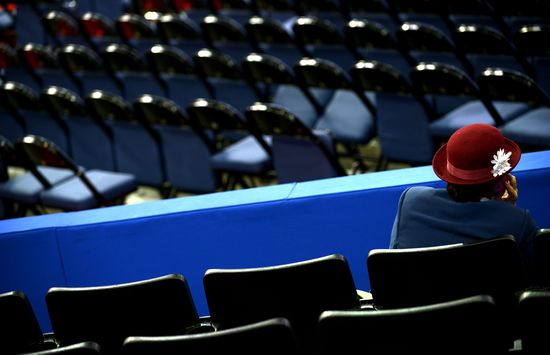
(Photo: A woman sits in the bleachers at the Tampa Bay Times Forum, in Tampa, Florida, during last preparations for the opening of the Republican National Convention on August 27, 2012. By Brendan Smialowski/AFP/Getty Images)

From a terrific slide-show of "bear culture" at the NYT in the photographs of Alan Charlesworth, written up by Peter Moskowitz. This one is of John and Gary at the Bear Tea Dance in Provincetown, 2010. More here.
In a must-read editorial, The Economist hasn't a clue:
Mr Romney may calculate that it is best to keep quiet: the faltering economy will drive voters towards him. It is more likely, however, that his evasiveness will erode his main competitive advantage. A businessman without a credible plan to fix a problem stops being a credible businessman. So does a businessman who tells you one thing at breakfast and the opposite at supper. Indeed, all this underlines the main doubt: nobody knows who this strange man really is. It is half a decade since he ran something. Why won’t he talk about his business career openly? Why has he been so reluctant to disclose his tax returns? How can a leader change tack so often? Where does he really want to take the world’s most powerful country?
 The Dish
