Romney Has Long Had Willke’s Endorsement In 2012

In fact, according to Willke, the inventer of the raped-women-don't-get-pregnant thesis, the two are close:

Dr Willke told The Daily Telegraph that he did meet Mr Romney during a presidential primary campaign stop in the doctor's home city of Cincinnati, Ohio, in October last year. Local news reports at the time noted that the candidate held "private meetings" during the visit.

"He told me ‘thank you for your support – we agree on almost everything, and if I am elected President I will make some major pro-life pronouncements’," Dr Willke said in a telephone interview on Tuesday. "I thanked him, and said I knew where he was – that he was 99 per cent of what we wanted," he said of the roughly ten-minute meeting. "I told him I would help in any way I could". A spokesman for Mr Romney declined to comment.

Someone needs to ask the Romney campaign whether they stand by their embrace of the man Todd Akin is being ostracized for.

Hewitt Award Nominee

"[President Obama is] going to try to hand over the sovereignty of the United States to the (United Nations), and what is going to happen when that happens? I'm thinking the worst. Civil unrest, civil disobedience, civil war maybe. And we're not just talking a few riots here and demonstrations, we're talking Lexington, Concord, take up arms and get rid of the guy. Now what's going to happen if we do that, if the public decides to do that? He's going to send in U.N. troops. I don't want 'em in Lubbock County. OK. So I'm going to stand in front of their armored personnel carrier and say 'you're not coming in here'," – Judge Tom Head of Lubbock County, Texas.

Sometimes it feels to me as if this campaign – with its entrenched support for both sides so dominant and the space for actual persuasion so minimal – is less a campaign than a cold civil war. Almost exactly along the same regional and racial lines as the real one.

Chart Of The Day

Household

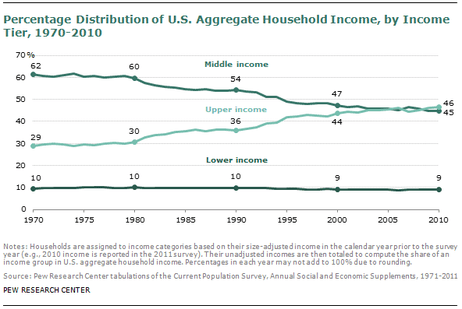
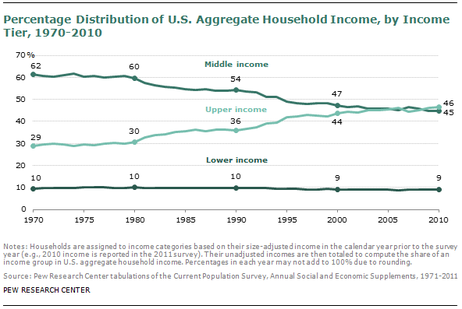
Eyder Peralta points to a new Pew study that finds the middle class "poorer, earning less and shrinking." For example:

[I]n 1970, the middle class held 62 percent of the income in the country. The upper income held 29 percent. Those numbers have now flipped: The middle class is at 45 percent and the upper income class is at 46 percent.

Lessons From Obamacare

David Cutler's perspective on Ryan's Medicare voucher system:

Supporters for the Romney-Ryan approach to Medicare have a new talking point. They say a new study by “three liberal Harvard economists” proves that the plan’s competition will reduce health care costs without harming beneficiaries. But the study doesn’t say that. And I should know. I’m one of the economists who wrote it.

Cutler views Obamacare as a test for seeing how vouchers, sometimes called "premium support," might work:

At the very least, it makes sense to see how premium-support works in the non-elderly population, since their health needs overall are less severe. The Affordable Care Act does that, by creating “exchanges” for people who don’t have employer-sponsored coverage. Watching and learning from that initiative would help in designing a workable system for the elderly. That is why, on many counts, the biggest lesson is that allowing the Affordable Care Act to work—rather than trying to take it off the books—might be the best way for premium support to succeed.

Totes Dangerous

Bans and taxes on plastic bags have produced some unpleasant consequences:

In research carried out at PERC this summer, Jonathan Klick, a PERC Lone Mountain Fellow, argues that reusable grocery bags contain potentially harmful bacteria, especially coliform bacteria such as E. coli. Klick finds that, in the wake of San Francisco’s ban, deaths and ER visits related to these bacteria spiked as soon as the ban went into effect.

The Real Red Scare

Pointing out that China's economy is rapidly slowing and that its "once-in-a-decade leadership tranisition…has not been going smoothly," Patrick Chovanec underscores legitimate concerns about China:

[F]ears of an unstoppable Chinese juggernaut are misplaced or outdated.  What we really should be worried about is a China that is stumbling badly and doesn’t know what to do next.

Meanwhile, Stan Abrams sighs about the Republican ticket's calling for a more "aggressive stance" on China:

Ryan has signed on to Romney’s team, and as such, he’s stuck playing the same game. That means trying to simultaneously use China bashing as  a populist lever on the campaign trail, while at the same time, in those fund raisers and in meetings with campaign donors, reassure the business community that they really don’t mean what they say.

Brent Budowsky notes a particular irony: Sheldon Adelson has contributed at least $35 million to the GOP this year and is under investigation for his dealings with the Chinese government.

A World Without Blemished Fruit, Ctd

A reader writes:

Your reader who insists that all apples are tasteless is clearly going to the wrong grocery stores. Red and golden delicious are disgusting, it's true, but there are many popular varietals that are both cheap and have excellent flavor and texture. Jazz, Fuji, and Pink Ladies are some of my favorites; newer (and more expensive) breeds like Envy and Honeycrisp are truly delicious. And none of these require one to make a trip to Whole Foods; I can find most of them at my local Safeway, or even Wal-Mart. My point is, it's a good time to be an apple-lover.

Another writes:

I don't know what your correspondents are talking about: when I was a kid in the '60s and '70s, our local grocery stores had red delicious and yellow delicious – period.  Now, I see Granny Smiths, Fujis, occasionally Pippins and Newtons, and sometimes varietals I don't recognize. 

The hothouse tomatoes – which I presume are really lousy from an environmental standpoint – are better than any other tomatoes I have ever found, including from my mothers' garden.  (And I, heretically, find the heirloom tomatoes I have tried to be bland.)

It is possible that some of the difference is in the location and/or type of store: a white-bread grocery store in Illinois obviously isn't going to match up with a gourmet store in California, but a) I don't think the gourmet grocery stores even existed in the 60s and 70s, and b) even at IGAs in British Columbia, I can find all manner of apples. People talk about how the good old days were so much better, and I frequently wonder which good old days they are talking about …

Another:

Michael Pollen's The Omnivore's Dilema points the finger at McDonald's and other huge demand users of tomatoes and iceberg lettuce as the root of the problem. I will make the point that McDonald's is the perfect customer for tasteless tomatoes and junk food lettuce. The flavor of a tomato can't possible be singled out in a bite of a McDonald's burger, so why should it even have flavor, never mind be required to taste good. And let's face it, shredded iceberg lettuce isn't meant to taste like anything, it's a filler. Might add some crunch or texture if eaten immediately, but for those who pick up at the window, it's compost by the time to open the cardboard container at home.

This mentality of quantity over quality has become an American mantra. Fifty years ago we didn't need an organic classification for food. Now there needs to be organic labeling, labels for genetically modified foods, artificial foods, flavor enhancers, fake coloring, and we've not even started the debate regarding "light" alternatives, and my favorite meaningless adjective on way too many packages, "natural."

Growing you own, and buying organic and locally grown isn't a trend. It's a necessity if you have any real appreciation for food and flavor, as well as eating a healthy diet. Shopping the local big box grocery, ignoring any organic offering they present, and buying cheap, as well as loading up the cart with all the ready-made processed frozen and the new scary stuff that's not even refrigerated, is for the self-loathing. This is the same consumer who's throwing away 40% of what they buy.

Moral of the story: convenience and fast food is the most expensive way to eat poorly.

Another:

"The fact that apple consumption has been on the decline for decades" is because there is no such thing as "apple" on the shelves of 99 percent of US supermarkets. The "closest science has come to creating the perfect apple specimen" could be found down the street in southern France at the daily and open produce market where you can find everything form Fuji to Ariane … oh yes, that delicious French variety developed at the National Institute of Agricultural Research only a decade ago. But it’s blemished, it turns brown immediately if cut, it lasts only for a few days, maybe a week. But oh it smells so good, and it tastes and it melts in your mouth like Ariane should every single time. Like real apple should. That is the perfect fruit – that lost natural seed cultivated and loved and enhanced by skilled farmers for centuries who use the lab to preserve them, not "perfect" them.

The difference is that the French – the biggest agricultural producers in the EU – remain intimately tied to their soil. The one bloody thing they do right.  And as the economist once said, farming is everything that complex financial capitalism is not. And it could never be.