Behind The Hate

by Chris Bodenner

Wade Michael Page, the Sikh temple shooter, was very active in the hate rock scene. Randy Blazak, a sociologist who specializes in the white-supremacist subculture, delves into the dark history:

[Hate rock's] heyday … roughly spanned the mid-90s. In its first three years of operation, Resistance was selling nearly Wade-page100,000 CDs and cassette tapes a year. Spurred by Burdi’s success, several record labels like Panzerfaust and Label 56 began to make the music available to the world via the largely anonymous marketplace of the internet. While skinhead bands sometimes struggled to find audiences in the U.S., they found legions of fans in Europe. The aftermath of the Cold War found many young Europeans clamoring for nationalism and an outlet for anti-immigrant hate, creating a concert market for American hate rock bands.

In musical terms, the central irony of hate rock is that it is fundamentally black music.

Anchored in the 12-bar blues, the music of white supremacy is, formally speaking, a tribute to Chuck Berry as much as anything else. But such irony is lost on most hate rockers, or at least it’s beside the point. (Just try to explain to a neo-Nazi fan of Gaelic music that the Irish were not considered “white” a hundred years ago.) Their goal is simple: to express the alienation and frustration of straight white males who feel the loss of their special rights and privileges, using the most hyper-masculine, aggressive mode available to them.

Andrew Kirell captions the above image:

[A] shot of Page playing guitar with what appears to be a replica of a flag with the German Eagle coat-of-arms used during the Nazi regime. … Page indicated he went to the Hammerfest 2000 in Georgia, which was an annual "hate rock" festival organized by a skinhead group. "That’s when I joined Youngland," he said. Slate‘s Dave Weigel reports that was a white power band with lyrics like: "Stand one stand all, stand up, stand proud/and raise the white man’s flag."

Update from a reader:

I just wanted to point out that the photo in this post shows a member of a Hate Rock group wearing what is clearly a t-shirt with the iconic Corrosion of Conformity emblem. I'm friends with some of the COC guys and readers should know that they have absolutely nothing to do with Hate Rock in any context and would be appalled if anyone seeing this image thought to link them to the genre.

Thanks for the heads up. I've swapped out that image with another highlighted in Kirell's post.
Behind The Mask

by Matthew Sitman

Gopnik believes that class, rather than faith, is at Mitt Romney's psychological core. I'm not so sure. As Gopnik concedes, faith does impact how a person views wealth and success. Why shouldn't we prioritize the specific religious motivation for that? For Romney, the theological thrust of Mormonism really could be behind his temporal pursuits. Accumulation – of land, wives, and wealth – stretches back to Mormonism's beginnings; we don't need to bring in the amorphous formulation of "American tycoon" to explain this.

But more importantly, and despite the amount of press it has received, wealth is not the most interesting facet of Mitt Romney. Many wealthy men have run for the presidency. While Romney might be especially rich, and use that money in ways easy to poke fun at, its not surprising that a wealthy man is the Republican nominee. Romney's personality tics are far more arresting – particularly the massive inability to handle criticism and the shamelessness, opportunism, and ease with which he changed positions over the years. Those, and not his wealth, are what stand out. This pattern has all the marks of a disposition shaped by a religion that has been notably wary of criticism from its start, as well as an understanding of doctrine that, as Gopnik notes, has built within it the ability to shift stances in a moment's notice. When the Mormon President, the church's "prophet, seer, and revelator," speaks, what Mormons are required to believe changes. Mormonism is the Etch-a-Sketch American religion. Whatever you make of it, I think it tells us as much as we are likely to know about Romney's inner life.

Ask Jesse Bering Anything: Why Is The Penis Shaped Like That?

by Zoë Pollock Jesse Bering has a new collection of essays out, Why is the Penis Shaped Like That? And Other Reflections On Being Human. From a snippet of Rose Lichter-Marck’s review:

The book is a compendium of topics normally greeted with skittishness or repulsion. Premature ejaculation, autofellatio, the chemical properties of human semen, cannibalism, masturbation, female orgasm, suicidal thoughts, pedophilia, zoophilia, foot fetishism—nothing is taboo. Bering’s goofy sense of humor makes these concepts easier to digest. The book is studded with puns and self-deprecating asides about Bering’s own sex life, among them tales of his own attempts to self-fellate, musings about how simpler life would be if he could love dogs to the extent that he could “dispense with all those emotional encumbrances that come with being attracted to” another human and settle down with “a sassy little bitch,” and the confession that as a gay man, the female orgasm seems “exotic and foreign . . . like decorative basket weaving in a small African village.”

We’ll feature the rest of Jesse’s video starting August 20th. Nicholas Blincoe picks some more cocktail conversations starters in his recent review:

Did you know, for instance, that sperm contains antidepressants, and so unprotected sex leaves one with a pleasurable glow that condoms simply cannot deliver? Bering is an evolutionary psychologist, which means that he views all human behaviour as the result of tiny adaptations that brought benefits to our primitive ancestors. To follow him, one has to believe that all the patterns of our life were laid down in the days of the cavemen so that, for instance, running for a bus is the same as running after a mastodon or, to use one of Bering’s examples, our predilection for night-time sex evolved because our ancestors lived in equatorial regions and our sperm would have been damaged in the daytime heat.

Also, Jesse is manning Savage Love while Dan is on vacation for the next two weeks. From his response to a “Girl with Commitment Issues”:

You’re confusing monogamy with love and happiness. These things don’t go hand-in-hand—not for every couple, at least. There’s absolutely no reason why you need to sacrifice your non-monogamous sex life for marital bliss and everything positive that goes along with that, such as having a best friend as your spouse and maybe even having children. There are legions of good men, some of whom you’ve probably left in the dust before bothering to have this conversation with them, who feel just as you do about monogamy being incompatible with their needs.

More Jesse Bering on the Dish here, here, and here. “Ask Anything” video archive here.

AWOL Olympians

by Patrick Appel

Alexandra Evans notices that eight Olympic athletes (seven from Cameroon, one from Ethiopia) have gone missing:

The Guardian speculates that the athletes were motivated to escape the Olympic Village for economic reasons and aim to remain within the European Union. Such disappearances are unfortunately not unusual at international sporting events. After 26 athletes sought asylum during the 2006 Commonwealth games in Melbourne, Australia, nine athletes from Sierra Leon, Tanzania and Bangladesh disappeared from the 2009 tournament. Not all seek legal residence, however, and in 2011, 15 Ethiopian athletes disappeared from the All African Games in Mozambique, a regional hub for illegal immigration. They were rumored to have fled to South Africa in search of employment.

The Dumb Jock Shtick

by Patrick Appel

Noreen Malone labels Ryan Lochte a "himbo":

Lochte is not as dumb as he’s playing on TV. Setting aside the unavoidable fact that elite athleticism requires intelligence: Any competitive swimmer does plenty of mental math to calculate his splits in practice every single day. Lochte knows his multiplication tables. Look at the gleam in his eye, and the expectant way the reporter asked the question. He also knows his brand—and that brand is himbo. As Lauren Bans explained in GQ recently, “It’s not like idiots only recently became amusing. But none of them were quite as blatantly objectified as today’s himbos. We’ve been building toward this moment, and now we’ve fully embraced the existence of the insipid-on-the-inside, bronzed-on-the-outside male sex object. Turning on the TV these days is kinda like being at a bachelorette party. Never have the lusting-for and laughing-at impulses blended so seamlessly.”

Too Interconnected To Fail

by Gwynn Guilford

Mark Buchanan thinks Google's PageRank algorithm could help prevent financial crises. PageRank "works on the notion that Web pages effectively vote for other pages by linking to them" and the most important  pages "should be those drawing links from many other pages, especially from other really important ones." How this relates to the financial industry:

The systemic risk that turned the U.S. subprime-lending crisis into a global disaster is circular, too. We can’t identify it simply by looking for the banks with the most assets or the biggest portfolios of risky loans. What matters is how many links a bank has to other institutions, how strong those links are and how risky those other banks are, not least because they too have links to other risky banks.

Apparently, European physicists and scientists have actually modeled something similar called DebtRank. Buchanan flags some surprising revelations:

At the peak of the financial crisis, in November 2008, for example, DebtRank scores for the largest 20 or so banks show that simple bank size isn’t as important as we have come to think. Institutions such as Barclays Plc, Bank of America Corp., JPMorgan Chase & Co. and Royal Bank of Scotland Group Plc presented more systemic risk than did Citigroup Inc. or Deutsche Bank AG, despite being significantly smaller in total assets. Wells Fargo & Co. stands out even more: It presented as much systemic risk as Citigroup, despite having only a quarter of the assets.

This lines up with the argument that it's interconnectedness – and not "bigness" – that creates the "too ___ to fail" problem. However, did Wells Fargo really present as much systemic risk as Citigroup? Maybe it did, but the fact of its retail focus – it didn't have an investment bank arm until it bought Wachovia in December 2008 – might suggest a distortion in the metrics (a quick look at the report shows that the period analyzed was March 2008-2010, but Wachovia is still a separate DebtRank node).

Vintage Motivation

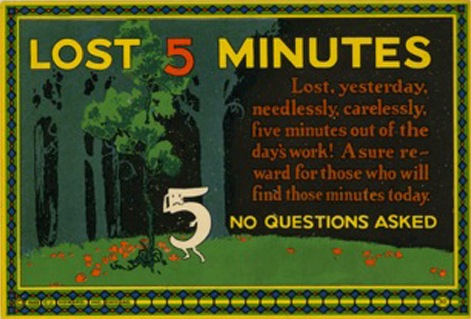
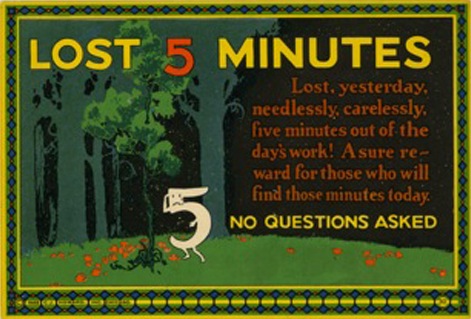
Lost_Minutes

by Zoë Pollock

Steve Heller uncovers some:

"Keep Calm and Carry On" is the most famous motivational poster, with "Tomorrow is the First Day of the Rest of Your Life" coming in at a close second. But back in the 1910s through the Depression-era 1930s, motivation was in its golden years. How did industrialists and business leaders get the most productivity out of their workers? Not through cost-of-living increases or profit sharing or unexpected bonuses—but through a barrage of motivational sayings.

Follow up here.

The World Runs On Coal

by Patrick Appel

Robert Bryce says "it’s obvious that coal will be powering the global economy for many decades to come":

[E]ven if the EPA and the Obama administration succeed in prohibiting new coal-fired electricity generation in the United States, they will leave global coal demand and CO2 emissions almost unchanged. Over the past decade or so, American coal consumption fell by 5 percent, but global coal consumption soared, growing by about the same amount as the growth in oil, natural gas, and nuclear combined.

Coal now fuels about 40 percent of global electricity production. Coal’s dominance helps explain why global CO2 emissions rose by 28.5 percent between 2001 and 2010, even as American CO2 emissions fell by 1.7 percent. Over the past decade, even if American emissions had dropped to zero, global emissions would still have increased.

Bryce admits that coal is a dirty energy source but he argues that we should embrace our coal dependence because "the EPA’s rule simply encourages domestic coal producers to ship more of their product to overseas electricity producers, who will happily burn it." Reihan adds:

This is one reason why resistance to increased natural gas production is so potentially problematic: it undermines the most readily accessible low-carbon alternative to coal.

Fallows's article from a few years back on our desperate need for cleaner coal is worth re-reading. Fallows follow up here.

Facebook-o-nomics

by Patrick Appel

Felix Salmon thinks going public has made Zuckerberg a less effective CEO. Frum connects Facebook's recent stock slump to the company's disrespect of user privacy:

[T]rust is an asset that every company should value — especially one that earns money by counting its own clicks. Today, as a question is raised about Facebook's advertising numbers, many of us think: "Gee, whom should I believe? This advertiser I'd never previously heard of? Or Facebook, a company that so often acts in ways that I personally find unethical?"

Facebook is infinitely more important culturally than it is economically. The company may deserve to be worth hundreds of billions, but, in the digital age, there is an increasing disconnect between a website's social and economic clout. The incredible story in the video above, about a man who lost his memory using the "people you may know" function on Facebook to reclaim it, is an extreme example of Facebook's power. But reclaimed memories don't show up on a balance sheet.

Liberating The English Language

by Matthew Sitman

On June 30, the Queen's English Society, "committed to protecting the language from declining standards," came to an end. VR Narayanswami applauds the demise of the language police:

What detractors of prescriptivism object to is the attempt by individuals to impose artificial and arbitrary rules on usage. A rule should be seen as a codification of existing practice. Grammarians point out that prescriptivists create such controversies by trying to fit English structure on to a Procrustean bed of Latin grammar. The history of English shows that language changes under the influence of good writers and speakers, not of academies of the French model.