"The demographics race we’re losing badly. We’re not generating enough angry white guys to stay in business for the long term," – Lindsey Graham.
Month: August 2012
The Digital Natives Are Restless
Teachers Jody Passanisi and Shara Peters notice that, for a kid, being a digital native isn't always an advantage when it comes to learning:
We [adults], as "digital immigrants," remember writing research papers by reading through piles of journals, books, and archives of periodicals. When we approach online research, we realize how revolutionary the Internet is because we know what it was like before. We then apply those research techniques to online search engines, and find our tasks much easier to complete. Our students have no frame of reference of a "pre-Internet" world. They are accustomed to working with intuitive electronics that provide instant gratification, and when they are not able to be "done" quickly, they tend to become discouraged.
They go on to explain a project they gave their 8th graders which involved using a non-intuitive online tool:
We thought that since our students were digital natives, this would be no problem, and they would be able to figure it out. Oh, were we mistaken. After quelling the near mutiny that ensued, quieting the chorus of “I don’t get it” and “mine doesn’t work,” and helping to calm down our students, we realized that we had misunderstood the concept of digital natives. All technology was not created equal for access by these students, and their proficiency is often predicated by the amount of patience and determination required to complete a given task.
How Hollywood Is Hurting Itself
David Pogue is baffled by the crappiness of online movie rentals:
[W]hen you rent the digital version, you often have only 24 hours to finish watching it, which makes no sense. Do these companies really expect us to rent the same movie again tomorrow night if we can't finish it tonight? In the DVD days, a Blockbuster rental was three days. Why should online rentals be any different? When you rent online, you don't get any of the DVD extras—deleted scenes, alternative endings, subtitles—even though you're paying as much as you would have paid to rent a DVD.
Yet perhaps most important, there's the availability problem. New movies aren't available online until months after they are finished in the theaters, thanks to the "windowing" system—a long-established obligation that makes each movie available, say, first to hotels, then to pay-per-view systems, then to HBO and, only after that, to you for online rental.
Because of that, Pogue argues that Hollywood is its own worst enemy when it comes to piracy:
The people want movies. None of Hollywood's baffling legal constructs will stop the demand. The studios are trying to prevent a dam from bursting by putting up a picket fence. And if you don't make your product available legally, guess what? The people will get it illegally. Traffic to illegal download sites has more than sextupled since 2009, and file downloading is expected to grow about 23 percent annually until 2015. Why? Of the 10 most pirated movies of 2011, guess how many of them are available to rent online, as I write this in midsummer 2012? Zero. That's right: Hollywood is actually encouraging the very practice they claim to be fighting (with new laws, for example).
A Better Way To Repay?
Stephen Burd wants a new student loan system:
We could follow the lead of countries like Australia, New Zealand, and the United Kingdom and create a single student loan repayment system that is entirely based on a borrower’s future income. Under such a program, employees with federal student loans would see a portion of their income withheld by their employers and used to pay down their debt, much as they see payroll taxes withheld today.
Self-employed borrowers would use a simple schedule on their federal income tax forms that would tell them how much they owed on their federal student loans. When a borrower’s adjustable gross income went up or down, so would their monthly payments, with the only enforcement mechanism needed being the Internal Revenue Service. Defaults would be virtually eliminated, along with the need for the government to spend tax dollars on collection agencies. Borrowers with high incomes would simply pay off the loans more quickly than those with low incomes. (For answers to questions critics of ICL raise, see "Answering the Critics of ‘Pay as You Earn’ Plans")
Bringing The Tropics To Suburbia
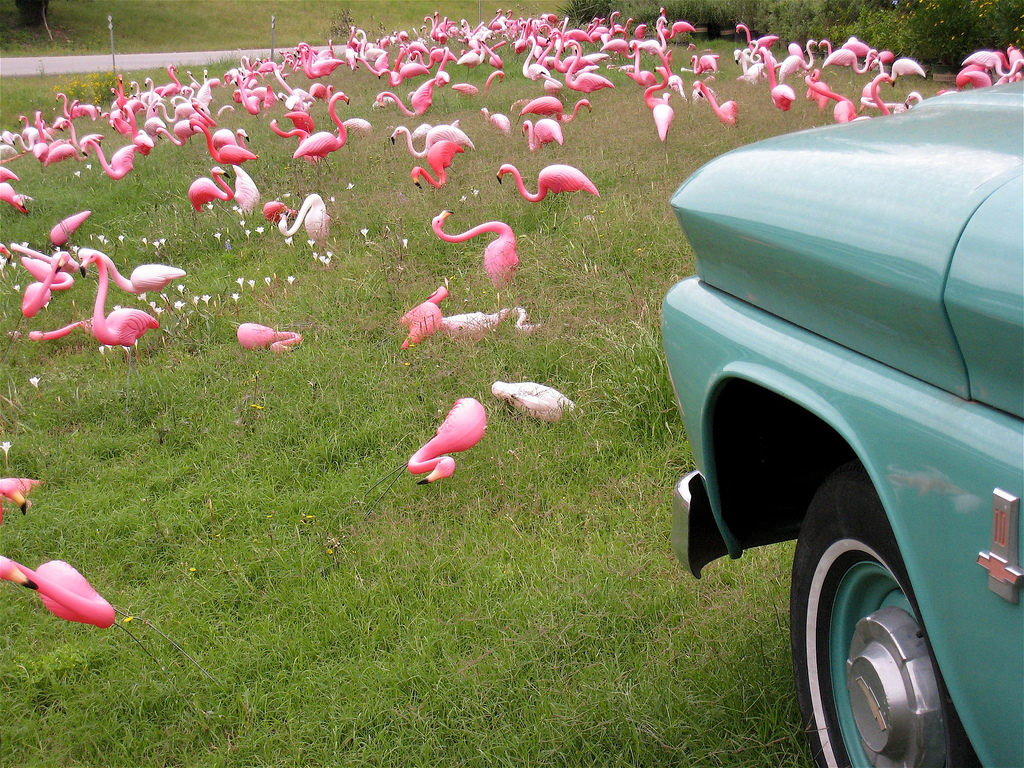
The plastic pink flamingo, first designed in 1957, caught on largely because of "the sameness of post-World War II construction":
Units in new subdivisions sometimes looked virtually identical. "You had to mark your house somehow," [sculptor Don Featherstone] says. "A woman could pick up a flamingo at the store and come home with a piece of tropical elegance under her arm to change her humdrum house." … That soon changed. Twenty-somethings of the Woodstock era romanticized nature and scorned plastics (à la The Graduate). Cast in flaming pink polyethylene, the flamingo became an emblem of what Nancy [Featherstone] delicately calls the "T-word"—tackiness. Sears eventually dropped the tchotchkes from its catalog.
(Photo: A flock of flamingos at the junction of Bee Caves Road and Capital of Texas Highway by Alan Levine. Update from a reader: "I hate to be a grammar dork, but a flock of flamingos is called a flamboyant. I have a three- and four-year old and live by the zoo so I get to learn all kinds of fun animal facts.") Another reader:
As a college student in the late '90s, those tacky pink flamingos also made for an excellent impromptu beer bong. Just slice off a bit of the beak and of the tail, and it could easily handle three beers (or any other libation of one's choosing). Though among my friends it was not enough just to do a round off the bird (we named ours Suzie), you also had to be able to "blow" the bird like a trumpet after. This required some real skill as to make any kind of sound out of the beast you needed to hum a certain octave while raspberrying your lisps.
Building The Digital University
Kevin Carey reports on online education efforts:
Instead of trying to directly challenge American colleges—a daunting proposition, given the political power and public subsidies they possess—the new breed of tech start-ups will likely start by working in the unregulated private sector, where they’ll build what amounts to a parallel higher education universe. … At a certain point, probably before this decade is out, that parallel universe will reach a point of sophistication and credibility where the degrees—or whatever new word is invented to mean “evidence of your skills and knowledge”—it grants are taken seriously by employers.
The online learning environments will be good enough, and access to broadband Internet wide enough, that you won’t need to be a math prodigy like Eren Bali to learn, get a credential, and attract the attention of global employers. Companies like OpenStudy, Kno, Quizlet, Chegg, Inigral, and Degreed will provide all manner of supportive services—study groups, e-books, flash cards, course notes, college-focused social networking, and many other fabulous, as-yet-un-invented things. Bali isn’t just the model of the new ed tech entrepreneur—he’s the new global student, too, finally able to transcend the happenstance of where he was born.
Robert Wyllie and Steven Knepper, on the other hand, critique online learning and point to the deeper meaning of face-to-face classroom exchanges:
Students learn not only from engaging with ideas, but also by engaging each other. In an intimate seminar, discussions of thorny topics—religion, sexuality, race, politics—are dislocating experiences, but also productive ones. Physical presence makes us "feel" ethical growth. Students form communities around texts over the course of the semester, sharing not only disagreements and difficult discussions but also laughs and moments of discovery. In seminars, seldom do you find you change your mind without a change of heart.
Cool Ad Watch
Old Spice does it again, with a new campaign featuring the insanity of Terry Crews:
[F]ormer NFL player and action movie star Terry Crews is literally playing cacophonous "music" with his bulging muscles, yelling entertaining non sequiturs like "GIMME A HAT!" and "SAUSAGES!" … [A]t end of the performance, the video becomes interactive and viewers are invited to bang out their own ridiculous track on their QWERTY keyboards. The native Vimeo player lets users record and share their videos too, and the slick setup is fully embeddable.
Kasia also talked to Vimeo, who partnered with Old Spice, about all the interactive features:
In addition to the live video recording of Crews, the video is a composite of over 150 different elements. While the Flash player runs through the music video, it loads the interactive portion, which is "effectively a new player." The real triumph, [Vimeo's Abby] Morgan says, was figuring out how to speed up the server-side compositing of 150 moving parts so that users could record and save their own Muscle Music videos. The process they came up with is surprisingly fast; watch the progress bar load and it just gleefully declares "COMPUTER STUFF HAPPENING!" The player is not just a sweet new interactive toy; it marks a new phase of native brand integration for Vimeo, which has traditionally avoided advertising on the site, with the exception of a few sponsored contests (Canon's Beyond the Still) and branded pages
(Disclosure: The Dish and Vimeo are both owned by IAC)
The Muffin Top Alert, Ctd
A reader writes:
I've been reading your blog for a long time now, and while I often disagree with the things you post, I've never been angry enough about it to write in before, always trusting your astute readership to write in and make my point better than I could. But this quote by Selene Yeager is such complete bullshit that I just had to respond. In what universe will suggesting fat people wear tight, uncomfortable work-out clothes encourage them to exercise? I'm fat, and have been an avid bike rider for three years now (I hate the pretension of the word "cyclist" almost as much at those tight lycra shorts with the padded butts). The suggestion that fat people like me don't know that we are fat because we wear baggy clothes is ludicrous. Fat people shower naked and have mirrors, not to mention the rest of the world telling them they are fat all the time: OF COURSE WE KNOW. Tight clothing will not encourage people to bike by "alerting" them of weight gain: all this suggestion does is continue to shame fat people, and you can't shame people into changing their behavior.
I went and read through the article, and the rest of the tips seem pretty reasonable, but the focus on "losing weight" is totally misguided. I've gotten much healthier and fitter in the time I have been commuting by bike, but I have not gotten any thinner. Focusing on weight as the main indicator of health will only discourage people, fat and thin alike, from adopting habits (like bike riding) that will make them healthier regardless of their weight. Most of the science on weight loss shows that it is very very difficult to make a fat person thin: most weight-loss programs fail in the long term (check out NY Times writer Gina Kolata's book, Rethinking Thin for detailed evidence).
Everyone needs to be more active and eat more real food rather than junk in order to improve public health, but the way we as a culture focus on weight loss rather than healthy habits is totally counter-productive. This country has a public health problem around eating and exercise but it is not a fat people problem: it's everyone's problem. Turning fat people into thin people wouldn't fix that problem, even if we had any idea how to actually do that, which we don't.
I lived for two years in Portland, Oregon, one of the most bike-friendly cities in the country, and I am 100% for more bike lanes, programs that encourage people to commute by foot or bike, getting healthy foods into "food deserts" and public schools, encouraging people to eat less meat and dairy, ending agricultural subsidies for corn and soy (which are the main reason highly processed junk foods are so cheap), and Michelle Obama's organic garden and Let's Move initiative. But tips like one this are SO counter-productive and do nothing to encourage people to be more active and everything to feed a culture already too rich in fat shaming.
Oh, and I highly doubt prisoners gain weight when they enter prison because of the baggy clothes they wear: that seems to me a case of mistaking correlation with causation. Stress and depression both cause hormonal changes that encourage weight gain, and I can't think of many things that are more stressful or depressing then entering prison.
The Daily Wrap
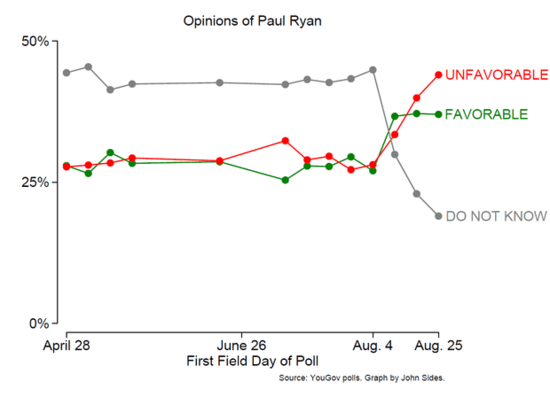
Today on the Dish, Andrew live-blogged Ryan's acceptance speech, followed by reader reax here. Earlier in the day, he called Romney-Ryan's foreign policy Dickish and highlighted a piece by Mike Lofgren on materialism's eclipse of conservatism. Crowley pondered how Ryan could credibly address Medicare in his speech, and while Leon Wieseltier unloaded on him, the veep candidate's numbers slid.
Reviewing yesterday's convention news, Andrew condemned CNN for its dismissal of a racist RNC incident, while readers pushed back. Andy McCarthy slammed Christie, and as Douthat praised Ann Romney's speech, Noonan noted how it perpetuated Romney's hollowness. Alex Altman called last night a "diversity pageant" and Andrew made the conservative case for Obama on The Colbert Report here.
Looking ahead, Andrew flagged a fascinating LDS discussion about Romney, and while some readers clarified Romney's LDS standing, others pinpointed relgious authorities in US political history. Drum remarked on Romney's brazen lying, John Sides reframed his challenge and Romney feted top donors aboard the Cracker Bay.
While Andrew reflected on humor and politics, Douthat advised the Paulites and Hanna Rosin fielded readers' abortion question. Yglesias then parsed the GOP platform, Team Obama thronged Florida and TNC observed Romney's double standard on affirmative action. Suzy Khimm investigated the party-switching penalty as Noam Scheiber reported on Joe's presidential designs. And while Sarah Palin jumped the shark (yet again), journalists ceded control at conventions and Patrick Gavin's Twitter meta-ed.
In assorted commentary, Paul Rozin rehabilitated recycled water, Maria Bustillos praised Lester Bangs' literary tastes and Teju Cole told of a near-blindness bout. Bill Nye dressed down creationists, Emily Landau examined Rakoff's and Hitchens' contributions to the dying debate, and Oliver Morton potrayed flowing power.
@ then baffled, Frank Jacobs lamented a Disney ride and Sonic blotted out Texas. The Swedish chef spoke a dialect of Norwegian sing-song, FOTD here, VFYW here and MHB here.
– G.G.
Tampa Day Two Reax
Will Wilkinson's takeaway:
Paul Ryan demonstrated that he is an appealing, energetic campaigner comfortable with the sort of looseness with facts voters perpetually reward. This somewhat sullies his reputation as a plainspoken, fact-oriented numbers guy, but Mitt Romney hired a running mate, not an actuary, and an able running mate is what Mr Ryan is proving to be. That said, despite his capacity for relatively substantive discourse, Mr Ryan's youthful looks and tenor vocals made him feel slightly light, especially when compared to Condoleezza Rice, who in her speech earlier in the evening had the gravitas of a neutron star.
John Hinderaker raves:
Ryan laid out the differences between conservatism–the American tradition–on the one hand, and liberalism on the other, as well as anyone ever has.
Jim Geraghty goes so far as to compare Ryan to Reagan:
This speech, and his warmth and sense of connection when delivering it, almost unnerved me. I started worrying that I was seeing what I wanted to see, that I was hyping a pretty good speech delivered pretty well in my own mind. Except my Twitter feed was exploding. The delegates were going nuts. And it just seemed to be getting better and better as it went on. Conversational, direct, funny, detailed… this was Reaganesque, guys.
Weigel, on the other hand, puts Ryan's lies in list form. Dan Amira does the same:
Most of the millions of people who watched the speech on television tonight do not read fact-checks or obsessively consume news 15 hours a day, and will never know how much Ryan's case against Obama relied on lies and deception. Ryan's pants are on fire, but all America saw was a barn-burner.
Joe Klein calls Ryan's speech "effective" but laments that there "was absolutely no plausible vision of the future":
Ryan talked about the “supervision and sanctimony of the central planners.” He said we were in danger of living in “a country where everything is free but us.” And that’s pretty much where he lost me. We actually live in a country with a modest but useful social safety net that is in need of reform. We live in a country where it is easier to start and build a business than any other advanced industrial democracy. We live in a country with a tattered, outdated regulatory apparatus that needs serious attention. We live in a country where the moneyed elite pays fewer taxes and suffers fewer restrictions than it has in nearly a century. Those who object to the influence that this elite wields are not criticizing success; they are criticizing plutocracy, which crushes true democracy.
Elspeth Reeve's found Ryan's speech a little thin:
Ryan is supposed to be really good at explaining policy to the masses. But he didn't explain much policy tonight. There were way more applause lines. … His job tonight was to help tell the story of who Mitt Romney is, so maybe there wasn't room for specifics. But it shows you that so many people are bad at math that all you have to do is say you're good at math and everyone believes you.
Suderman fears Ryan's policy ideas have been discarded:
[Ryan] made his name as an energetic Medicare reformer, someone who believed the program wasn't working, was too expensive, and needed to be changed. But tonight, in the most prominent speech of his career, he chose to defend the idea that the program was not only worth preserving but worth defending from any and all of the other party's cuts. That may or may not be good for his political career, but it's hard to see how it will be good for his policy reforms. He's helped join his party to the cause of mindlessly protecting the program he says he wants to reform.
Ed Kilgore fears they haven't:
[T]here was nothing of his radical social agenda. It was all sizzle and no steak. But the delegates knew what he actually stands for, so they loved it. His views are so well known that he didn’t even have to issue that many dog whistles.
Ezra Klein questions how the big speakers are selling Romney:
Chris Christie and Paul Ryan hit the same themes. We have hard choices facing us. We need leaders who won’t flinch before those choices. Leaders who won’t be deterred by the polls. Leaders who won’t compromise their principles. Leaders who won’t duck the tough issues. Leaders who won’t hide the hard truths. That description arguably works for Christie and Ryan. That’s their brand, even if it’s selectively applied. But whether you love Romney or you hate him, do these lines really sound like a description of him? Is his political history really that of a bold, poll-defying, truth-talker?
And Josh Barro argues that "many of the criticisms he leveled against Barack Obama apply equally to his and Mitt Romney’s own records":
The central attack in the speech is one that I agree with: The Obama administration is out of ideas and adrift on economic policies. “They have run out of ideas. Their moment came and went. Fear and division is all they’ve got left.” But the speech did not make the case that Romney and Ryan would succeed where Obama has failed.
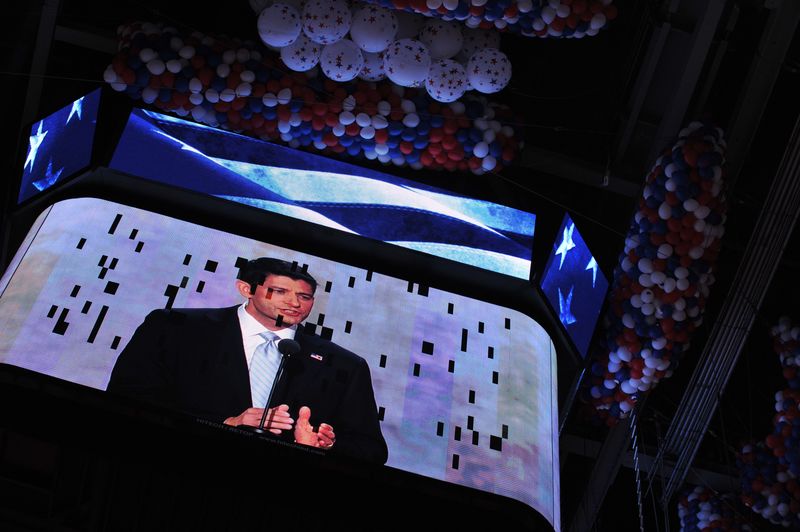
(Republican vice presidential nominee Paul Ryan appears on a giant screen as he speaks to the crowd at the Tampa Bay Times Forum in Tampa, Florida, on August 29, 2012 during the Republican National Convention (RNC). By Stan Honda/AFP/Getty Images)
 The Dish