The GOP Is Still Running Against Carter

Weigel says he knows "of at least one GOP group that's going to buy a few million dollars of ads on foreign policy, midway through October, to smack Obama." Larison suspects the ads will do nothing:

Republican hawks don’t understand why they’re losing on foreign policy because they can’t admit that Obama isn’t Carter and they can’t or won’t acknowledge that the Iraq war was a debacle. They also don’t realize that their reputation is in tatters because of their own Carter-like administration, and it isn’t helped by their belligerent Dukakis-like nominee. So they’re stuck drawing strained comparisons to the hostage crisis that even they probably don’t find credible.

That generation of neocons experienced 1980 as an epiphany. They keep trying to relive it. They have largely ceased thinking about foreign policy seriously since then, except as an extension of the global hegemony the collapse of the Soviet Union dangled in front of their twitchy fingers. They have simply erased the Bush-Cheney catastrophe from memory. They have learned nothing. And they think Americans have learned nothing either. Dumb and contemptuous of the American public: a good description of the Romney campaign.

Can A Dog Be Depressed?

Eddysuitcase

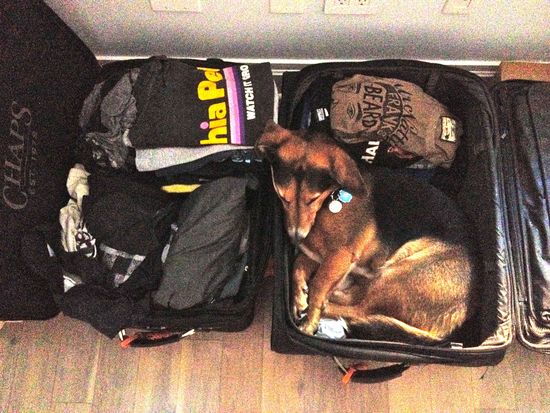
The trauma of moving to a new empty apartment in a new city has certainly turned Eddy into a total mess. She hates change (dogs are wise conservatives) and is a rescue-dog, so always panics if abandoned. Aaron had to go to DC for a few days, and every time I left, Eddy would howl as if terrified. The police were called. She doesn't have her crate yet and one morning we found her sleeping in one of our suitcases (above). She's now staying with a friend we have all stayed with before, and is much calmer. But her range of emotion appears to me as vast. Dusty (not a rescue) on the other hand is more like Snoopy. Nothing much fazes her. All that matters is food. But even she gave me major attitude when I went to see her.

Malcolm Harris asked Laurel Braitman, author of Animal Madness, about her own experience:

I had a dog at the time, my partner and I had adopted a Burnese Mountain Dog. And he was fine for the first six months and then he went spectacularly crazy. He developed a debilitating case of separation anxiety. If we left him alone he would destroy himself, the house, anything in the way. He nearly killed himself at least once. So I had to take him to the vet hospital after he jumped out of our 4th floor apartment, and they said I had to take him to a veterinary behaviorist who would give him a prescription for Prozac and Valium.

I was stopped in my tracks. I had heard there were some animals taking these drugs, but I never thought of myself as the kind of person who would put an animal on Prozac. But I found myself in a desperate situation with a 120 pound dog and I tried all these things and they didn’t work, so I became that person that puts her dog on antidepressants. Prozac didn’t work for him really, but the Valium did, at least in the short term.

The experience drew her to study animal personality:

As most people who live with other animals can attest, you can have two dogs with an identical upbringing in the same house, and one might develop a debilitating fear of vacuum cleaners, and the other could be just fine. This might not have much to do with the environment, and that’s where personality and individual difference come in. We see that in people all the time, you can have two people exposed to the same event, and it could haunt one person and not the other. It’s a pan-animal sort of mystery: Why some of us are more susceptible to certain experiences than others, and what are our triggers. It extends far beyond the human species. It’s not just humans driving other animals crazy, they are more than capable of doing it themselves.

Quote For The Day II

"Whenever conservatives talk to me about Barack Obama, I always feel quite certain that they mean something else. But what exactly? The anger, the suspicion, the freestyle fantasizing have no perceptible object in the space-time continuum that centrist Democrats like me inhabit. What are we missing? Seen from our perspective, the country elected a moderate and cautious straight shooter committed to getting things right and giving the United States its self-­respect back after the Bush-Cheney years. Unlike the crybabies at MSNBC and Harper’s Magazine, we never bought into the campaign’s hollow “hope and change” rhetoric, so aren’t crushed that, well, life got in the way. At most we hoped for a sensible health care program to end the scandal of America’s uninsured, and were relieved that Obama proposed no other grand schemes of Nixonian scale. We liked him for his political liberalism and instinctual conservatism. And we still like him," – Mark Lilla, in a brilliant and often hilarious review.

Obama: More Efficient Than Romney

Obama is out-advertising Romney in Ohio and Florida despite the overall Republican fund-raising advantage. Jon Chait explains how this is possible:

Obama seems to be getting way more bang for his buck. Republicans are paying their staff twice the rate Democrats are paying theirs, allowing Obama to have twice as many people working for him for the same amount Romney is spending. And the Washington Post today reports the little-known fact that campaigns, by federal law, can command lower advertising rates than Superpacs, giving Obama consistent, and occasionally huge, savings.

The Beginning Of The End Of Prohibition?

Marijuana_GT

Jacob Sullum sees this election's pot legalization initiatives as a major challenge to the status quo:

By the time the 21st Amendment ended national alcohol prohibition in December 1933, more than a dozen states had already opted out. Maryland never passed its own version of the Volstead Act, while New York repealed its alcohol prohibition law in 1923. Eleven other states eliminated their statutes by referendum in November 1932.

We could see the beginning of a similar rebellion against marijuana prohibition this year as voters in three states—Washington, Colorado, and Oregon—decide whether to legalize the drug's production and sale for recreational use. If any of these ballot initiatives pass, it might be the most consequential election result this fall, forcing both major parties to confront an unjust, irrational policy that Americans increasingly oppose.

Meanwhile, Winston Ross covers the intensification of the medical marijuana crackdown:

For a while, the feds tended to look the other way—until last year, when the Obama administration began stepping up enforcement of a law that supersedes the writs of the 17 states that have legalized marijuana. The Controlled Substances Act, which classifies pot as a “schedule one” drug on par with cocaine, makes it illegal to sell or possess it.

Now, the federal crackdown appears to be expanding. On Tuesday, officials raided several pot shops in Los Angeles and sent letters to dozens more warning them to close or face criminal charges. Last week, the DEA raided one of Oregon’s largest medical marijuana operations. In Washington, U.S. Attorney Jenny Durkan sent a threatening letter last month (PDF) to 23 pot dispensaries identified as being within 1,000 feet of a school, prompting many of them to close. And in Colorado, 57 dispensaries have quit so far this year after the U.S. attorney there announced it would prosecute shops that were deemed too close to schools.

If Romney wins, prohibition will be back with more force than under Bush. If Obama wins, and refuses to rein in the FDA, we will have to go to war with him and his party on this. No government has the right to restrict any citizen's use of a plant for her own health. I cannot see how this right over our own bodies – when no one else is affected – isn't an inalienable one.

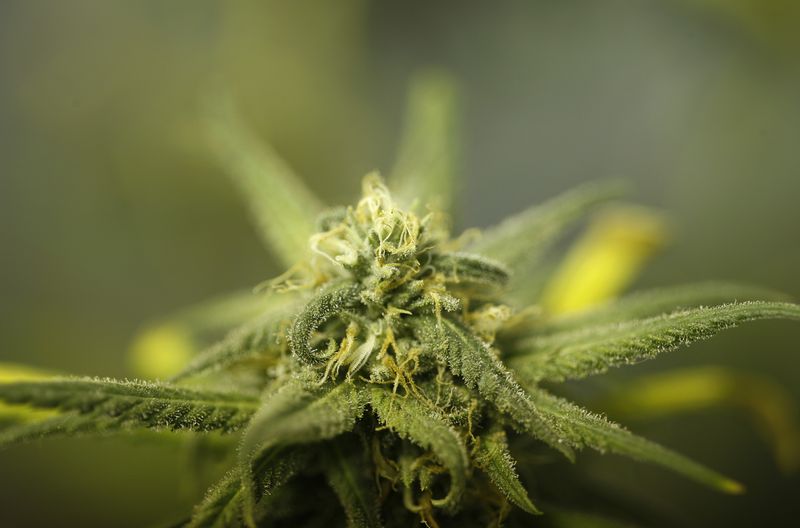
(Photo: Marijuana plants grow at Perennial Holistic Wellness Center, a not-for-profit medical marijuana dispensary in operation since 2006, on September 7, 2012 in Los Angeles, California. By David McNew/Getty Images)
Polls Are Now Part Of The Liberal Conspiracy, Ctd

Tomasky asks Republicans to face reality:

[W]hile [Dick Morris] is correct that the polls are showing strong Democratic advantages, they’re doing so because that’s how people are identifying themselves to pollsters. In fact, Stan Greenberg noted last Friday, Republicans lost five points in voter identification in a month. This is not bad poll sampling. It’s reality. And while it’s true that today’s numbers might overstate what will be the case on Nov. 6, the way things are going, they just might be understating them.

Nate Cohn also pushes back against the poll skeptics:

We don’t need pollsters to tell us that Obama would lose if the electorate looks like 2010, nor do we need them to tell us that Obama would win if the electorate looked like 2008. What we need—and what we have—are pollsters with methods that allow us to get a decent grasp on what's going to happen on Election Day. Pollsters are not sooth-sayers who correctly guess the composition of the electorate every four years; they take demographically representative samples of adults and let the sample speak for itself. That’s how polls using the same methodology managed to show Bush winning in 2004, Obama winning big in 2008, and a GOP takeover in 2010. It’s how Ann Selzer managed to show Obama winning the Iowa Caucus’ in 2008, even though there wasn’t any comparable Caucus to mirror as a “turnout model.” None was necessary.

Douglas Schoen and Jessica Tarlov weigh in:

[W]hile the mainstream polls may be slightly skewed, they still hold the key to the election. And the gaps they are showing are increasing. According to a new Quinnipiac/New York Times/CBS poll, Obama holds a 10-point lead in Ohio, a 9-point lead in Florida, and a 12-point lead in Pennsylvania. With numbers like these, it is hard to avoid the conclusion that Obama is ahead. How far ahead may not be clear—but he is definitely winning.

Even though he calls poll denialists "totally crazy," Chait is somewhat sympathetic:

[W]hat is surely true is that individual polls do over-sample Democrats. That’s just how statistical margin of error works — some polls will err in one direction, others in another direction. It’s pretty crazy for poll denialists to assume all the non-Rasmussen polls have a Democratic bias, but some of them probably do. The recent Quinnipiac poll showing Obama up by nine points in Florida and ten points in Ohio stands apart from a host of polls showing a tighter race, and it’s probably wrong.

Earlier Dish on the poll skeptics here, here, and here.

Catholics Flee Romney-Ryan-Dolan

Screen shot 2012-09-27 at 1.19.39 PM

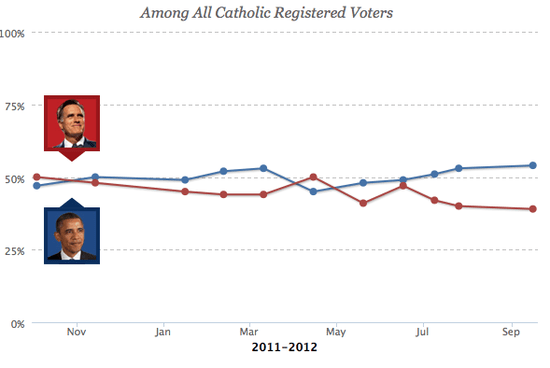
National Catholic Reporter finds something remarkable in a new poll from Pew:

On June 17, Obama held a slight edge over Mitt Romney among Catholics (49 percent to 47 percent), according to the Pew Research Center. Since then, Obama has surged ahead, and now leads 54 percent to 39 percent, according to a Pew poll conducted Sept. 16. Among all registered voters, Obama leads Romney 51 percent to 42 percent, according to Pew. Obama and Romney are essentially tied among white Catholics, which some pollsters call the ultimate swing group.

But Obama's current even status among white Catholics now is an improvement over 2008, when McCain beat Obama among white Catholics by 52 – 47. Obama's total Catholic vote against McCain was where he is now: 54 percent. But Romney has only 39 percent compared with McCain's 45. 

A small word of thanks to Cardinal Dolan, Robert George and K-Lo for helping shift the Catholic vote massively toward Obama with their summer campaign for religious liberty. And special thanks to Paul Ryan. No actual Catholic could ever find anything but puerile cruelty in the works of Ayn Rand, or rally to the idea that home-care for the elderly should be sacrificed to reduce tax rates for the super-rich. Paul Ryan believes that the basic principles of Rand can be compatible with Catholicism. American Catholics are just not that dumb or confused about their faith.

One other small point. The poll, though just released, was conducted on September 16. The polls have shifted slightly in his favor since. The 47 percent tape – about as anathema to Catholic social teaching as is possible to express in its contempt for the poor – cannot have helped. I wonder also about white Catholics and Romney's Mormonism. There may be some conservative Catholics leery of what some regard as a cult.

Obama Moves In For The Kill

With early voting underway, the above Obama ad is set to run in seven states. At a whopping two minutes, the quadruple-length appeal is likely intended as his closing argument. It follows the direct-to-camera ad Romney released yesterday in which he tries to yet again relaunch his flailing campaign. 

Also, about that Romney ad – the campaign looks to be betting everything on it. Sargent reports that it will be "airing at full throttle in all of Romney’s media markets in nine swing states, and it will be the only Romney ad running in them [save some Spanish-language ads in Florida]."

The L-Word

Race_By_State

Silver isn't ruling out a landslide:

[T]here looks to be about a 20 percent chance that Mr. Romney will win, but also about a 20 percent chance that Mr. Obama will actually beat his 2008 margin in the popular vote. The smart money is on an outcome somewhere in the middle – as it has been all year. But if you can conceive of a Romney comeback – and you should account for that possibility – you should also allow for the chance that things could get really out of hand, and that Mr. Obama could win in a borderline landslide.

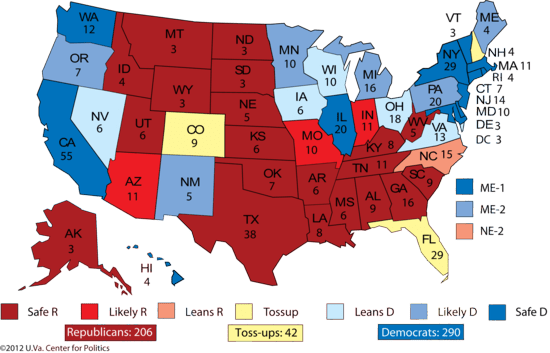
That's exactly my feeling. And it is based in part about an intuition about the reddest states. Moving to NYC has been crazy but I hope to deal with this later today. Electoral map above from Sabato, who also analyzes the Senate and House races.

Romney At Bain: We “Harvest” Companies

David Corn continues his series of scoops. In this unearthed footage, Romney explains the logic behind Bain Capital: not creating jobs but "harvesting" companies they take over:

This is not the "47 percent" bombshell. It just shows what Bain Capital was about: rewarding its shareholders by "harvesting" companies. That word is clinical. And look: there's nothing evil or wrong about Bain. It did what it does, it has had some successes and failures, and it's not a crime to make money this way. But it isn't business, as Romney concedes, so much as finance. And those who lost their jobs as a result will not be thrilled to find out that they were harvested for Romney's mega-rich Bain peeps.