Thinking Outside The Box Office

The Library of America just released a new collection of film critic Pauline Kael's best writing. According to Clive James, she taught us how to think about more than movies:

Some of her judgments about Holly­wood spread right out to cover the whole of American society.

This is one of the big hurdles that defeat artists in Hollywood: they aren’t allowed to assume that anybody knows anything, and they become discouraged and corrupt when they discover that studio thinking is not necessarily wrong in its estimate of the mass audience.

Right there is one of the differences between the American and, say, the British cultures. In Britain, an editor will permit a writer to make an allusion if he, the editor, understands it. In America, an editor might well understand it but he will want it taken out, for fear that the readers won’t.

Literary Promiscuity

Book-4

Mark O'Connell confesses to being "a pathetic serial book-adulterer who’ll chase after anything in a dust jacket." He will start one book, picking up another before the first is finished, thereby leaving a stack of half-read paperbacks on his nightstand. His attempt to come to terms with the habit:

I often feel as though I’m a bad reader, an unfaithful reader, a reckless literary philanderer. But I can usually assuage this guilt by reminding myself that if I were to impose some sort of embargo on starting a new book before finishing a current one, I would end up reading fewer books. I would be a more methodical and orderly reader, certainly, but a less varied and prolific one. There’s a bit in Boswell’s “Life of Samuel Johnson”—a book that I started but never finished—where Johnson gives amusingly short shrift to the notion that you should finish reading any book you start. “This,” he says, “is surely a strange advice; you may as well resolve that whatever men you happen to get acquainted with, you are to keep them for life. A book may be good for nothing; or there may be only one thing in it worth knowing; are we to read it all through?” Well, when you put it like that, then no. It’s always reassuring to have Dr. Johnson on your side, and he makes an excellent point—that we don’t necessarily have to think of books we are reading as relationships, that they can just as well be casual acquaintanceships—but I’m still only ever half convinced of the virtue of my ways.

(Image from a maze of books in the shape of Luis Borges' fingerprint by Marcos Saboya and Gualter Pupo, via Colossal)

Behind Every Great Author

Yelena Akhtiorskaya reviews a new book that focuses on the wives of famous Russian authors:

For the husbands, life was work and work was life—and so their wives and even mistresses necessarily assumed professional responsibilities. (Bulgakov’s wife and his mistress “took his dictation in turns.”) Many of these husbands demanded their ladies’ services to the exclusion of everything else. Anna Dostoevsky was a talented stenographer, but when the couple faced financial straits, Dostoevsky forbade Anna to seek work—he demanded her services all for himself. Though Osip Mandelstam and his wife were practically homeless and starving after the Russian revolution, Nadezhda, who had studied law at Kiev University, never even considered a job. Mandelstam “wanted her to be ‘entirely dependent on his will.’ So she would spend most of her day sitting on her mattress, taking dictations.” Vladimir Nabokov was no less stingy: “The typewriter does not function without Véra,” he said.

The Wives is captivating when lightheartedly doling out anecdotes, but less so when laboring to prove the worth of these women. Writers die young, and writers in a totalitarian regime die younger, so sections invariably end with harried synopses of unwavering devotion to literary legacies. Then there is the inherently monotonous nature of the work itself. Sophia Tolstoy “loved copying War and Peace,” writes Popoff, “work she did for seven years, remarking, ‘The idea of serving a genius and great man has given me strength to do anything.’” If Popoff’s mission is to redeem these women as legitimate figures in literary history, her methods are strangely counter-productive. By emphasizing their diligence, she underlines their drudgery.

The View From Your Window Contest

Vfyw_9-1

You have until noon on Tuesday to guess it. City and/or state first, then country. Please put the location in the subject heading, along with any description within the email. If no one guesses the exact location, proximity counts.  Be sure to email entries to VFYWcontest@gmail.com. Winner gets a free The View From Your Window book. Have at it.

Wedding Readings In The Age Of Pinterest

Lydia Kiesling scoured her favorite poetry, fiction, and even Louis C.K. riffs for an original take on love and marriage to use for her nuptials. Why she found it so difficult:

As a bookish person, it felt like cheating to be searching for beautiful passages from the Internet. I preferred for it to happen more organically (so precious, so mistaken). I read books all the time, I thought to myself; surely I should have some interior commonplace book chock-full of beauty and inspiration to consult. But the only two poems I can recite in their entirety — Philip Larkin’s "High Windows" and "This be the Verse" — are so far from wedding-worthy it’s hard to imagine anything worse: "When I see a couple of kids/ And guess he’s fucking her and she’s/ Taking pills or wearing a diaphragm,/ I know this is paradise." (or "They fuck you up, your mum and dad," obviously.)

What did she end up choosing?

…with several days remaining until the wedding I picked Collins’s "Litany" ("You are the bread and the knife,/ the crystal goblet and the wine"), which I thought was lovely and romantic and yet also conveyed the promised prosaic qualities of long relationships. It’s funny, but not too much. I find the long dashes of the last lines poignant: "You will always be the bread and the knife,/ not to mention the crystal goblet and — somehow –/ the wine."  There is an element of the sacramental which appeals to me, something that begins to approach the reverence I feel for my own beloved.

A Model Of Restraint

Bernard Avishai revisits Philip Roth's classic Bildungsroman of sexual neuroses, Portnoy's Complaint. He finds a lesson about how easily we fall prey to human desires:

Jews presumed to control themselves so well—partly because they had been a scorned minority and had learned to ingratiate themselves—but also because they had a religious culture that could seem an endless restraining order. Portnoy knew better. He had seemed to come around to something like D.H. Lawrence’s rebellion against the confinements latent in this curiously Ben Franklinish culture:

What else, I ask you, were all those prohibitive dietary rules and regulations all about to begin with, what else but to give us little Jewish children practice in being repressed? Practice, darling, practice, practice, practice … Why else the two sets of dishes? Why else the kosher soap and salt? Why else, I ask you, but to remind us three times a day that life is boundaries and restrictions if it’s anything, hundreds of thousands of little rules laid down by none other than None Other …

Thus, the American embodiment of self-restraint cannot restrain himself, at least not in private, where lovers and analysts learn the truth. And if a Jew can’t hold it all together, then surely Everyman can’t.

The Wright Angle

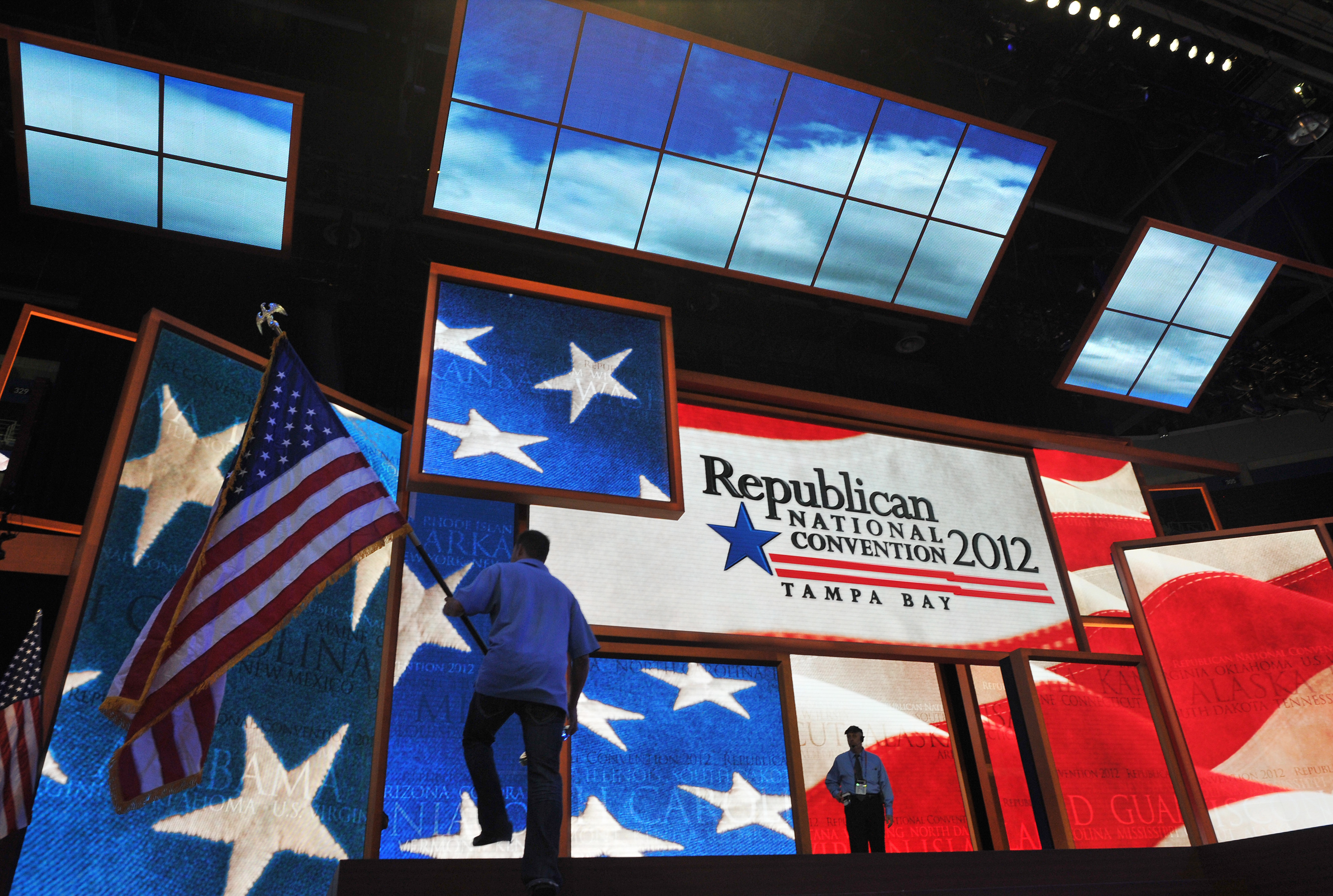
GT_RNC_SET_120829

The RNC's set design was loosely based on Frank Lloyd Wright's "Prairie style." A possible reason why:

Ayn Rand based the architect-hero character in The Fountainhead on Wright. Howard Roark soon became the poster boy for Rand’s Objectivist philosophical system. (Rand idolized Wright and tried to connect with him while writing the book, only to have Wright resist. The two became friends after the book’s publication in 1943, however.) … When Ryan stands in front of that stage accepting the VP nomination with an homage to the ultimate Randian hero looming over his shoulder, the associations might be too hard to ignore.

Christopher Hawthorne has more on the connections between the architect and the writer:

Rand and director King Vidor wanted Wright to design the sets for the movie version of "The Fountainhead," but the job ultimately went to Edward Carrere. Not that Wright was uninterested in how the movie would turn out. After the great designer George Nelson trashed the designs in Interiors in 1949, in an essay called "Mr. Roark Goes to Hollywood: A Comment on Warner Brothers' Attempt to Interpret F. L. Wright to the Masses," Wright sent a telegram to the magazine.

"Any move I would make against such grossly abusive caricature of my work by this film crew would only serve their purpose," the telegram read. "They belie the one decent thesis of 'The Fountainhead,' the inalienable right of the individual to the integrity of his idea. It is best to laugh."

(Photo: A man steps onto the stage with a US flag at the Tampa Bay Times Forum in Tampa, Florida, on August 28, 2012 ahead of the day's Republican National Convention events. By Mladen Antonov/AFP/Getty Images)

Rove’s Game

Craig Unger finds it distasteful:

Undeniably, he’s back. He has re-invented himself. He is not merely Bush’s Brain; he’s the man who swallowed the Republican Party. As the maestro orchestrating the various super-pacs, he has inspired the wealthiest people on the right to pony up what could amount to $1 billion and has created an unelected position for himself of real enduring power with no term limits. Rival operatives in the party who loathe him nonetheless evince a grudging respect. “He’s playing a very long game,” says Roger Stone. “Even if Romney loses, that’s good for Karl, because he will still be in control. And there’s always Jeb Bush in 2016.”

Sheelah Kolhatkar snuck into one of Rove's billionaire fundraisers. Here's what she learned:

Rove, joined by former Mississippi Governor Haley Barbour, laid out his strategy for winning the White House. “The people we’ve got to win in this election, by and large, voted for Barack Obama,” Rove said, in a soothing, professorial tone, explaining why the campaign hadn’t launched more pointed attacks on the president’s character. …

What had emerged from that data is an “acute understanding of the nature of those undecided, persuadable” voters. “If you say he’s a socialist, they’ll go to defend him. If you call him a ‘far out left-winger,’ they’ll say, ‘no, no, he’s not.’” The proper strategy, Rove declared, was criticizing Obama without really criticizing him—by reminding voters of what the president said that he was going to do and comparing it to what he’s actually done. “If you keep it focused on the facts and adopt a respectful tone, then they’re gonna agree with you.”

Previous Dish on Rove's tactics here and here.