The Dowd Of The Dude

An entertaining glimpse of the real-life dude that inspired Jeff Bridges' character in The Big Lebowski:

Director Jeff Feuerzeig recounts their first meeting:

In 1986, twelve years before The Big Lebowski, first screenplay in hand, I flew from NY to LA, rented a car, and pulled up to The Dude’s dilapidated apartment/office on the "boardwalk" of Venice Beach for my very first Hollywood meeting. As if on cue, this Avery Schreiber-looking mop-topped behemoth clad in super-tight grape smuggling polyester shorts and a hideous floral Hawaiian shirt rolled up on roller blades and welcomed me to paradise. While I stood on his sagging balcony overlooking the Pacific Ocean watching all the blonde bikini-clad beach girls in leg warmers skate by, the Dude ransacked his living room, overturning stacks of unread scripts, looking for my screenplay, which I’m still not convinced he’d read. Finally locating it, he launched into an inspirational rant, this bear-like wild tangle of hair showering me with spittle as he gesticulated wildly, telling me with a straight face that I was "the next Cassavetes" and I was going to make films my own way. …

Jeff Dowd is a right of passage in the indie film world — baptism by the Dude — his spittle and good vibes setting you free to create a world of your own.

Ivy League Sex

Nora Caplan-Bricker is unimpressed with Nathan Harden's Sex and God at Yale:

Harden’s argument completely doubles back on itself. The book is supposed to start a conversation about how Yale’s sexual culture should change, but Harden’s real point is that he wishes we would just, please, stop talking about it. “If colleges can’t do anything to help students,” he writes, “I wish they would at least stop actively doing them harm” by teaching them how to masturbate and tell a partner what they want. He asks, “What interest should Yale have in the details of students’ sex lives?” In Harden’s universe, disrespect toward women and sexual assault are prevalent not because university high-ups aren’t setting rules and teaching values, but because we think and talk about sex too much. If we would just close the doors, everything would be fine.

Former Yale students Kathryn Olivarius and Claire Gordon also criticize the book:

[I]n our opinion, bunches of dudes weren’t misogynist dicks because of a talk by a porn star or a workshop on vibrators—the crux of Harden’s book. They were misogynist dicks because they grew up in a world full of misogynist dickishness, where women don’t have enough power yet to control our own image, and men consume thousands of hours of porn that makes humiliating women seem sexy. There are thousands of reasons sexism is still pervasive in America, but a lecture on “lip tricks” isn’t one of them.

Read Harden's preview of the book at the Beast here.

A Poem For Saturday

Chairs

"Houseguests" by Anne Porter:

"All of us are coming"
No they are not coming
They may be coming
They may not be coming.

Four of them are coming,
That is, if they are coming!
Five will come on Friday
Three will leave on Sunday
Two will come back Tuesday,
That is, if they are coming.

If they were coming
Two of them would be coming
But they are not coming . . .

Six of them are coming!

(Reprinted from Living Things by Anne Porter, published by Zoland Books, an imprint of Steerforth Press, 2006. Photo by Flickr user Gruenemann)

Courting The Drunk Vote

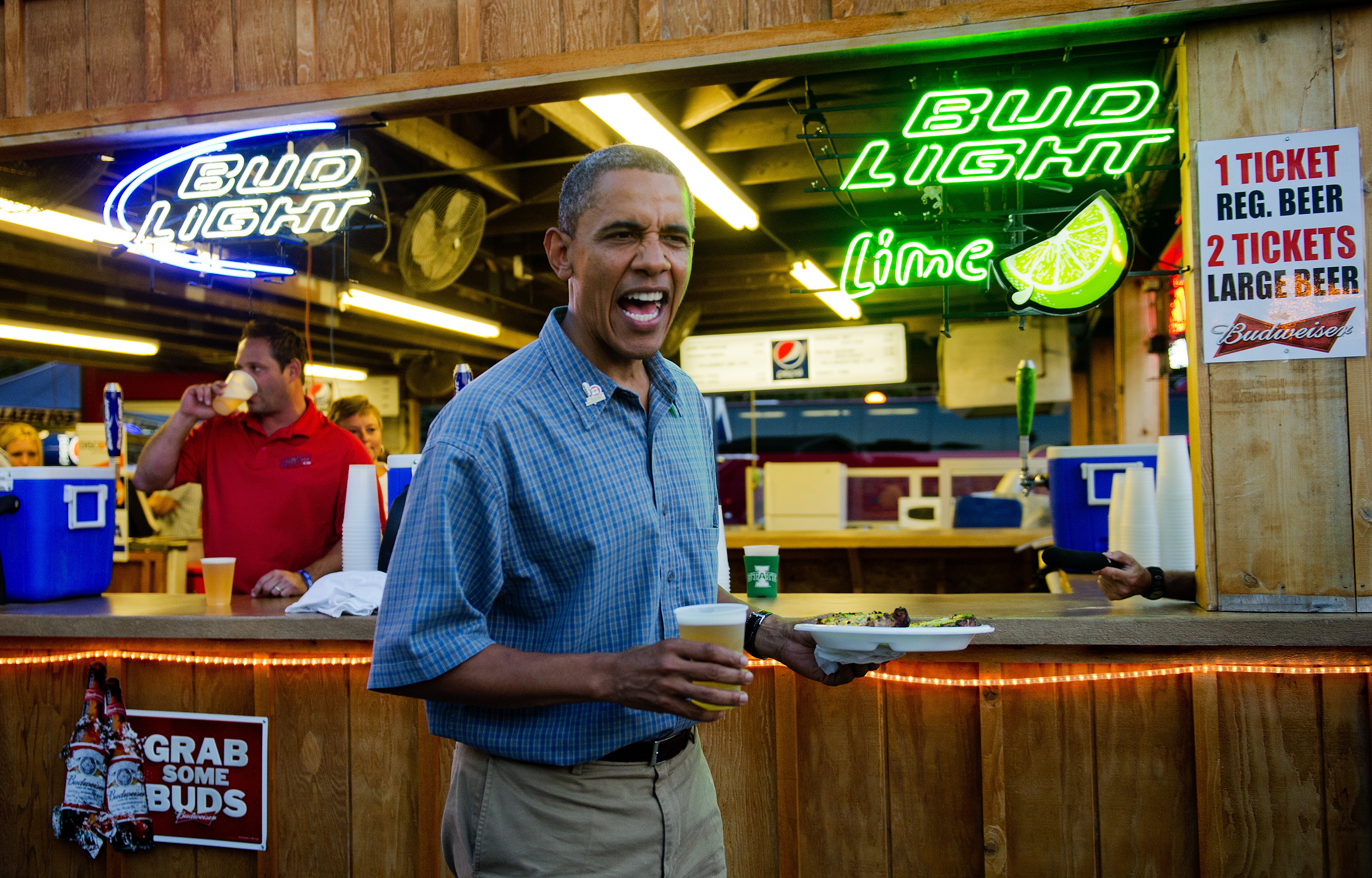
GT_OBAMABEER_120817

It's a time-honored tradition:

In colonial times, it was considered ungentlemanly, corrupt, and downright sleazy to openly solicit votes through campaign speeches and advertisements. Instead, upstanding politicians engaged in an old and cherished tradition called "swilling the planters with bumbo" – otherwise known as "getting voters drunk on Election Day." (Bumbo was a type of rum.)

In Washington’s day, elections were largely an excuse to party. Voting presented a rare opportunity for people to gather from miles around, catch up with their neighbors, and imbibe liberally. Crafty politicians capitalized on the festive climate to rack up votes. In fact, it was difficult for anyone to win an election without wining and dining his constituents. Though it was technically illegal to explicitly purchase gifts for voters, it was perfectly appropriate for a politician to buy a round for two hundred of his closest friends on Election Day.

(Photo: US President Barack Obama gets a beer and a pork chop as he visits the Iowa State Fair in Des Moines, Iowa, on August 13, 2012 during an unannounced stop on his three-day campaign bus tour. By Jim Watson/AFP/Getty Images.)

The Writer And The Man

Reviews of D.T. Max's David Foster Wallace biography, Every Love Story is a Ghost Story, are starting to appear. Scott Esposito describes it as "a book without much human or philosophical insight," but not entirely unuseful:

On the positive side, Max is clearly a diligent and able researcher. He’s dug up all sorts of interesting facts about Wallace and seems to even be familiar with his correspondence (at least with luminaries like Jonathan Franzen and Don DeLillo). There are lots of little gems in here, and I think this would constitute the main appeal for this book to Wallace fans and academics. The depth to which Wallace himself was an addict surprised me, as well as the extent to which fame really did seduce and then mangle him as a young writer who had an enormous amount of early success. These findings do put books like Infinite Jest into a new light.

At Publisher's Weekly, Gabe Habash finds the book limited for similar reasons. In a particularly thoughtful review, Craig Fehrman focuses on Wallace's relationship to the Midwest:

Wallace went to a big public high school and interacted with students from all sorts of backgrounds in a way the son of two professors in a larger city might not have. And at Amherst, at Arizona, and on his return to Illinois, he deliberately re-created this mix. One of his neighbors in Bloomington-Normal worked at a lumberyard; another repaired Xerox machines. Wallace even engaged with the midwest Franzen ignores—especially through his recovery group, which drew most of its members from the working class. "You're special," he wrote to another author in 1999, six years after settling in Bloomington-Normal. "But so's the guy across the table who's raising two kids sober and rebuilding a '73 Mustang. It's a magical thing with 4,000,000,000 forms. It kind of takes your breath away."

Of course, the midwest isn't the only place one can learn these things. But it's where Wallace learned them. Max realizes this on some level, and in his book he offers a few pieties about how Wallace grew up surrounded by "midwestern virtues of normality, kindness, and community." Yet it's not clear that a single one of those virtues took: Wallace was mostly a loner, he was certainly a creep (his relationships with women make Brief Interviews With Hideous Men, his second collection of short stories, seem almost autobiographical), and nothing about him seemed normal. The midwest influenced him on a more abstract level, in his philosophical and artistic orientation toward the larger world. Max might have explored these ideas. Instead, he chooses to alternate between dismissing and sentimentalizing the midwest—two gestures that, in the end, amount to the same thing.

Michiko Kakutani's dutiful, rather boring NYT review is here. Recent Dish DFW coverage here, here, and here. An excerpt from the biography appeared on The Daily Beast here.

Looking For Love

According to another great theoretical experiment from XKCD, the odds of finding your one true soul mate are pretty dismal:

We’ll assume your soul mate is set at birth. You know nothing about who or where they are, but—as in the romantic cliché—you’ll recognize each other the moment your eyes meet. … The number of strangers we make eye contact with each day is hard to estimate. It can vary from almost none (shut-ins or people in small towns) to many thousands (a police officer in Times Square). Let’s suppose you lock eyes with an average of a few dozen new strangers each day. (I’m pretty introverted, so for me that’s definitely a generous estimate.) If 10% of them are close to your age, that’s around 50,000 people in a lifetime. Given that you have 500,000,000 potential soul mates, it means you’ll only find true love in one lifetime out of ten thousand.

Ask Not What Your Authors Can Do For You

In Hip Figures, Michael Szalay charts a literary history of the Democratic Party. In a review of the book, Evan Kindley fondly looks back on the symbiotic relationship between politics and writerly intellectuals:

"In the decades following the Second World War," [Szalay] writes, "during the heyday of the American novel’s prestige, when it was unclear to the Democrats how they should understand the base of their power or the nature of their interests, it seemed plausible to . . . novelists that they might change the party in significant ways." Evidently, it seemed plausible to the Democrats, too. The Kennedy and Johnson administrations, in particular, flattered and cultivated writers; Gore Vidal stated that 1960 was the year when “politics and literature officially joined forces.”"

William Styron went sailing with JFK and regaled the president with tidbits from his research for The Confessions of Nat Turner. Even writers who weren’t hobnobbing with the political elite felt strongly about their party’s candidates: Ralph Ellison called Johnson "the greatest American President for the poor and for Negroes" and loved his "unreconstructed Texas accent"; and a young Joan Didion “voted, ardently, for Barry Goldwater" and commented decades later, "Had Goldwater remained the same age and continued running, I would have voted for him in every election thereafter." (She later drifted into the Democratic Party, in reaction to the rise of Ronald Reagan, and was much taken with Jesse Jackson in 1988.)

Face Of The Day

Moth

Meet the teacup pet of the future, the Venezuelan Poodle Moth:

The image that has been buzzing around the Internet in the past week–and has been greeted with a measure of skepticism–is very much authentic and comes to you via a zoologist from Bishkek, Kyrgyzstan. Dr. Karl Shuker, a zoologist, science writer, and cryptozoologist (one who studies animals in order to evaluate the possibility of their existence), investigated the photo that is taking the Web by storm and discovered Dr. Arthur Anker, NUS, and his legitimate collection of 75 photos from Gran Sabana national park in Venezuela.