Ask Dina Anything: Raising A Kid In Vegas

And a bonus question about her favorite public figure:

Dina Martina is currently performing at the Laurie Beechman Theater in NYC through the 30th. Details here:

DINA MARTINA: AMPLE WATTAGE, like all of Martina’s surreal shows, is a nearly indescribable night of unique entertainment that assaults the senses like no other show. Perhaps the best description of Dina comes from a glowing review in Seattle’s famed alternative weekly The Stranger: “Her voice sounds like a cat having an epileptic fit on a chalkboard, her body moves like two pigs fighting their way out of a sleeping bag, and her face looks like the collision of a Maybelline truck with a Shoney’s buffet. But Dina redefines what it means to be a star.”

Buy tickets here. I’m a hardcore fan – and saw her show eleven separate times this year in Ptown (and it’s the same show with only minor tweaks every night). Dan Savage was her lighting man in her early Seattle shows. Yesterday’s video of Dina here; “Ask Anything” archive here.

Quote For The Day

“It would be accurate to describe the race now as tied. But Romney has the edge because:

• The incumbent is under 50% in key states and nationally. He will probably lose any state where he is below 50% of the vote.

• The Republican enthusiasm and likelihood of voting is higher

• The GOP field organization is better,” – Dick Morris, in a column called “Romney Pulls Ahead.”

The Angry Muslim Archetype

Steve Coll turns the mirror on the Western commentariat:

[T]he notion that a generalized Muslim anger about Western ideas could explain violence or politics from Indonesia to Bangladesh, from Iran to Senegal, seemed deficient. It was like arguing that authoritarian strains in Christianity could explain apartheid, Argentine juntas, and the rise of Vladimir Putin. Nevertheless, the meme sold, and it still sells. Last week, Newsweek’s cover splashed “Muslim Rage” in large type above a photograph of shouting men. Inside came advice on how to survive “Islamic hate.” Cable news channels—Fox and MSNBC alike—showed similar images, hour after hour. By now, many Americans must find nothing remarkable about the conflation of Muslim faith and contorted faces.

Along the same lines, Hussein Ibish, responding to comments by Stanley Fish, rejects the idea that “free speech can only be the product of Western, and indeed, Protestant political, social and intellectual traditions”:

It is solipsistic, if not narcissistic, to imagine that—because the culturally-specific features of contemporary American liberalism (that, after all, in our own history was long in the making and is still not fully accomplished) derive from certain Protestant Western European traditions—this is therefore the only context in which such values can be firmly rooted. By pretending to “understand” the illiberal attitude of what he imagines the protesters’ mindset must be, Fish simultaneously privileges the American, Protestant and Western traditions (in that order) and implicitly dismisses all others as belonging to different experiences that cannot produce an adherence to values such as free speech.

Modernity may have originated in the West, but it no longer belongs exclusively to the West. Almost all existing societies participate in and help shape it.

Marc Lynch makes related points:

[T]he Arab uprisings make it harder for a single issue to dominate the public agenda than in the past. In 2006, the Danish Cartoons could dominate politics for weeks on end because it provided a useful political issue for a variety of Islamists, and most Arab regimes found it convenient to have popular anger directed at Western targets. But now there are so many other issues competing for space, and far less patience for any attempt to monopolize the arena. Syria demands attention at the regional level, of course, but local issues are the most potent challengers for attention. In Yemen a few days ago, for example, more than 10,000 came out to demand an end to the immunity for prosecution granted to former President Ali Abdullah Saleh. Jordanians are protesting about new internet restrictions. Egyptians and Tunisians have a lot on their political mind. What is more, intense domestic political competition means that other political forces have little interest in allowing one Islamist trend to define the public agenda. A sign seen in Benghazi today reading “Our Revolution Will Not Be Stolen” could have stood in for the attitude across many of the region’s now well-entrenched activist communities.
Et Tu, Gallup?

Screen shot 2012-09-27 at 11.04.01 AM

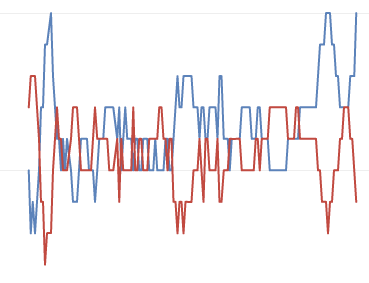
They have consistently shown a much smaller gap between the candidates than other polls, puzzling some. The puzzled can unfurrow their brow a mite at the latest data. Obama is now at 50 percent in the Gallup tracking poll. Rasmussen still believes the country is on a knife edge. In 2004, on this date, Bush was leading 52 – 44. But Kerry was about to make a huge comeback. Hence this lack of complacency from the Obama campaign:

Devastating. If you ran just clips of Romney's cynicism and Bill Clinton's convention speech, you could win this easily.

(Hat tip: Molly Ball, who saw it on Ohio TV and says it wasn't publicly announced.)

Why Is DC So Wealthy?

Lobbying_dc_wages

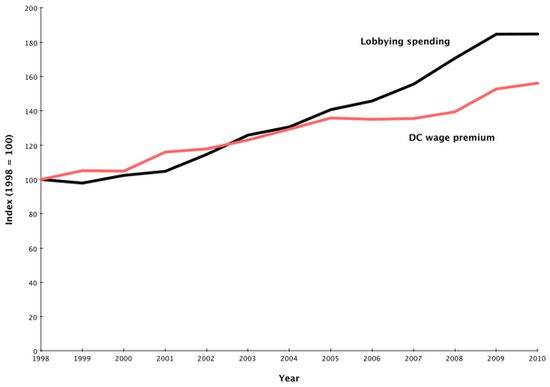
Dylan Matthews tests out the competing theories to why 7 of the 10 richest counties in America are in the DC area. District wages are now 36 percent higher than the national average, compared with just 12 percent in 1969. His conclusion:

The growth in inflation-adjusted lobbying spending, as measured by OpenSecrets, tracks the DC wage premium’s rise since the 1990s quite well. … And though lobbying alone is not a huge industry, its growth most likely grew in concert with other influence-peddling activities. The rise of influence-peddling more broadly, more than just lobbying, is likely what’s driving this correlation.

Ryan Avent, meanwhile, points to military contractors, arguing that this type of "clustering" tends to be good for local economies. Matt Steinglass has another theory:

The government isn't spending more money now than it was 40 years ago, as a percentage of the economy, so that doesn't explain why Washington is richer than other American cities. Rather, Washington is getting richer because the intensity of the struggle for influence at the centre of power has a natural tendency to keep spiraling upwards, and influence groups have to spend more on their struggles in the capital just to stand still. 

Douthat's two cents:

I think the best way to at least contain the Beltway influencers’ arms races are the boring, old fashioned, conservative ones: Look for reforms that make existing programs less amenable to political and interest-group intrigue, and if you can’t shrink the state’s footprint at least keep it roughly where it’s been these last few decades, instead of giving the D.C. area’s Littlefingers another 3-5 percent of G.D.P. to work with.

Almost Everyone Depends On Government

Suzanne Mettler and John Sides find that nearly every American is "both a maker and a taker":

[N]early all Americans — 96 percent — have relied on the federal government to assist them. Young adults, who are not yet eligible for many policies, account for most of the remaining 4 percent.

On average, people reported that they had used five social policies at some point in their lives. An individual typically had received two direct social benefits in the form of checks, goods or services paid for by government, like Social Security or unemployment insurance. Most had also benefited from three policies in which government’s role was "submerged," meaning that it was channeled through the tax code or private organizations, like the home mortgage-interest deduction and the tax-free status of the employer contribution to employees’ health insurance. The design of these policies camouflages the fact that they are social benefits, too, just like the direct benefits that help Americans pay for housing, health care, retirement and college.

Brad Plumer follows up:

The contentious bit here is how one views tax expenditures. There are two ways to look at the vast buffet of credits and deductions that Congress offers through the tax code. One is that these are essentially tax cuts. People making mortgage interest payments get to keep a bigger chunk of their paychecks than they otherwise would. A firm that offers its employees health insurance pays less in taxes than it would if it spent that money on extra wages.

The other way to look at these credits and deductions is that they’re essentially government spending programs in disguise. After all, if these deductions didn’t exist, then either the deficit would be smaller or everyone else could pay fewer taxes.

The Tough-On-Trade Charade, Ctd

Alec MacGillis digs up a video of Romney's eloquent defense of lowering trade barriers with China (it begins around the 31:10 mark). Money quote:

The tire workers of America look at these tires coming in from China and say this is not good for me…. And it will — as those tires come in it does hurt them directly, and therefore what their response is, their immediate response is, don’t let them in. But if that’s what their response is, my experience is over time, they will lose out slowly but surely, as they protect their lack of productivity with barriers, they will become less and less competitive, the foreign guys will get more and more volume, more and more successful.

Yet, Romney's recent web-ad (above), which Stan Abrams finds misleading, rips into Obama's China policy once again. Molly Ball reports that on the Ohio airwaves, it's all anti-China talk, all the time. This is more than a little hypocritical for both candidates, she notes:

Both Obama and Romney are clearly proponents of free trade. Obama has signed a number of new free-trade agreements, some of them proposed by his predecessor; beyond the WTO complaints, he's mostly taken a conciliatory, diplomatic line toward China, and he hasn't proposed to go further in a potential second term than the incremental steps he's taken in his first.

Romney, meanwhile, prefaced his anti-China spiel on Tuesday with a riff about the virtues of trade, and in his economic plan he promises to take many of the same free-trade actions Obama has already taken. And while Romney talks constantly about his plan to label China a currency manipulator, you never hear him go into what would happen next — the volleys of escalating tariffs that would ensue. Romney's big-money donors, many of whom, like Sheldon Adelson, have interests in China, don't believe he's serious about undertaking a full-scale trade war, or they wouldn't be able to sleep at night.

Earlier Dish commentary on both candidates' attacks on China here.

Torture’s Growing Popularity

Amy Zegart passes along dispiriting polling:

Respondents in 2012 are more pro-waterboarding, pro-threatening prisoners with dogs, pro-religious humiliation, and pro-forcing-prisoners-to-remain-naked-and-chained-in-uncomfortable-positions-in-cold-rooms. In 2005, 18 percent said they believed the naked chaining approach was OK, while 79 percent thought it was wrong. In 2012, 30 percent of Americans thought this technique was right, an increase of 12 points, while just 51 percent thought it was wrong, a drop of 28 points. In 2005, only 16 percent approved of waterboarding suspected terrorists, while an overwhelming majority (82 percent) thought it was wrong to strap people on boards and force their heads underwater to simulate drowning. Now, 25 percent of Americans believe in waterboarding terrorists, and only 55 percent think it's wrong. The only specific interrogation technique that is less popular now than in 2005, strangely enough, is prolonged sleep deprivation.

Buying Civilization

Shamus Khan remembers the days when paying higher taxes could be a point of pride for the wealthy:

In 1909, Republican president Teddy Roosevelt argued in favor of income and inheritance taxes, as they would promote, "equality of opportunity."  The programs required a constitutional amendment, and by 1913, 88% of states agreed that it was time to tax the income of its citizens. But not all its citizens — instead the income tax burden fell solely on couples who made over $4,000 (in today’s terms, around $88,000). If you made less, you paid nothing. And the more you made, the more you paid.

For the next 60 years Americans lived under a progressive tax structure. And while elites were not overjoyed to pay higher taxes than other Americans (and some sought ways to avoid them), most understood their tax burden as their civic duty. Franklin Delano Roosevelt argued that, "Taxes shall be levied according to ability to pay. That is the only American principle.” Supreme Court Justice (and Boston Brahmin) Oliver Wendell Holmes was known to "enjoy" his taxes. According to Felix Frankfurter’s book Mr. Justice Holmes and the Supreme Court, Justice Holmes told a young law clerk who complained about paying them, "I like to pay taxes. With them I buy civilization." 

Mitt Romney and Lucille Bluth differ:

Tumblr_maq2tcEJbz1rroj07o1_400