The Daily Wrap

GT_SPAIN_120925

Today on the Dish, Andrew praised Obama's UN speech and expanded on his Obama-as-Reagan thesis. Meanwhile, Iowa prepared to vote, Ohio leaned left and Eric McGhee doused hopes for a Dem House takeback. Romney's finances depended on how close the race is, Paul Ryan dismissed reinstating DADT and John Sides examined the white working-class vote. And as Dick Morris joined the poll skeptics, Scott Brown's supporters offended.

The US recovered faster than most other countries with financial crises, law enforcement complicated deportation policy and Fox fibbed. And as Obama administration stepped up prison rape prevention, Jeff Rubin worried about the end of cheap oil.

In global coverage, Libya needed militias and Chinese Buddhists drove elephant slaughter. More broadly, Dana Goldstein encouraged apprenticeships, Paul Campos advised on avoiding the law school trap and Lisa Beyer wanted to hold parents accountable for vaccination. Plus, TNC discussed black figures who hinder race relations.

Meanwhile, readers celebrated their dogs, psychopaths couldn't pass a smell test and Facebook stalking saddened the lovelorn. Robert Boyers then pondered political novels, e-books withstood deletion and Rob Dunn cherished plant beauty. And as two pitchers threw knuckleballs, boutique hotel minimalism infiltrated homes.

Andrew then praised jazz singer Sharon Clark, who is performing in NYC this week. Plus, FOTD here, Tweet of the Day here, VFYW contest winner here and VFYW here.

G.G.

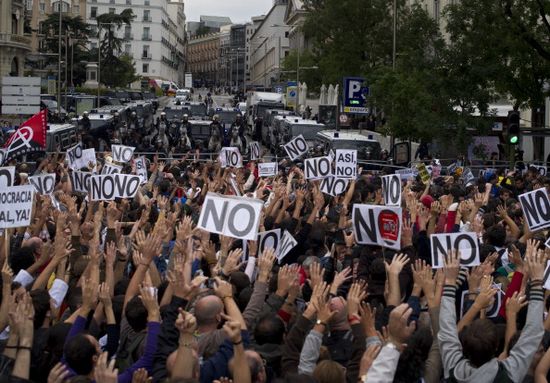
(Photo: Demonstrators in Madrid raise their hands in protest, while riot policemen wait at the other side of a fence blocking the access to the Spanish parliament, just before clashing during a protest against spending cuts and the government of Mariano Rajoy earlier today. By Jasper Juinen/Getty Images)

The Lives Of Leaves

2588099477_21cfffe411_b

Rob Dunn celebrates the celestial beauty of plants:

A leaf is filled with chambers illuminated by gathered light. In these glowing rooms photons bump around, and the leaf captures their energy, turning it into the sugar from which plants, animals, and civilizations are built. Chloroplasts, fed by sun, water, carbon dioxide, and nutrients, do the leaf’s work. They evolved about 1.6 billion years ago when one cell, incapable of using the sun’s energy, engulfed another cell—a cyanobacterium—that could. That cyanobacterium became the ancestor of every living chloroplast. Without their chloroplasts plants would be left like the rest of us, to eat what they find. Instead they hold out their green palms and catch light.

If there is magic in the world, surely this is it: the descendants of tiny creatures in leaves, capable of ingesting the sun.

(Photo by Flickr user cygnus921)

Ad War Update: Super Hacks

The Obama campaign is out with another variation of the 47%-related ad they released yesterday, and this one has a larger scope, airing in eight states (ad buy size unknown):

The campaign also released two web videos going after Romney, one bringing up a healthcare-related comment he made during last weekend's "60 Minutes" and the other using testimonials to cast a negative light on Romney's education record as governor. Nothing new from the Romney campaign today, and Maggie Haberman passes along word that, despite its numbers in the polls, the campaign is perfectly happy with the less-targeted approach it has been pursuing with its ads:

This has been a difference between the Romney campaign and the Obama campaign throughout the last several months. The Obama campaign has had a number of tailored, surgically-applied ads depending on the market; the Romney campaign has, at least in the ads released and captured by media trackers, stayed more with a singular approach.

Meanwhile, the RNC is continuing the GOP's kitchen sink approach in trying to thump Obama for having referred to the recent embassy attacks as "bumps in the road". After showing lots of chaotic footage, the web video calls the president's response a "crisis of leadership":

While a report from the Times today suggests the GOP Super PACs are "synchronizing" their ad messages, the WSJ's Neil King Jr. reports that so far the effect of outside spending on both the presidential and down-ticket races seems to have been minimal – at least as far as actually moving the poll numbers. One example they cite:

In Ohio, nearly $18 million in super PAC attack ads have targeted Democratic Sen. Sherrod Brown since last year, almost double what he spent in total to win election six years ago, records show. Yet he remains ahead of his opponent, state Treasurer Josh Mandel, by 7.2 percentage points in a running average of polls.

And Sherrod Brown's campaign released a pretty impressive one minute ad today championing a bill he sought in response to a fatal bus accident in Ohio:

Regardless of the effect the ads are having, Rove's Crossroads groups are still targeting Democratic Senate candidates, sinking $5.5 million into five races, including another ad in Ohio. Here is a new ad hitting Senator Bill Nelson in Florida:

In other down-ticket news, Jennifer Liberto reports that the Senate race between Scott Brown and Elizabeth Warren seat is now, at $48 million, the priciest down-ticket race this election cycle (and if you include the Super PACs that are active in the race, the total is actually $53 million). As we noted earlier, the Senate race there has heated up this week around the issue of Warren's heritage. Here is Brown's ad on the controversy:

And Warren's response:

Lastly, we missed this web video from Gary Johnson last week, but it's worth watching:

Ad War archive here.

Avoiding The Law School Trap

McArdle chats with Paul Campos, author of Don't Go to Law School (Unless). An exchange:

Megan: So what is your advice for people looking at law school? Is it a simple "don't go"?

Paul: No, it's "don't go unless you have a reasonable basis for believing that the cost of your law degree will make sense given your career prospects." I estimate that for around 80% of current law students their degrees won't be worth the costs they incur in getting them. So law schools should be producing vastly fewer graduates at a much lower cost.

Face Of The Day

GT_RAINDROPS_120925

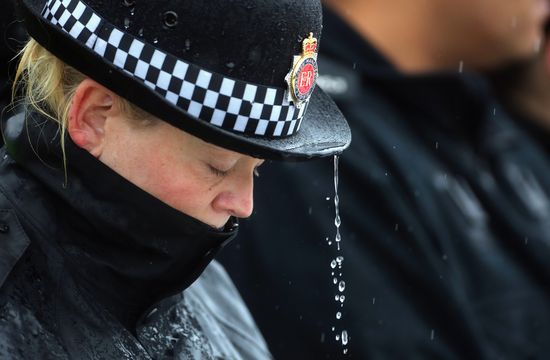
Rain drips from a female police officer's hat as she, members of the public and fellow officers take part in a one minute's silence during a memorial vigil at the scene where PC Nicola Hughes and PC Fiona Bone were murdered one week ago, in Mottram on September 25, 2012 in Manchester, England. Members of the public joined police officers in a walk from Hyde police station to the scene of the killings, for a vigil of prayers and reflection. Dale Cregan, 29, appeared before Manchester Magistrates last week accused of four murders, including those of PC Nicola Hughes and PC Fiona Bone on September 18, and also in two separate attacks earlier this year on Mark Short and his father David Short. Cregan is also being charged with an additional four counts of attempted murder. By Christopher Furlong/Getty Images.

The End Of Cheap Oil?

Jeff Rubin worries that oil is increasingly expensive to extract:

It’s not enough for the global energy industry simply to find new caches of oil; the crude must be affordable. Triple-digit prices make it profitable to tap ever-more-expensive sources of oil, but the prices needed to pull this crude out of the ground will throw our economies right back into a recession.

The energy industry’s task is not simply to find oil, but also to find stuff we can afford to burn. And that’s where the industry is failing. Each new barrel we pull out of the ground is costing us more than the last. The resources may be there for the taking, but our economies are already telling us we can’t afford the cost.

A few weeks back, Felix Salmon argued for regulation to prompt automakers to make more efficient cars:

The fact is that fuel-economy standards are a pretty good way of ensuring that carmakers can plan for a more fuel-efficient future, without worrying about competitors undercutting them with gas-guzzlers. If the US government ever comes to its senses and increases the gas tax, or if it — wonder of wonders — actually implements a broader carbon tax, then at that point you would have three different forces conspiring to make America’s fleet more efficient. You’d have the tax, you’d have the fuel-economy standards, and you’d have the general global increase in fuel efficiency.

Without new taxes, we’re down to two; and without new fuel-efficiency standards either, we’d be down to just one. And that’s dangerous, because the US market is big enough that at that point there’s always a risk that we could replay the era of SUVs and Hummers, with manufacturers of small, efficient cars running a risk that they might get crushed if oil prices fall.

Iowa Prepares To Vote

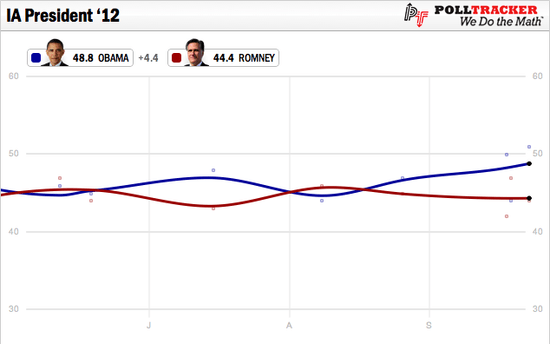
Iowa_Polling

Scott Conroy reports on early voting efforts:

On Thursday, Iowa will become the first swing state to begin early voting. Once it has been gradually rolled out nationwide, early voting is expected to be even more consequential than was the case four years ago — perhaps all but foretelling the winner of the presidential race before Election Day comes around on Nov. 6.

For months, staffers and volunteers at the Obama campaign’s more than five dozen Iowa field office have worked relentlessly to encourage Democrats to request absentee ballots, which any registered voter in the state is allowed to fill out and submit before the polls open officially in six weeks.

As of Monday, registered Democrats had requested 109,709 such ballots in Iowa, while Republicans there had requested less than one-fifth of that total (20,458).

The Fix provides a primer on early voting. An important point:

Democrats generally vote early more than Republicans. In the five 2012 swing states where a 2008 early voting breakdown is available, Democrats voted early more than Republicans in all five. Even in a very good GOP year in 2010, Democrats voted early more often than Republicans in North Carolina, Iowa and Nevada.

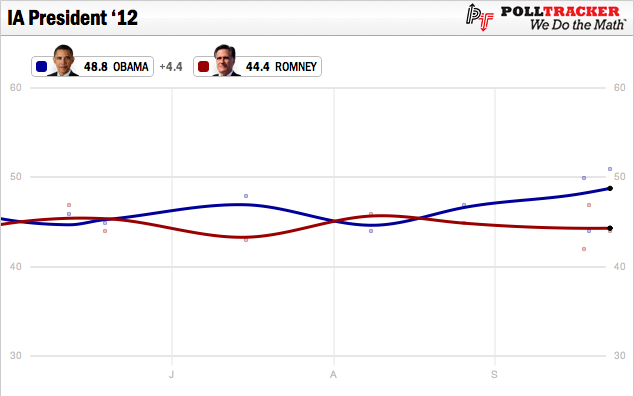
Chart from TPM.

Polls Are Now Part Of The Liberal Conspiracy, Ctd

It's no surprise that Dick Morris has joined the poll skeptics:

Almost all of the published polls show Obama getting less than 50% of the vote and less than 50% job approval. A majority of the voters either support Romney or are undecided in almost every poll. But the fact is that the undecided vote always goes against the incumbent… an undecided voter has really decided not to back the incumbent. He just won’t focus on the race until later in the game. So, when the published poll shows Obama ahead by, say, 48-45, he’s really probably losing by 52-48!

Relying on the work of Nate Silver, Dave Weigel notes that there is "literally no evidence that undecided voters will break the way [Morris] says they're breaking." Drew Linzer further unspins the GOP's new spin:

If the polls are all biased 2% in Obama’s favor, the simulation moves Romney up to a 37% chance of winning – still not great, but at least better than 8%. No wonder the Republicans are starting to challenge the polls. Unfortunately, there’s no serious indication that the polls are behaving strangely this year.

“To The Masses It’s A Circus Pitch”

Scott Tobias highlights a new documentary, Knuckleball!, about Tim Wakefield and R.A. Dickey – Major League Baseball's only pitchers last season to deploy the offbeat weapon:

There are essentially two things that can happen with a knuckleball. It can float toward the plate without spin, jerk around like boozy relatives at a wedding hall and make the world's best hitters look like hapless Looney Tunes characters. Or it can float toward the plate with spin, lope with a steady trajectory at 65 mph and give the world's best hitters the juiciest slab of red meat this side of Sizzler. When a knuckleball specialist is on, he's a magician, conjuring the dark and mysterious forces of the universe; when he's off, he's the pot-bellied assistant manager throwing batting practice…

Throughout the history of Major League Baseball, only one or two knuckleball pitchers have tended to play at any one time, which keeps the pitch on the endangered species list. Stern and Sundberg have done well to round up all the living knuckleballers for interviews, including old-timers like Phil Niekro, Charlie Hough and Jim Bouton, whose classic book Ball Four details his efforts to develop the knuckler when his other pitches faltered.

Watch the kooky pitch in action here.