The Apprentice Economy

Dana Goldstein encourages American companies to create apprenticeship programs for certain mid-skill manufacturing jobs:

There is a shortage of machinists who can operate the new, computer-programmed, robotic assembly lines that build cars, turbines, generators, steel and iron plumbing products, armaments, and shipping and packing equipment. There may be as many as 600,000 unfilled manufacturing jobs of this type, but compared with their European counterparts, American companies have shown little willingness to invest in training workers to fill these positions.

At last a small group of employers are importing the Northern European apprenticeship model to the United States. These programs combine classroom learning, typically at community colleges, with paid worksite training, and guarantee successful graduates a job. This is the sort of meaningful, fairly compensated work experience that is almost impossible to come by in our loosely regulated American internship culture yet is built into the educational systems of nations like Germany and Switzerland, where youth unemployment is far lower than it is in the United States.


Anesthetized Living

Grout

Matthew Sweet argues for mainting the distinction between hotel decor and the way we furnish our homes:

We expect a hotel room to be cleaned as thoroughly as if a corpse had just been hauled from the bed. (In some cases, this will actually have happened.) The domestic interior embodies the opposite idea: it is a repository of memories. The story of its inhabitants ought to be there in the photos on the mantelpiece, the pictures on the wall, the books on the shelves. If hotel rooms were people, they would be smiling lobotomy patients or plausible psychopaths.

He blames the boutique hotel for the way minimalist design has infiltrated our homes:

[I]t appropriated the vernacular of small-scale domestic design, giving its guests a sexed-up, spotless, intensified version of the home. It has effected a subtle revision of the relationship between the rooms in which people spend their lives and the rooms in which they spend their wedding anniversaries. The message of those magazine spreads is this: make your house look like somewhere nobody lives.

(Photo by Dean Kaufman of Dwell with Kaufman's permission, via Unhappy Hipsters.)

Ask Beinart Anything

Ask Beinart Anything

[Updated with questions from readers]

Peter Beinart is a long-time friend of the Dish and author of the critically needed book, The Crisis of Zionism. From one of my many defenses of the book against its knee-jerk critics:

The notion that Beinart ignores the standard and fair criticisms of past Palestinian leaders is simply wrong, as any reader will see. Yes, he presses the case that the Israelis and their American patrons have recently led the Jewish state into a dead end – but his book is an argument, not a history. He lacerates one side – persuasively, I might add – but doesn't excuse the other. … The real shift in US policy toward Israel has been the embrace of the settlements by the Christianist base of the GOP over the last decade and their continuing power. The real development is the fusion of Jewish and Christian fundamentalism around the cause of Greater Israel. Which means to say that a democratic Israel is living on borrowed time. And Peter's book will one day be seen as one lone protest, a marker that not everyone acquiesced in Israel's degeneration, not everyone put blinders on. Just most.

Read his latest writing at Open Zion. To submit a question for Peter, simply enter it into the field at the top of the Urtak poll (ignore the "YES or NO question" aspect and simply enter any open-ended question). We primed the poll with questions you can vote on right away – click "Yes" if you have a strong interest in seeing him answer the question or "No" if you don't particularly care. We really appreciate your help.

An Attempt To End Prison Rape

David Kaiser and Lovisa Stannow examine the Obama administration's program:

The Justice Department estimates that compliance with the new standards will cost about $55,000 a year per prison, and somewhat less for jails and other facilities. According to its cost-benefit analysis, this would be “justified” in financial terms if, nationally, the standards “reduced the annual number of victims of prison rape by 1,671 from the baseline levels, which is less than 1 percent of the total.”1

During the first few years in which standards are implemented, the rate of sexual abuse as measured by the BJS may actually go up, since inmates may become less afraid to report it. Thereafter, though, the trend should reverse, and much more dramatically than the department has dared predict. Previously in these pages, we have argued that even by a conservative means of calculation, reasonably well-crafted standards should reduce the incidence of prisoner rape by more than half.15 These standards—always assuming, of course, that they are adequately funded, carried out, and enforced—are good enough to do markedly better than that.

Previous Dish coverage here, here, here, here, here and here.

Bloody Icons

GT_ELEPHANTIVORY_120918

Bryan Christy reports on the rise of illegally traded ivory around the world. He notes that in China, "sales of Buddhist jewelry and related religious products have reached $15.8 billion a year and are growing by 50 percent a year":

By all accounts, China is the world’s greatest villain when it comes to smuggled ivory. In recent years China has been implicated in more large-scale ivory seizures than any other non-African country. For the first time in generations many Chinese can afford to reach forward into a wealthy future, and they can also afford to look back into their own vibrant past. One of the first places many look is religion. … “Ivory is very precious,” Xue tells me, “so to be respectful of the Buddha one should use precious material. If not ivory then gold. But ivory is more precious.” It is a version of the same message I heard from Filipino Catholics: Ivory honors God.

(Photo: Five tons of ivory worth around 10 million euros ($14 million) wait to be burnt on June 27, 2011 in Libreville, Gabon to mark his government's commitment to battling poachers and saving elephants. By Wils Yanick Maniengui /AFP/Getty Images)

The Paradoxes Of Dogs, Ctd

A reader responds to this post:

I didn’t even want a dog.  But my wife insisted, and finally, when I ran out of excuses, I (reluctantly) acquiesced and two years ago, we adopted Oscar, a 25 lb. French bulldog.Veggie

Don’t tell my wife, but Oscar has become the true love of my life.  I always had pets (cats, mainly) but I had never before experienced the kind of unconditional love I now have from Oscar.  And more than that, Oscar loves every part of his life, every moment, so earnestly and enthusiastically that I truly envy him.  I tell people (only half-jokingly) that if there is a next life, I want to return as Oscar. 

There’s lots more to say about Oscar, but I only have time for one quick story.

My mother died of cancer last year at age 71.  When she entered the hospice, Oscar and I would visit her, but she was asleep most of the time.  During our visits, I would walk Oscar around the hallway and introduce him to other residents, and he visited with them, and made them laugh and smile.  Who else could give dying strangers joy like that?  I don’t have that power; but Oscar does.  All I can do is share Oscar's personality and magnetism with others as much as possible. 

Another sends the above photo:

I thought all dogs ate vegetables.  Mine loves them.

Update from another:

The dog in this picture is so cute it makes my soul ache. I see babies and think "meh". I see a puppy and my ovaries quake.

A Nose For Evil

The results of new study suggest that psychopaths can't pass a smell test:

The researchers found that those individuals who scored highly on psychopathic traits were more likely to struggle to both identify smells and tell the difference between smells, even though they knew they were smelling something. These results show that brain areas controlling olfactory processes are less efficient in individuals with psychopathic tendencies. 

Poor smelling is thought to correlate with psychopathic traits because the orbito-frontal cortex both processes smells and regulates impulse-control and the observing of social rules. The potential implications for this particular study:

The finding could be useful for identifying psychopaths, who are famously manipulative in the face of questioning, says the paper, published in the journal Chemosensory Perception. “Olfactory measures represent a potentially interesting marker for psychopathic traits, because performance expectancies are unclear in odour tests and may therefore be less susceptible to attempts to fake ‘good’ or ‘bad’ responses.”

The Political Novel

LIt_1

Robert Boyers ponders how the genre's definition has evolved over the years, from something explicit to, more broadly, "the intersection of public and private life":

At a public interview I conducted with Nadine Gordimer thirty years ago, she bristled at my use of the epithet “political novel” to describe her masterwork, Burger’s Daughter. It was not, Gordimer argued, written to promote an agenda. It did not subscribe to a particular idea or ideology. To call it a political novel was to suggest that it had–as Henry James once put it–“designs” upon us, that its author wished to banish incorrect opinions and to install in their place clearly more beneficial views of politics and society. At their best, Gordimer contended, novels were not useful. If I admired her novel as much as I said I did, I would do better to regard it as a free work of the imagination, an inquiry with no purpose that involved providing answers to the difficult questions it posed.

I had no intention of reducing Gordimer’s book to a species of blunt propaganda, and I thought of the epithet simply as a shorthand for “a novel invested in politics as a way of thinking about the fate of society at a particular place and time.”

(Image from the installation Literature vs Traffic by Luzinterruptus via Wooster Collective)

E-Book Burning, Ctd

A reader quotes Maria Konnikova:

An e-book is not a physical book. That point might seem trite until you stop for a moment to think how much simpler it is, in a certain sense, to destroy electronic than physical traces.

But the opposite is equally true.  That is, it is much harder to destroy electronic than physical traces.  As anyone who has lost control of an image of themselves online can attest, electronic artifacts can be copied anywhere and everywhere at the speed of light, and be stored anywhere and everywhere.  They are extremely difficult to wipe out. DRM makes it harder to make, and therefore hang on to, copies of an e-book, but not all that much harder.

Is somebody going to go to the trouble for a book like Lehrer's?  Not likely.  But for the kinds of e-literature one might worry about being burned, the kinds that historically have been burned, people absolutely will.

Another writes:

For sure, it's simple for Amazon or Barnes & Noble to scrub a book's existence from their stores and devices. That's no small issue for those who care about protecting the right to free speech, especially at a time when the entire digital marketplace is dominated by so few publishers. However, the qualities that make a digital text so easy to pull from the "shelves" are the same qualities that make it almost impossible to eradicate.

Jonah Lehrer's book was bought and downloaded by thousands of readers before it was recalled. The tools to remove an e-book's DRM encryption are freely available and trivial to use, even for a low-tech buyer with a cheap PC. Once the book is decrypted, it's just another file on a computer, as easy to copy and send around as any photo or Microsoft Word document. E-book files are tiny compared to other commonly-pirated media like movies and music; most are under 10 megabytes, which is small enough to send as an email attachment. And if they're stripped of their fancy formatting and converted into plain text, they get even smaller. Project Gutenberg's entire collection of over 40,000 public-domain titles would fit comfortably on an average iPod.

A single e-book could be copied thousands of times in a matter of hours. It could be emailed to a list of random addresses; uploaded to dozens of peer-to-peer sharing services like BitTorrent; published in disguise on Tumblr or Facebook; or hidden inside another file and uploaded to any of a hundred free project-hosting services like deviantArt or GitHub. And in the miraculous event that some draconian government agency (or private bureaucracy) was able to track down and destroy every public copy of poor Jonah's opus, the book could be kept safe in any number of private backup services like Dropbox, Google Drive or Carbonite, all under anonymous and untraceable accounts, waiting for their owners to try again and again.

All it takes is a single person to liberate a single copy from the clutches of her $120 Amazon Kindle, and in a matter of minutes, that text is well beyond the reach of any corporate kill-switch – especially if a motivated group of people have dedicated themselves to its preservation. The traditional, Orwellian methods of censorship are powerless against the awesome technology that we have now placed in virtually every home in America. (This is, of course, not to underestimate the creativity of future despots.)

The Daily Wrap

GT_OBAMAPOINTS_120925
Today on the Dish, Andrew envisioned Obama as Reagan and hoped for his re-election to prompt change in Israel's coalition government. Meanwhile, Nate Cohn analyzed Obama's lead, and as Josh Barro noted that Romney can recoup his tax overpayment later, readers reminded us that notarization had no bearing on the veracity of Romney's tax summaries.

While early voting began, Romney buried his head in the sand about swing states, Joseph Cera outlined why Obama's bounce will hold and Matthew Continetti blamed the media for reporting poll results. The Obama campaign then rolled out 47% ads, Simpson and Bowles warned of the looming fiscal cliff and TNC discussed when Obama disappointed him most.

As Maine firemen supported marriage equality, John Corvino explained marriage equality rationales. Scott Reynolds Nelson then explained how America was founded on credit, the Seattle Times endorsed marijuana legalization, and while Evan Thomas liked Ike, Lewis J. Gould described TR's PR.

In world news, Andrew likened the MEK to the IRA, Libya fought back and Gourevitch critiqued intervention. Plus, data suggested the world's heating up.

In assorted commentary, Andrew looked forward to seeing "The Master" after reading a brilliant post. Meanwhile, cold offices slowed down employees – or perhaps they misunderstood procrastination – Jeff Wheelwright augured the future of our ageing nation, and Apple's map proved dangerous. Someone scrubbed Jonah Lehrer's e-book, Americans envied beer and electronic chess players cheated. And as Matt Bell graded in Beckett quotes, The Oatmeal captured dog diets.

Andrew and Dina shot here, VFYW here and MHB here.

G.G.

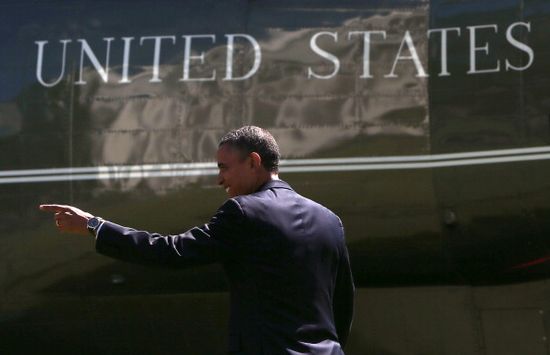
(Photo: U.S. President Barack Obama walks from the Oval Office to a waiting Marine One helicopter while departing the White House on September 24, 2012, in Washington, DC. Obama is scheduled to travel to New York City for the United Nations General Assembly. By Win McNamee/Getty Images)