Ad War Update: Don’t Touch That Mute Button

The Obama campaign puts out its first real ad utilizing Romney's 47% remarks. The TV spot will follow Romney to Ohio this week and combines the fundraiser remarks with the campaign's already prevalent tax return attacks (ad buy size unknown):

The Obama campaign also put out a tax-return focused web video comparing Romney to previous nominees. In a response to the two coal-centered commercials Romney ran last week, the Obama camp brings out some old Romney footage to hit back in eastern and southern Ohio (ad buy size unknown):

In a "60 Minutes" interview, Obama was asked about the tone of his campaign's advertising and the "mistakes" they've made:

"You know, do we see sometimes us going overboard in our campaign, the mistakes that are made, or the areas where there's no doubt that somebody could dispute how we are presenting things?" Obama said in a "60 Minutes" interview. "That happens in politics."

Team Romney is already trying to spin the comment. They are also using China as the bogeyman to criticize the president on trade (ad buy size/scope unknown):

Romney's "will-this-stick?" ad strategy apparently now includes noting Bob Woodward's reporting that Pelosi pressed the mute button during a healthcare conference call with Obama. It's TV length but might just be baiting the media, since the campaign hasn't announced if they'll actually put any money behind it:

And then there's a flat new web video out from the Romney campaign targeting young voters and trying to capitalize on Obama's "you can't change Washington from the inside" comment last week – which of course translates to "No I Can't" in the video:

In analysis news, Matthew Dowd argues that political ads on TV aren't anywhere near as influential as people may assume:

It becomes an easy myth to repeat that the money poured into ads will determine the election results. The media finds it easy to report on the amount of ad dollars spent as a quick way to describe a campaign. In the past few elections, though, the actual importance of advertising has dropped dramatically. In fact, there is little evidence that TV ads have made much difference at all.  After the 2004 campaign, I was involved in an analysis that showed ads made an insignificant difference. In 2008, Barack Obama outspent Hillary Clinton in Texas, Ohio, and Pennsylvania by more than two to one and lost all three in the primaries.  In the general election, there was no extra bump for Obama against John McCain in places in which Democrats considerably outspent Republicans. In fact, there was no difference in attitudes between the target states that saw the ads and non-target states.

Lastly, Senator Joe Manchin (D-WV) has his wife cut his hair – and that's why you should vote for him:

Ad War archive here.
“The Most Predictable Economic Crisis In History”

Alan Simpson and Erskine Bowles recently launched Campaign to Fix the Debt, an initiative to urge both parties to cooperate on debt reduction. Noting that the current fiasco "is too large to cut our way out, it's too large to tax our way out and it's too large to grow our way out," the two remind us what's around the corner:

Let there be no question in your mind: the fiscal path our nation is on is simply not sustainable. The only responsible course of action is to replace the fiscal cliff with the framework that gradually and thoughtfully reduces the debt over the next decade and puts America's fiscal house in order.

Things might be looking up on that front, according to a recent WaPo report:

“This is a referendum on taxes,” said Rep. Tom Cole (R-Okla.), a senior member of the House Budget Committee. “If the president wins reelection, taxes are going up” for the nation’s wealthiest households, and “there’s not a lot we can do about that.”…

[I]f Obama wins, the GOP would have no leverage — political or procedural — to force him to abandon his pledge to raise taxes on family income over $250,000, according to senior Republicans in the House and the Senate.

So they are beginning to contemplate a compromise that would let taxes go up in exchange for Democratic concessions on GOP priorities.

Batting down an argument from Paul Mirengoff,  Mataconis thinks there's something to the "referendum" notion:

Given that the candidate’s tax plans are likely to be a central point of discussion during October 3rd’s domestic policy debate, and that the President has spent the better part of the campaign so far highlighting the differences between him and Governor Romney on tax policy, I can’t see how you can argue that taxes will not be an issue in this election. Voters are being presented with a clear choice on the question of how to proceed on tax policy. If they end up re-electing President Obama, he is going to argue that it is in part an endorsement of his position, and he’d have merit in making that argument.

Meanwhile, Jared Bernstein examines what might happen if the upper-income tax cuts expire:

[I]n the really real world, the tax increase would be smart on a number of levels.  Allowing these high-end tax cuts to expire raises about $1 trillion in new revenue over 10 years, breaks the Norquist strangle hold, and sends an important and salutary signal to markets and others worried that US policy makers have lost the capacity to undertake sane fiscal policy.

The Geriatric Crossroads

Age_5_And_65

Jeff Wheelwright argues that Sun City, Arizona, "the once and future retirement mecca" with a population of 38,000 and a fertility rate of zero, provides a glimpse of our impending demographic troubles:

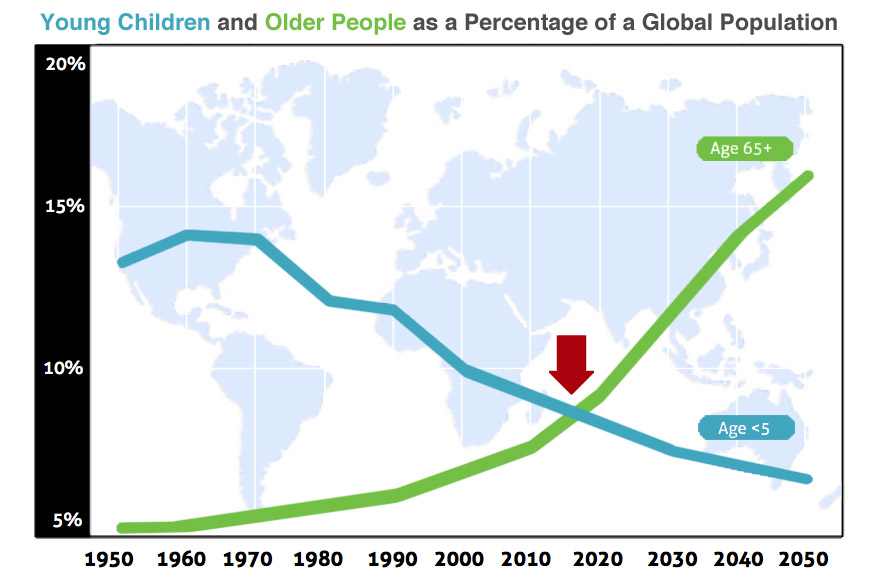
[Gerontologist Michael Birt] describes a favorite graphic of his, derived from a 2007 United Nations publication. He calls it “Solving for X” because of the problem it raises for the world’s health-care systems. Two lines are crossing, the percentage of people over 65 and the percentage under 5. Back in 1950, children predominated in the world; in 2050 the seniors will be on top. “The percent over 65 and under 5 are trading places,” Birt says. “We’re almost at the X spot.” The forecast date for global X to occur is 2017, but each country will arrive at the transition at a different time. “Japan blasted through its intersection years ago,” he notes.

Was there a single factor to account for this world-shaking reversal? “Yes,” [Jennifer Glick, a sociologist and demographer at the ASU Center for Population Dynamics] says. “You start educating girls.”

(Chart from ASU's Center for Sustainable Health, which has Birt as its director)

Will Obama’s Bounce Hold?

Joseph Cera provides reason to think so:

Once a cognitive investment has been made in a particular point of view, confirmation bias comes into play when new information is encountered.  Over the last two decades, researchers have repeatedly demonstrated that individuals discount or ignore incoming information that conflicts with a pre-existing viewpoint (Ditto and Lopez 1992; Edwards and Smith 1996; Taber and Lodge 2006).  Recent work by Brendan Nyhan and Jason Reifler has shown that in some instances, exposure to new information that contradicts previously held political views can actually trigger an intensified attachment to those old views—a “backfire effect”.  There is still a lot to learn about this phenomenon, but evidence suggests that the process of constructing counterarguments to newly encountered incongruent information leads individuals to develop a greater degree of mental organization and structure in support of their original beliefs than they normally would if left unchallenged.

Recently, Aaron Weinschenk and I have presented evidence that voters have made these types of cognitive investments in messages delivered during past conventions, and that once made these investments are resilient and in some cases strengthen under the pressure of subsequent conflicting information. 

Best Buds

James Lantolf, a professor of linguistics at the University of Pennsylvania, and his colleague, Larysa Bobrova, recently analyzed thirty-seven beer commercials in the U.S. and Ukraine. Linda Besner summarizes some of their findings:

In the Ukrainian commercials, the study notes, “people do not become friends by sharing beer; rather beer drinking occurs among individuals who are already established as friends, which entails a close and trusting relationship.” … By contrast, Dr. Lantolf notes that “friend” has become a very loose term in English; we call someone we met on an airplane half an hour ago a friend. “We speculate,” he writes with Bobrova, “that these commercials, most likely unintentionally, display an aspect of the American concept of friendship as superficial and transitory.”

To illustrate, they give the example of a Budweiser commercial currently up on Youtube under the name “Magic Beer.” A young man sits alone at a bar, opening a bottle. He pours it into his glass, but, miraculously, once the glass is full, beer continues to spill forth. Quickly, he pours some of the excess beer into the glasses of the men next to him. In the next shot, the bar is packed with carousers dancing to a live Scottish band as beer continues to gush from the magic bottle. The erstwhile lonely young man dances between his new friends, a beatific look on his face. Then he drops the bottle. It smashes on the floor, and the flow of beer trickles to nothing amid ghastly silence. The outraged people around him glare daggers. Those closest to him turn and walk away.

They come to the conclusion that "not only do Americans see beer as a person, they see beer as a person other people like better than them."

Still Liking Ike

In a preview of his forthcoming book on Dwight Eisenhower, Ike's Bluff, Evan Thomas pens an appreciation of the former president's greatest virtue – prudence:

In his second term in office, after the Soviets launched Sputnik, the world's first satellite, in October 1957, many Americans were near hysteria. Was a Soviet surprise missile attack next? Eisenhower's handling of the crisis shows a leader who refused to pander, who understood he was playing a long and dangerous game that required patience and a shrewd gambler's instinct.

Eisenhower came under immense pressure from Congress and within his own administration to build up U.S. forces. He resisted: he believed that too much military spending would hurt national security by running up a vast debt and harming the economy (Defense spending was over half of federal spending in those days, as opposed to less than one quarter today). He privately scorned "those boys" over at the Pentagon (his former military colleagues) who clamored for bigger weapons. He imitated Senator Lyndon Johnson of Texas trying to whip up public fears by raising his arms heavenward and crying out, "How long? Lord, how long?" That November, the poet Robert Frost came to see Eisenhower in the Oval Office and gave him a book of poems inscribed, "The strong are saying nothing until they see." "I like this maxim perhaps best of all," Ike wrote in his memoirs.

Checked By Tech

Dave McKenna reports on the rise of electronic cheating in competitive chess:

"I grew up when nothing was computerized and you had to live in New York or San Francisco to get to play against great players," [U.S. Chess Federation president Ruth] Haring says. "You just played your neighbor. Now, you can train against a grandmaster-strength program, and all the openings of all the great players are available at your fingertips. There are all these tools that have really opened up the game."

The dark side, of course, is that technology-aided cheating episodes have popped up all over the place in recent years.

The Apple Mapocalypse

I0s 6 map

iOS 6, the new iPhone/iPad operating system released last week, has replaced Google Maps with a a map app Apple built itself – except, as Tom Simonite notes, it doesn't really work:

People living outside the US seem to have been hit hardest, suffering problems such as one of Tokyo’s largest railway stations disappearing, large towns such as Antwerp in Belgium relocating, and Stratford-upon-Avon, Shakespeare’s birthplace, even disappearing altogether. Many people have also reported problems with directions given by the app, such as their offering a route to the wrong place.

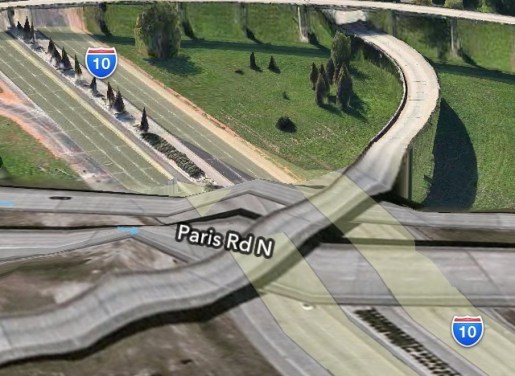
There are also significant bugs with the 3D view function, as seen above. Kyle Wagner believes Apple's maps will definitely get better, and that it's important to understand the sophistication required:

Maps are tough. They're not just about dumping data onto vector graphic maps and making it look pretty. Most mapping systems are built from a few huge data sets that are constantly being optimized and updated. But Apple's maps … are not updated, and they are certainly not optimized. They don't know that asking for "heathrow" is absolutely a question about the airport in London.

Google is working on a standalone app for iOS to replace the one Apple discontinued, but has said it could take months to arrive. In the meantime, Apple remains severely behind, as Rebecca Greenfield explains:

 [T]he issues stem from more than just a lack of data: Apple has a people problem. On top of all the technology stuff, there is a team of human beings behind all maps, who iron out the kinks and turn the data into a whole product the works well together. (Right now Apple's human are "under lockdown … working to fix it," says Apple.) Compared to Google, Apple's team is a joke in [mapping industry executive Mike] Dobson's book. Not only does Google have 7,000 people already working on mapping, but, the smaller contigent at Apple was not as involved in the map-making process. As Alexis Madrigal's [excellent piece about Google's mapping operation] made clear, people make a huge difference when it comes to map quality. "The sheer amount of human effort that goes into Google's maps is just mind-boggling. Every road that you see slightly askew in the top image has been hand-massaged by a human," he wrote. Apple just doesn't have enough humans on hand to take that kind of care.

David Talbott is ticked

It’s nuts that a service that used to work well (when it was Google Maps) suddenly become not only ineffective—but actually counterproductive, even dangerous.  So much so that this debacle might warrant re-asking the question of why the software industry has to meet virtually no standard, no bar of accuracy, no guarantee of reliability–on what tens or hundreds of millions of people increasingly rely on.

(Image via The Amazing iOS 6 Maps Tumblr – another good example here)