A reader sends in a campaign poster in Papua New Guinea (yes, Dishheads are everywhere):
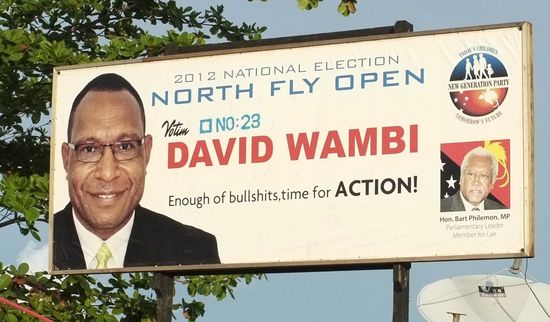
A reader sends in a campaign poster in Papua New Guinea (yes, Dishheads are everywhere):
The Senate just voted by that overwhelming margin on a non-binding motion to back a foreign prime minister, Binyamin Netanyahu, over the president of the US, in declaring that the US would act if Iran gained a capability for a nuke, regardless of whether it decided to weaponize it:
The "capability" debate was initially framed as one over "containment" in February, and hawks like Graham found little bipartisan support until their position became a centerpiece of the AIPAC policy conference in March.
AIPAC does its work with unremitting diligence. I favor containment as the least worst option. But that obvious position is held by no-one in power in Washington. Including Obama.
William Gibson argues that we shouldn't read the genre to peer into the future:
I think the least important thing about science fiction for me is its predictive capacity. Its record for being accurately predictive is really, really poor! If you look at the whole history of science fiction, what people have said is going to happen, what writers have said is going to happen, and what actually happened — it’s terrible. We’re almost always wrong. Our reputation for being right relies on some human capacity to marvel at the times when, yay, you got it right! Arthur Clarke predicted communications satellites and things like that. Those are marvelous — it’s great when someone gets it right, but almost always it’s wrong.
If you’ve read a lot of vintage science fiction, as I have, at one time or another in my life, you can’t help but realize how wrong we get it. I have gotten it wrong more times than I’ve gotten it right. But I knew that when I started; I knew that before I wrote a word of science fiction. I knew that about science fiction. It just goes with the territory.
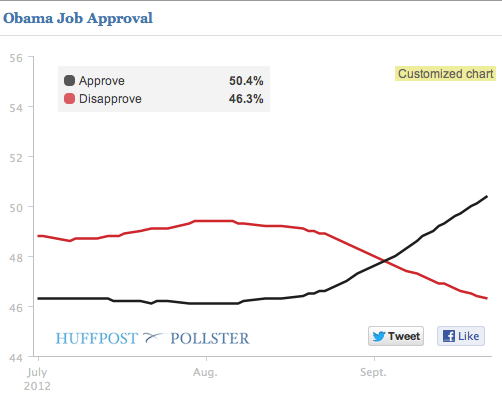
… a simple fact. More Americans are approving of his record, and I think Bill Clinton's speech was critical to that. He provided a story, prodded our memory of the last decade, and reminded us of the inevitably tough way out of a ditch of soaring debt and near-depression Obama inherited.
(I increased the intensity of the poll above, but the shift is clear with more moderate smoothing as well.)
Feel the burn:
In Canada, the evolution is almost as remarkable as in Britain. Only the GOP in the West remains actively hostile – but that’s because they’re not a conservative party, but a fundamentalist movement.
Joe Hiland, the editor of the Indiana Review, wrote a note to potential contributors about what sort of submissions are almost instantly rejected. He describes three different types of cliche-ridden stories that are eliminated "simply because I read the first three or four pages and say to myself, 'I’ve read this story before.'" Behold one of these categories, what Hiland labels "Scholars Misbehaving" stories:
These stories follow a) precarious graduate students or b) disillusioned professors as they indulge in various intoxicants and engage in ill-advised affairs with a) precarious undergraduates or b) precarious graduate students, respectively. The prevalence of “Scholars Misbehaving” stories is perhaps an inevitable side effect of the number of contemporary writers who have been through the academy (and can’t seem to keep their pants on), but these stories tend to suffer from two major shortcomings. First, they’re often packed with dense, sometimes esoteric, passages about the main character’s academic pursuits. Reading Chaucer can make for a pleasant evening. Reading about a character who’s reading (and hyper-analyzing) Chaucer…not so much. Second, these stories frequently start with depression and go downhill from there. Too often, the protagonists in “Scholars Misbehaving” stories simply aren’t sympathetic. They’re characterized by little more than their status as misbehaving scholars, and so much of the space that could be devoted to what might make these characters unique and interesting is devoted instead to the aforementioned academic passages that clog up the story and slow down the narrative.
Relatedly, you can peruse rejection letters from a wide array of literary journals at RejectionWiki.
(Hat tip: The Paris Review)
In a review of the recent spat of memoirs penned by rappers, James Guida ponders Jay-Z's bonafides as a poet:
In Decoded, Jay-Z reveals himself as an unlikely hip-hop statesman. He likes acts both old and new and from all over the country. This catholic view helps him make the case that rap is rooted in tradition. But is the tradition chiefly a poetic one? “Rap is poetry,” Jay-Z says, “and a good MC is a good poet.” Clearly the music is a monster of living vernacular, and has plenty in common with poetry—besides rhythm and rhyme, there’s a love of phrase, simile, and metaphor. But rap is also preeminently oral, sharing qualities with acting, storytelling, and the high arts of bullshitting and invective. It makes more sense to locate its roots elsewhere, in street corner talk, toasting, and other musical genres. The music critic Kelefa Sanneh, reviewing Decoded in the New Yorker, captured the problem nicely: “Sure, he’s a poet—and, while we’re at it, a singer and percussionist, too. But why should any of these titles be more impressive than ‘rapper’?” In other words, why the need for literary prestige? After all, rappers enjoy collaborations, gatherings on boats, and the right to squash foes real and imaginary and pun all day without reprisal. And let’s not forget the heart of it, the exaltation of sailing endlessly on a rhythmic current of speech. If Jay-Z wants to be thought a poet, many actual poets would probably jump at the chance to switch places.
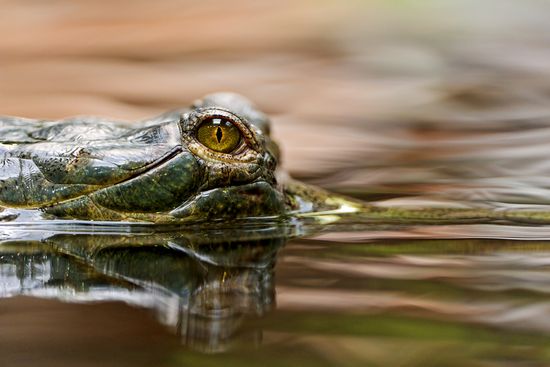
“The Crocodile” by Lewis Carroll (1832-1898):
How doth the little crocodile
Improve his shining tail,
And pour the waters of the Nile
On every shining scale!How cheerfully he seems to grin,
How neatly spreads his claws,
And welcomes little fishes in
With gently smiling jaws!
(Photo by Flickr user Tambako the Jaguar)
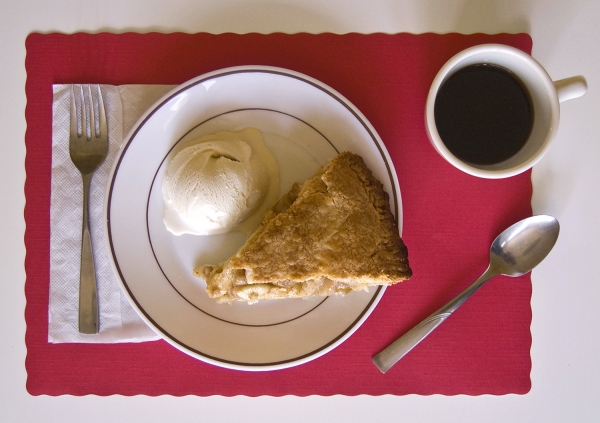
Laura Krantz adores the photography of Dinah Fried, who takes vivid culinary scenes from great books and brings them to (still) life:
I remember the hoecakes and the maple snow candy from Laura Ingalls Wilder's books. My favorite scene from Roald Dahl's "Boy" is in the candy shop. The details of meals and food and eating always stay with me long after the plotlines have faded.
So when I saw a series of photographs by Dinah Fried being passed around Tumblr, I knew I'd found a kindred spirit. Her "Fictitious Dishes" recreate the food scenes from a range of books, largely classics like "Moby Dick" and "The Bell Jar."
"For me as a reader, and in life as well, I remember the eating scenes in books," says Fried on the phone. "They really bring me to an emotional place in the character and the book."
The above photograph was inspired by Jack Kerouac's On the Road: "I ate apple pie and ice cream — it was getting better as I got deeper into Iowa, the pie bigger, the ice cream richer."
(Photo used with the permission of Dinah Fried. Follow her on Twitter @dinahfried)
 The Dish