Ad War Update: Making The Grade

The Romney campaign is out with a new Spanish language ad targeting students (ad buy size/scope unknown): Justin Sink translates:

“Four years ago, Hispanics hoped Democrats would get an ‘A’ in improving our education,” a narrator says. “The reality is that more than 75 percent of the population thinks that college is not affordable. Tuition costs have increased 25 percent under Obama and the Democrats, and total student debt has reached a trillion dollars.” The video then transitions to a clip of Obama saying he wants to be held accountable on education.“When it comes to education, Obama and the Democrats have failed our kids,” the narrator says, before presenting Obama with an “F” grade.

The Romney campaign also released a Spanish version of the Rubio ad we ran yesterday. And the RNC is up with a new web ad hitting the president on his “you can’t change Washington from inside, only from the outside” comment yesterday – something the GOP has been doing a lot in the last 24 hours. Meanwhile, the Obama campaign is out with two seniors-focused videos today, one a three-state TV ad related to Medicare (ad buy amount unknown): And then also this web video applying Romney’s 47% comments to seniors on the street:

In outside money news, last month the pro-Obama Super PAC Priorities USA out-raised its pro-Romney counterpart, Restore Our Future, $10.1 to $7 million. However:

American Crossroads, the Karl Rove-connected super PAC that has spent millions supporting Romney as well, raised $9.4 million while spending $6.9 million. That leaves American Crossroads with a whopping $32 million still in the bank, which it can let loose as an an enormous water balloon of negative advertising in the closing weeks of the campaign.

A new NYT report goes into some depth regarding each campaign’s money situation – it’s worth reading in full, but in essence it says that the Obama campaign is in a surprisingly good position financially, both as far as money on hand as well as what investments they’ve already been able to make regarding advertising and the ground game. Romney meanwhile is not doing as well for a variety of reasons including the restrictions on pre-convention spending, the inflexibility that comes from relying on larger donors than Obama, and the costs of building out his ground game. 

Ad War archive here.

The Paradoxes of Papa’s Style

Continuing The New Yorker's series on writers and books their contributors return to "again and again," Brad Leithauser muses on Hemingway's "inherently paradoxical style, calculatedly ungainly, terse, and fluid at once". Despite his criticism of Hemingway's limitations, and too-frequent descent into near self-parody, Leithauser admits his best work is remarkable:

[T]he underpinnings of Hemingway’s style seem especially unpromising. The deep reliance on the most insipid of approbative terms: "nice," "good," "pleasant." The stringing together of phrases with that most colorless of connectives: "and." The limp verbs ("is," "was," "were") and the shameless recycling of "there is" and "there was." The avoidance of most adverbs except the most hackneyed ("suddenly," "incredibly").

The wonder lies in just how extraordinarily full of nuance and verve are the scenes Hemingway can create with such coarse and unlikely tools. He has peerless moments: the harrowing explosion of the mortar shell in "A Farewell to Arms"; the painstaking erecting of a tent in "Big Two-Hearted River"; the repetitions building to a profound unease, and then to a sad resignation more uneasy-making than any unease, in "The Killers"; the astronomically vast dispersals of ocean current and cloud in "The Old Man and the Sea."

Recent Dish coverage of Hemingway here, here, here and here.

“A Beautiful Lie”

Chris Jones profiles Teller, the mostly-silent half of Penn and Teller:

There is a lecture about belief that Teller has given exactly four times. … The real point of magic, Teller said during those lectures, is "telling a beautiful lie. It lets you see what the world would be like if cause and effect weren't bound by physics." It's the collision between what you know and what you see that provides magic's greatest spark.

Debating The Debates

In a conversation over at Daily Intel, Jim Fallows and Josh Barro consider the importance of the debates. Barrow expects them to be "uneventful" since Romney and Obama share "defensive debating styles":

Their strength in debates is mostly about not making mistakes, rather than landing grand knockout punches. I can't remember anything Barack Obama said in the debates in 2008, primary or general. Romney did have a couple of memorable moments in the primaries — "helping" Rick Perry remember the names of cabinet departments, listing the shifting set of pork-barrel panders that Newt Gingrich would tout depending on which state he was in. But that was sort of shooting fish in a barrel.

Fallows believes that "among the various elements that go into effective political performance" debates are "by far the area of Romney's greatest skill." Obama's debating abilities, on the other hand, are not his strongpoint, says Fallows:

[W]ithout going into all the details, it strikes me that debating is near the lower end of Obama's range of performance skills. Very effective set-piece orator, usually effective at press conferences and so on. But at least against Hillary Clinton, not really that memorably effective. So we have the high end of Romney's skills and the low-average range of Obama's. 

The Struggle Over Gay Stereotypes

Reviewing David Halperin's book, How To Be Gay, J. Bryan Lowder zeroes in on how gays going mainstream had to reject queeniness:

Halperin is at his best when critiquing the current assimilationist model of gay-rights activism, with its denial of any cultural interests or aesthetic points-of-view that hint of femininity or campiness or of the "stereotypically gay." His cultural history of how this attitude emerged in the 1970s will be surprising to those who view the gay-rights movement as a consistently positive progression; Halperin argues convincingly that as butch masculine styles became ever more mandatory, both for attracting sexual/romantic partners (no femmes, no fats!) as well as earning political credibility, the push toward conformity lead to the "euthanasia of traditional gay male culture."

(Video via Copyranter)

Voting On Foreign Policy

Dan Drezner explains why he is "one of the 5 percent … who vote in presidential elections based on the foreign policy views of the candidates":

It’s precisely because presidents have so much more leeway to do what they want in the global realm that I now vote based on foreign policy. Mistakes in international affairs can lead to incalculable losses in blood and treasure. Paradoxically, if Americans suddenly started to vote based on national security issues, presidents would have to start to care about the domestic political consequences of their overseas actions.

Who knows, they might just start redirecting their efforts to problems at home.

Romney’s Tax Release: No Big Surprises

Romney_Speech

Today, Romney released his tax returns for 2011 and a notarized summary of his returns from 1990 to 2009. In 2011, the Romneys paid $1.9 million in taxes on $13.7 million in income, the majority of which came from investment. Annie Lowrey sums up how the Romneys' rates compare with the rest of ours:

The Romneys paid a higher effective tax rate than the average middle-income American, though a significantly lower rate than the average rich, or very rich, American. According to the nonpartisan Tax Policy Center, the middle quintile of taxpayers – earning between $33,542 and $59,486 a year – had an effective direct federal tax rate of about 12 percent in 2011. The top 1 percent of earners, making more than $532,613 a year, paid a direct federal tax rate of about 22.7 percent. And the top 0.1 percent of earners, making more than $2,178,886 a year, paid a direct federal tax rate of about 21.4 percent.

Yglesias explains why Romney's effective tax rate is so low. Meanwhile, Brad Plumer thinks it's kind of weird that, by only reporting $2.25 million of his $4 million in charity for deduction, Romney paid more in taxes than he needed to:

[If he had claimed the full $4 million, it] would have conflicted with his statement in August that he has paid at least 13 percent the past ten years. So Romney opted to limit his charitable deduction to just $2.25 million, essentially agreeing to pay the government more in taxes than he needed to. In the end, Romney had an effective federal tax rate of 14.1 percent.

There’s nothing wrong with voluntarily donating a bit more to reduce the federal deficit. Although there is this awkward quote from Romney during a primary debate in January: “I pay all the taxes that are legally required and not a dollar more,” he said. “I don’t think you want someone as the candidate for president who pays more taxes than he owes.”

Also noting Romney's self-disqualification for the presidency, Zeke Miller and Rebecca Berg share the campaign's explanation:

An email to the Romney campaign account dedicated to responding to questions about tax returns, returns@mittromney.com, produced this response:

He has been clear that no American need pay more than he or she owes under the law. At the same time, he was in the unique position of having made a commitment to the public that his tax rate would be above 13%. In order to be consistent with that statement, the Romneys limited their deduction of charitable contributions.

Benjy Sarlin asks:

Did Romney artificially inflate his tax rate using the same strategy in other returns? That’s the biggest question raised by the disclosure of his move to take fewer deductions in 2011. The Romney campaign did not immediately respond to questions over whether Romney amended any of his previous returns.

Jacob Weisberg frames it another way:

Romney’s charitable contribution to the Treasury concedes this unfairness. The real reason Romney is overpaying is that it simply feels wrong to most people, if not also to him, for someone who earned $13.7 million to be paying less than 13 percent of his income in taxes when working people face a payroll tax of 13.3 percent on their first dollar of income. By yielding to political criticism and moral pressure about how little he pays, Romney implicitly accepts that under a fairer tax system, people like him would be required to pay more.

Meanwhile, important details on the tax returns from 1990 to 2009 are missing. The notarized letter claims that Romney paid an average of 20.20 percent over that time period. Greg Sargent notes that how that number was calculated could be problematic:

If Romney paid his lowest rates in a number of the higher income years, the overall 20 percent figure would overstate the rate he actually paid over the whole period. [The Tax Policy Center's Roberton] Williams provided the following purely hypothetical example: “Let’s say you have 10 years in which you paid 13 percent in taxes, and 10 years in which you paid 27 percent,” Williams told me. “If you average those rates, you’ll get an overall rate of 20 percent. But if the 13 percent years were high income years, and the 27 percent years were low income years, then his total taxes paid as a share of total income over the 20 years would be less, perhaps significantly less, than 20 percent….”

Williams concluded: “The only way we can know for sure what rate he actually paid is to see what his tax payment and his income was for each of the 20 years.”

The letter also states that "the lowest of any annual 'effective federal personal income tax rate' for any year during the period [of 1990 to 2009] is 13.66%," putting to rest at least some of the rumors about his 2009 returns that dogged the campaign throughout the summer. David Graham, meanwhile, wonders about the timing:

The campaign sent out Brad Malt's memo in midafternoon and posted the taxes at 3 p.m. That's late enough in the day to look like a Friday afternoon news dump but, paradoxically, probably not late enough to keep it from dominating the next 72 hours or so. Previously, the Romney team had said the candidate would release his returns by October 15. It seems they hope to dull any blowback by putting more time between the release and the election. What's more, it's coming at the end of an awful two weeks for Romney. As long as the night is already pitch dark, what's one more cloud in the sky? Might as well get it over with, right?

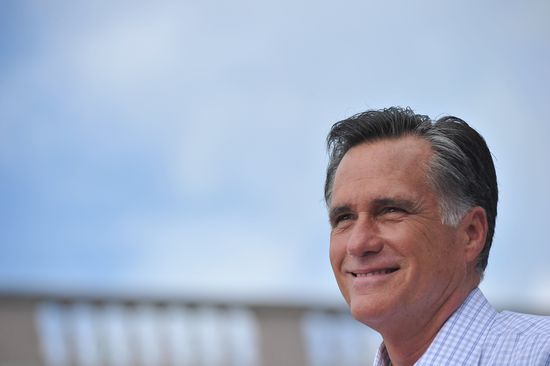
(Photo: US Republican presidential candidate Mitt Romney speaks at a campaign rally at the Ringling Art Museum in Sarasota, Florida, on September 20, 2012. Nicholas Kamm/AFP/GettyImages)
Undecideds Are Breaking For Obama

Undecided_Decide

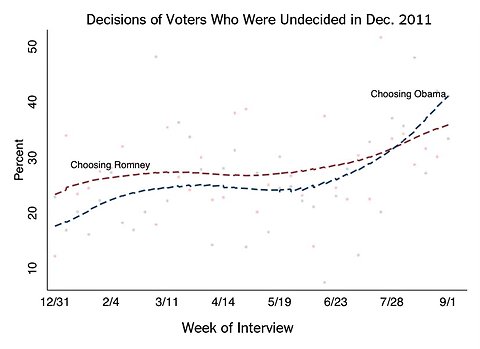
Lynn Vavreck checks in with the fence-sitters:

Taken together, there is good news in these numbers for the president. He has the advantage among undecided voters who are making choices as Election Day draws near, and his initial supporters are quite loyal. Even among the small set of voters changing their minds, Obama is on equal footing with, if not slightly ahead of, Romney. Of course, there are six-and-a-half weeks and three presidential debates to go in the 2012 race. Maybe the last 40 or 50 days will be pivotal — but I’m not betting on it.

The GOP’s Best Isn’t Good

Kevin Drum continues to argue that Romney "was, without much question, the most electable of the primary bunch and the toughest opponent for Barack Obama":

Romney was the best they had. The very best. Let that sink in for a bit.

Herman Cain disagrees. Josh Marshall comments:

Needless to say, the factual claim here is preposterous, as are most things Cain says. But the drip drip drip of casual disrespect for Romney from supposed supporters and the assumption that he's a bad candidate who's destined for defeat is no joke.

Meanwhile, John Sides asks whether Romney really is a bad candidate. Andrew Gelman nods vigorously:

There’s evidence from various sources that centrists do better in elections compared to political extremists. When I looked at Romney several months ago, I thought voters would like him because, compared to his primary-election rivals Gingrich, Santorum, Bachmann, etc., he’s a centrist. I was wrong when I predicted that "Romney will start the general election campaign with a healthy lead." One thing I didn’t account for was that Romney has not done the expected move to the center during the general election campaign.