Women Aren’t Victims Of The Hookup Culture, Ctd

Readers continue the popular thread:

Does this reader ever eat for the sheer pleasure of eating? Hike in a big, useless circle in the woods in order to enjoy fresh air? Yes, sex creates life but we use most of our potential frivolously most the time. To reduce the fantastic recreational potential of sex to "a culture of death," and to offensively assume that these recreational encounters are superficial or that they are enjoyed with people that you don’t really care about and probably don't want to see again, is to deny one of the things that makes us human – our capacity for play. We inject frivolity into many of the things we do, and when we do this we create meaning.

I don't begrudge the pleasure and meaning the reader is getting out of harnessing his or her libido to procreation, but I tremendously resent the idea that this is the only way to make sex meaningful. All of the sex I have is recreational, and I have plenty of it, with plenty of people. These experiences are mostly beautiful and always meaningful, and I care greatly about the people I share my body and time with. To live without this pleasure, which hurts no one, would make my life feel needlessly empty.

Another quotes another:

"Marriage is about love, commitment, service, not about pleasing each other." What!?! Pleasure isn't something that's important in a marriage? How dull!

Full disclosure: I'm a non-religious, straight white male, and single. What the "hookup culture" has taught me is that the sexual tastes I had when I was 18 have grown in the past ten years. I discovered that I love pegging (cue Dan Savage) and other sex acts that a lot of my partners didn't feel so strong about. I feel that this personal development has enhanced my life, I enjoy a variety of sexual experiences and I want to find a long term partner that I can be GGG with. Yay for an enhanced sex life! If I were to marry the first person I ever dated (I almost did), I would either be 1) completely ignorant of everything that I've discovered in the past 10 years about my sexuality, or 2) completely miserable since my partner would never strap on and go to town …

Another:

I thought I would put in my two cents.  I was a virgin when I married.  In the time before and even after I was married, I had some opportunities to hook up with women, all of which I passed up.  It was easy then; I was a newlywed.  I even turned down a spectacular opportunity just two years ago.  At the time I was afraid of not being able to live with myself if I did it, but I was also afraid that I could have lived with myself.

Now I am nearing 50.  I am still married, and I plan to stay that way.  I love my wife dearly, but the doubts and regrets that used to creep in now won't go away.  I guess I'll learn to live with it, but remaining a virgin until marriage isn't something I would recommend.

Another:

The story of my own relationship is radically different from your Mormon reader's experience.  I met my wife 25 years ago next month, and we hooked up at the end of our first date.  No drugs and only a little alcohol were involved.  We enjoyed the experience so much that we did not leave her bed for a week, except occasionally to wash up and eat.  (Oh, to be a university student again!)  Over the next several weeks we missed a lot of class.

We were both foreign students in a university town that did not offer many diversions.  We met in the middle of the semester and both assumed that we would return to our home countries at term's end, never to see one another again.  We are reasonably intelligent, strong-willed people from different cultures, and as a result we clashed frequently during our first weeks together.  Objective observers would have concluded that we were totally incompatible; we argued often.  The only thing that held us together was the awesome sex and the difficulty of carrying on a prolonged argument in the host country's language (as neither of us spoke the other's native language).

I don't think either of us would have said that we were in love.  The semester ended; we parted, but we wrote to one another.  We found a way to get together, we had more awesome sex, and then we parted again.  We reunited, had more awesome sex and kept repeating this pattern.  At some point we began to find that we enjoyed each other's company outside the bedroom, and about six to nine months in, I realized, holy cow, I'm beginning to fall for this woman.  When people ask now how we met, we explain that we had a one night stand that ran amuck.

Despite our profoundly different relationship stories, I share one important thing with your Mormon reader: we both have deeply satisfying, deeply loving, holy relationships with our wives.  We also have one significant difference:  I would never, ever suggest that my experience should be a model for anyone else's relationship. 

And this is perhaps the major point of difference between your Mormon reader and me.  Your Mormon reader and his friends managed, in a highly sexualized society in which virginity at marriage is most definitely not the norm, to stay true the dictates of their Church.  This is admirable, and I am genuinely happy that it has worked out so well for them.  Nevertheless – and your Mormon reader should please forgive me if I am misinterpreting him – he seems to suggest that society and most individuals would be better off if people followed the Mormon precepts and refrained from having sex until marriage, that the Mormon way leads to better, healthier, happier relationships. 

This I find presumptuous.  What worked for your Mormon reader and his friends may or may not work for anyone else.  Hot hookup sex ignited a truly beautiful relationship for my wife and me, but I'm not about to evangelize it.

There is one other similarity between your Mormon reader and me that might surprise him:  our Church and faith play an equally central role in my wife's and my life and relationship – and have almost from the very start.  We pray; we raise our children in the Church; we serve as lay leaders.   It's just that we – along the other members of our very inclusive, LGBT-friendly Church community - aren't really hung up on the sex thing.

You see, I'm not sure whether I believe in the Final Judgment, but if I do come before God on Judgment Day, I expect to be held accountable for my arrogance, my occasional lack of compassion, the times when I have judged others.  I expect to be asked what I have done for the least of God's children, for the poor, the lonely, the imprisoned, and I will probably have to answer, with more than a little regret, "Not enough, Lord."  I may be wrong, of course, but I'm pretty sure the matter of my premarital relations with my wife (and the small number of girlfriends who preceded her) won't even enter the conversation.  We'll have plenty of other, more important, things to discuss.

To read the entire Dish thread on the hookup culture, go here.
Obama Volleys Back Again

He tackled the 47 percent comment yesterday. Round two:

Jonathan Bernstein wonders why Romney picks such feeble attacks. One theory:

All Romney's campaign has to do is pull out a sentence and call it a gaffe, and it instantly becomes one. It blows up on twitter, it goes straight to Fox News and most of the conservative radio shows…it's all over the place. Indeed, if it's in those places, it's also going to be in Politico and Buzzfeed, too. So on the one hand, it must encourage laziness to know that all you have to do is come up with something vaguely appropriate to movement conservatives in order to get that effect; on the other hand, it must just feel as if you're making something happen when you do it. And the more it hits the sort of things that the GOP-aligned media loves, the more you get the immediate effect. Really, for campaign operatives, it must be incredibly temping to do it.

Benghazi’s Identity Crisis

Two dueling protests are scheduled today in Benghazi: One is another anti-film protest planned by Ansar Al-Sharia, the Islamist militia that remains a prime suspect in the consulate attacks, while the the other (seen above) has been organized by residents and activists to pressure Ansar Al-Sharia and other extremist groups to disband, as well as to urge the central government to get more involved. Chris Stephen reports on a city at a crossroads:

“Everything we have been working for has been crushed,” says Hana el-Galal, one of the city’s most prominent civil rights activists. Until last week’s attack she had been confident after the success of trouble-free elections in July. She and other rights groups had been due to meet Stevens the day after he died. “We lost a friend and nationally we lost a lot.” Signs of just how much Libya threatens to lose if the killers are not brought to justice and the militias disciplined are all around: all foreign missions in the city have been evacuated, together with the United Nations.

Earlier in the week, Marc Lynch reflected on the disagreements within Arab Spring nations:

The Islamist protestors using the YouTube film to whip up outrage are only one small voice in a contested, turbulent new public sphere. The new Arab public is far more diverse and self-confident today than it was six years ago, and able and willing to push back against simplistic interpretations. Political jockeying between Muslim Brothers and salafis in transitional countries may create incentives for outbidding on Islamic issues, but the political arena — both at home and abroad — offers more countervailing forces and pressure points. Leaders of transitional governments have different political interests than did the old dictators, as do Islamist movements now struggling with the exercise of power amidst ongoing institutional crisis and polarized politics. There are certainly plenty of people and movements on both sides who yearn for a return to the simple politics of a clash of civilizations, but there are many more who are manifestly impatient with such dichotomies and now have the political space to reject them.

Ask Dina Anything

Ask Dina Anything

Dina Martina is currently performing at the Laurie Beechman Theater in NYC through the 30th. Details here:

DINA MARTINA: AMPLE WATTAGE, like all of Martina’s surreal shows, is a nearly indescribable night of unique entertainment that assaults the senses like no other show. It promises to be a delightful blend of unequalled song, unnecessary dance, unattractive costumes, unbelievable video and unwanted gifts for lucky audience members. Perhaps the best description of Dina comes from a glowing review in Seattle’s famed alternative weekly The Stranger: "Her voice sounds like a cat having an epileptic fit on a chalkboard, her body moves like two pigs fighting their way out of a sleeping bag, and her face looks like the collision of a Maybelline truck with a Shoney's buffet. But Dina redefines what it means to be a star."

Buy tickets here. I'm a hardcore fan – and saw her show eleven separate times this year in Ptown (and it's the same show with only minor tweaks every night). Ask her anything.

To submit a question for Dina, simply enter it into the field at the top of the Urtak poll (ignore the "YES or NO question" aspect and simply enter any open-ended question). We primed the poll with questions you can vote on right away – click "Yes" if you have a strong interest in seeing Dina answer the question or "No" if you don't particularly care. We will air her responses soon. Thanks to everyone for participating.

Monsters In Our Mist, Ctd

A reader makes a distinction regarding this post:

There’s a difference between child molesters and pedophiles. Pedophilia is a psychiatric disorder characterized by a sexual interest in prepubescent children.  Many (or possibly even most) pedophiles don’t act on their impulses; they repress them or go to therapy, stick to pornography, or opt for chemical castration. A child molester, on the other hand, may be a pedophile, but he or she is also immoral, and a criminal. To write about how "child molesters screen their victims" could be informative; an article on how "pedophiles screen victims" spreads misinformation, and erroneously suggests that all pedophiles are predators.

Dan Savage has discussed this on a number of occasions. He even lauds Gold Star Pedophiles who never offend and actively seek help.

Another writes:

Gladwell's piece gave me chills. For years as a kid I attended a camp hosted by a priest.

He was part of the Maryknoll, and not associated with one parish. It was a blast. Art, swimming, playing in the woods, and thoughtful discussions about scripture (which, at the age of 10, was unfamiliar to me.) I was usually at the camp for weekenders or week-long sessions. 8-10 kids total. He was Italian. He also lived in Taiwan for many years, so we learned all kinds of language and cooking (much I carry with me to this day.) As I aged, Father became a third parent, providing advice and counsel on all issues. I counted on him emotionally in ways I still can't replace.

You see, he abused some of the boys at the camp.

Not all, thankfully. Not me or my brother. He didn't pick on kids with strong family structure. We later learned that he abused blond boys from broken homes. His approach made sense. As a traveling priest, he would meet thousands of people every year. He found kids from single-parent homes and invited them to join the other boys at his secluded camp. These kids were allowed to spend weeks – as many as six – every summer at his place. He gave these vulnerable kids emotional and spiritual support, and, sadly, he molested them.

(I'm barely holding myself together writing this because 16 years later I still feel immensely hurt.)

In the documentary "Delivery Us From Evil", two parents recall the horrible story of phone calls to their daughters to ask them if they had been abused. In the film, the children answered yes (they were molested by a priest living in their own home.) My mother had to make the same call. Like the family in the film, my folks placed us in this man's care, and they didn't know if anything terrible had happened. That scene destroyed me. I knew that other guys I spent summers with did not escape – other parents now feel guilty because they left their kids in the care of a monster.

A Less Equal Nation

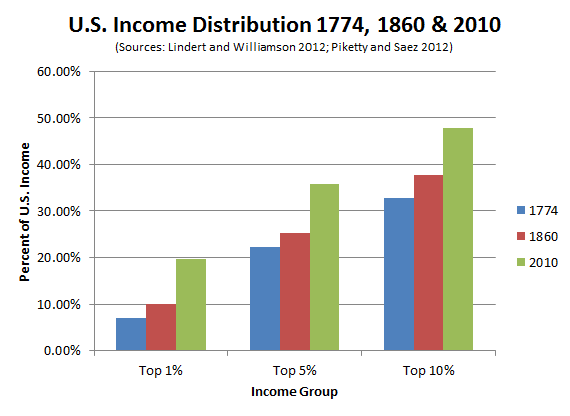
US_Inequality_Through_the_Centuries

 Jordan Weissman calls attention to a study that shows income inequality to be worse than in 1774:

We are much richer nation, and much better off today, than 240 years ago. In the 1770s, America was a heavily agrarian country of yeoman farmers, merchants, and tradesmen, with an economy that accounted to just a few billion dollars in present values. Like India or Russia today, both of which technically enjoy more income equality than the United States, early Americans were relatively poor compared to us.

They were just relatively poor together. The first wave of industrialization in the 19th century increased living standards, but also offered bigger rewards to factory owners than their workers. That pattern neatly fits our classic understanding of what's supposed to happen when economies move from farming to manufacturing. And by now, we've gone through several epic rounds of economic upheaval that have left us with a vast gulf between the rich and the rest, as well as a welfare state that tries to mitigate some of the side effects of that difference. 

So, awful as it might sound, the fact that the United States is less economically egalitarian than during its rural, slave-society ancestors is not inherently a reason to fret. 

Meanwhile, Colin Gordon maps present-day income inequality by state.

Can Democrats Retake The House? Ctd

Sam Wang defends his House forecast against skepticism:

As I wrote this summer, models based on “fundamentals” (GDP growth, previous seat count, and so on) are research tools that set a range for what might happen before an election season starts. To make my favorite analogy to weather forecasting, they are like what climatologists do when they warn that there may be a lot of hurricanes next year.

However, “next year” has already started. And climatologists are not of use when one is trying to identify a hurricane strike zone. At this point the best indicator of opinion is…measurements of opinion. Polls are like a thermometer that tells us what is happening now. As I have pointed out, this is why econometric models for the Presidential race have been all over the place, yet our Meta-Analysis has been tightly clustered around a probable Obama victory since July.

Ask Dina Anything, Ctd

A reader writes:

So here's one of the many things that makes me LOVE the Dish and read it ravenously: in recent weeks and months, you've featured as part of your "Ask Anything" series Hanna Rosin, Ta-Nehisi Coates, Jesse Bering, Jim Holt … and now, the amazingly surreal and brilliantly funny Dina Martina.  The fact that you would feature this too-little-known performer (whom I believe to be a true comic genius) in the same forum where Maggie Gallagher, Eli Lake, and Veronique deRugy have responded to readers' questions just makes me giggle with delight, and endears the Dish to me more than ever.  And here's an irony that I predict with great confidence: Dina's answers will make just as much sense, and be just as funny, as Maggie's twisted answers were.

Thank you for featuring this amazing, edgy, inventive performer.  I can't wait to see what Dina has to say about ANYTHING.

Ask here.