Jesus Said To Them “My Wife …” Ctd

A reader writes:

"It appears genuine" – really? This is a very creative way of saying something that's technically true while avoiding the actual issue. Yes, it appears to be a 4th-century Coptic Christian document, perhaps from an alternative Gospel. However, there are dozens of similar alternative Gospels, from the one written by Jesus's brother to the one that makes Judas out to be the hero of Gnosis. Why would this one have any greater claim to fact than those other documents, written hundreds of years after Jesus' death?

It has no greater claim at all. It doesn't tell us much except that some fourth century Christians thought Jesus was married. Another gets bent out of shape:

That's a legitimately interesting discovery that you posted to earlier. But the way you tossed in that this find "greets the fundamentalist world and the Vatican" – as though the pope has to explain this away, or else the jig is up! – was such a dilettantish and hackish overreaction that I had to respond. Where to start?

This is part of a completely unknown text. We know that this bit of papyrus is from about the 4th century – more years between it and Jesus than between us and George Washington – but that's it. We don't know what larger work this is a part of. It could be an editor's later addition to an earlier book, like the Gospel of Thomas, as part of it has a similar wording. It could be a work completely new to us. We have no idea of what the surrounding text says.

The sentence isn't even complete: "And Jesus said to them, 'My wife…'" It could be the start of a parable, or the beginning of a metaphor involving family members, a la Matthew 12:48: "Jesus said to him, 'Who is my mother, and who are my brothers?'" You don't respond to that isolated sentence by concluding that Jesus was an orphan or had no idea of his family, do you? And as this post at The Atlantic points out, a reference to Christ's wife is hardly limited to a literal spouse.

But, as you point out, "It appears genuine." As in, it's old, and not a recent forgery. Well! What it says must be true. Even though we're not sure what it is. The pope should just quit now. Do you know what you call people who take a decontextualized piece of an ancient work (in this case, a couple of sentence fragments) they know next to nothing about, make sweeping, unsubstantiated assumptions about what it is and how to understand it, and decide that their conclusions are likely historical fact? Biblical literalists. They have a museum in Kentucky you might like.

I do think that seeing the wide diversity of early Christianity does scramble old notions of a single, monolithic Christianity from the beginning onwards which fundamentalists, yes, cling to. The Pope's circular non-arguments against married priests are also challenged somewhat by this scrap.

David Haglund, who passes along the above video, argues that "the parchment serves primarily as a reminder that this question about the historical Jesus has never been settled, and that confident assertions on the matter tend to be fraught with social and political implications." We'll delve more into this on Sunday.
The Bounce Endures?

Screen shot 2012-09-21 at 9.16.34 AM
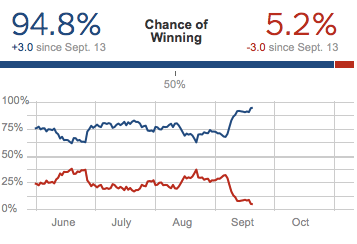
Above is Silver's "now-cast" of what would happen if the election were held today. It's a double-whammy, when you see the convention bounce, and then what could be a second "47 percent"/"Cairo opportunism" bump. Silver notes that the national tracking polls – using robocalls – show a closer race than others. But the swing state polling seems to back up the more traditional live interview format, where Obama's lead is clear and growing.

Last night, we saw NBC's poll give Obama 50 percent support in Colorado and Wisconsin among likely voters – with a lead over Romney of 5 points. In Iowa, Obama is ahead by a whopping eight points among likely voters. Here's a graph of the poll of polls on Romney's recent favorability numbers, starting in August, with heightened sensitivity to pick up small shifts:

He's edging 50 percent in unfavorable numbers – 3 percent more than the unfavorable opinion he has of 47 percent of Americans. The feeling, apparently, is mutual.

Sugar Daddies 2.0

As an experiment, Alex Belanger signed up "for a site that sets up escorts with men who want to pay them — handsomely — for sex and company":

The single guys I met made it clear they weren’t looking for any type of real relationship. They liked the idea that the money bought them the ability not to commit. One guy I met said that his job was his girlfriend, that sometimes he thought of money as his love of his life. He even went as far as to say that the money can’t keep him warm at night, but it won’t leave him and won’t end up making him try to change. The funny thing with these men is that there was a freedom they felt with me once they thought of me as a commodity, of someone who had put herself out there on the market to be bought in increments. If I had gone for a drink with a banker on a date, he — of course — would never say any of that out loud.

Yglesias Award Nominee

“This week I called [the Romney campaign] incompetent, but only because I was being polite. I really meant “rolling calamity.” A lot of people weighed in, in I suppose expected ways: “Glad you said this,” “Mad you said this.” But, some surprises. No one that I know of defended the campaign or argued “you’re missing some of its quiet excellence,” – Peggy Noonan.

Chart Of The Day

Jobs_Education

Kay Steiger captions:

This comes from the The Georgetown University Center on Education and the Workforce’s latest report, “Along The Way To The B.A.” (PDF), which points to an increasing demand over time for a bachelor’s degree or other postsecondary training over time. “As jobs that require only high school or less have disappeared, postsecondary education and training on the job and in schools have become the gateways to the middle class,” the report notes.

When Idioms Stop Making Sense

Ben Yagoda notes that "a disproportionate number of all idioms are nonsensical, or, at the very least, don’t parse":

That’s why they’re idioms. Take (randomly) Be that as it may. We all know the idea it conveys. But exactly how (if at all) do the words in the phrase combine to mean that? I’m sure some of you smart people out there can answer the question. I cannot. And that’s no big deal. Sometimes idioms start out as sensical and make a transition to non-, and it’s fun to chart their progress. One I have my eye on at the moment is can’t help but, as in I can’t help but think that Philip Roth is going to win the Nobel Prize. It’s easy to see how it emerged—as a new, improved combination of two older idioms, I cannot but think that … and I can’t help thinking that. … The grafted version may be strictly speaking nonsensical, but it’s got rhetorical punch and has had remarkable success in taking the place of its parents.

Breaking The Amish

Elizabeth Greenwood claims TLC's "Breaking Amish" is a new low for the producers of reality television:

[H]ow could an Amish young person, who has grown up without electricity or ever being photographed, possibly comprehend the consequences of having his drunken exploits filmed for posterity? Not only is the idea of the participants of Breaking Amish making a fully informed decision dubious, but the stakes are also quite high. If an Amish decides not to return to their community after rumpsringa, they are shunned, and must give up all contact with their family. But in the first episode of Breaking Amish, the show alludes to the fact that the cast members' agreeing to be on camera has already strained relationships to a breaking point.

TLC plays up this drama. Sabrina, a 20-year-old of Italian and Puerto Rican extraction who was adopted by Mennonite parents, tells cameras, "I'm nervous about going to New York because I know there's no going back. I'll lose a lot of my friends. If I sacrifice everything I have and it doesn't work out, I'll have nothing." Over a tense last supper, Abe's mother tells him flat out, "If you go to New York, you're going to be shunned." Like drinking and fighting, a good old-fashioned shunning makes for stylized TV drama. But unlike the guidos and guidettes of Jersey Shore, this cast won't have a home to return to when filming ends. Most everyone can agree that reality TV is fake. But that conventional wisdom has probably not entered the candle-lit homes of the Amish. For members of this community, the consequences of reality television are all too real.

Why Bad Science Spreads

Seth Mnookin explains:

Because it’s sexier to discover something than to show there’s nothing to be discovered, high-impact journals show a marked preference for "initial studies" as opposed to disconfirmations. Unfortunately, as anyone who has ever worked in a research lab knows, initial observations are almost inevitably refuted or heavily attenuated by future studies — and that data tends to get printed in less prestigious journals.  Newspapers, meanwhile, give lots of attention to those first, eye-catching results while spilling very little (if any) ink on the ongoing research that shows why people shouldn’t have gotten all hot and bothered in the first place. (I have a high degree of confidence that the same phenomenon occurs regardless of the medium, but the PLOS ONE study only examined print newspapers.) The result? "[A]n almost complete amnesia in the newspaper coverage of biomedical findings."

The Daily Wrap

Afghanistan

Today on the Dish, Kevin Drum marveled at Romney's ignorance, Jesuits tackled Ryan, Joan Walsh mused on Ryan's future presidential prospects, and Ezra Klein summed up Romney's income tax-only deception. Readers agreed with Andrew on Hillary's presidential cred and dazzled us with their knowledge of home state-losing tickets. Andrew debated Jesse Bering on circumcision.

Looking at the polls, the race leaned hard in Obama's direction, and while Sam Wang predicted a Dem House retaking, Dylan Matthews dismantled his case. Rasmussen showed Obama in the lead, while Silver assessed the Senate and tried to filter out the noise. Pareene believed gaffes mattered, Tod Kelly pondered the fact that few people like Romney – in part for cracking jokes like this. Alex Massie compared Romney to Gore, Shafer likened him to Nixon, and a commenter christened him "Money Boo-Boo."

Meanwhile, Joyner gave up on Afghanistan while Dexter Filkins noted the relative absence of the Taliban in Afghanistan's killings. Bill Browning wanted gayer ads, Michelle Malkin frothed on Fox News, and partisanship picked up in the '60s and '70s. And as Jill Lepore investigated political consulting, Barbara Spipndel revisited Strom Thurmond's bizarre relationship with race while Rick Perry spouted off about Satan. TNC addressed the Trayvon Martin case, wealthier people noticed their use of government programs less than poor people, and all psychotherpies were created equal.

In other assorted commentary, Gila Lyons recounted her panic attacks, Malcolm Harris reframed Breaking Bad's main product, Daniel Trone mapped Springsteen's concerts, Davy Rothbart collected "anything that gives a glimpse into someone else's life," and Chris Anderson hailed the DIY movement. And as David Byrne considered the right to silence, a Korean guy loved drumming. FOTD here and VFYW here – and don't forget to ask Dina anything!

G.G.

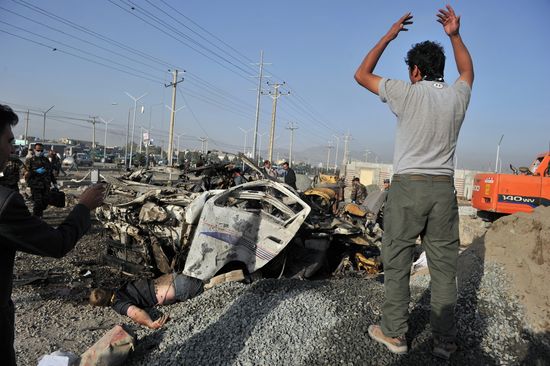
(Photo: A man (R) looks at a victim (L) lying on the ground outside a petrol station at the site of a suicide attack in Kabul on September 18, 2012. A suicide bomber blew himself up alongside a minivan carrying foreigners on a major highway leading to the international airport in the Afghan capital, police said, killing at least 10 people, including nine foreigners. By Massoud Hossaini/AFP/Getty Images)

The War In Afghanistan Is Lost, Ctd

GT_AFGHAN-REFLECT_120920

Dexter Filkins, who has written extensively on Afghanistan, says that it's "difficult to overstate just how calamitous the decision, announced Tuesday, to suspend most joint combat patrols between Afghan soldiers and their American and NATO mentors is." An important point:

In some ways, it would be comforting if the Afghans who were doing these killings were Taliban agents who’d slipped inside American training camps. There is some truth to this notion, but not much. When I was in Afghanistan this spring, a senior Afghan defense official told me that he and his fellow officials had little knowledge of the loyalties—or even the nationalities—of many of the new recruits. Many, he said, were presumed to have been sent by Pakistani intelligence officials from across the border. An American official told me that "several hundred" Afghan recruits, including some officers, had been identified as loyal either to the Taliban or to the Pakistanis.

As bad as that sounds, though, the reality is much worse.

By the Americans’ own accounting, only ten per cent of the green-on-blue attacks have been carried out by Taliban infiltrators. The overwhelming majority of green-on-blue attacks are coming from ordinary Afghans signing up for the military. The very people we are trying to help fight the Taliban are turning their guns on us.

Earlier commentary here.

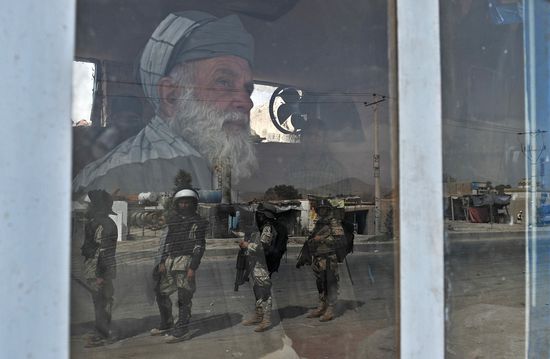
(Photo: An elderly Afghan man looks through a window in which Afghan riot police are reflected on Jalalabad Road during an anti-US protest in Kabul on September 17, 2012. Hundreds of Afghans staged a violent protest in Kabul on Monday against an American film mocking the Prophet Mohammed, throwing stones at a US base, torching cars and shouting 'Death to America', police said. By Massoud Hossaini/AFP/Getty Images.)