The Odd Lies Of Paul Ryan

Taking in Ryan's latest body boast – this one claiming he keeps his body fat between 6 and 8 percent – Bill Gifford wonders about the candidate's chronic fibbing on the topic:

Ryan wouldn’t be the first guy to dissemble about his physical attributes. But with him it’s become a pattern: first the marathon, then the dubious mountain climbs, as well as some minor confusion about the exact level of his skiing prowess. (He told Ryan Lizza of The New Yorker that he was on Janesville Craig High School’s "ski team," when in fact the school only maintains a ski club.) "Sounds a lot like when guys say they can also bench 300 pounds, run a 4.5 forty, etc.," says Rooney.

Earlier this month, Fallows questioned what this string of falsehoods might mean about Ryan:

This doesn't fit the normal model of "efficient" political or human truth-shaving. It was a lie that was totally unnecessary — if he'd said he had run a five-hour marathon, we'd still know that he's physically very fit. And telling it in his current state of 24/7-scrutiny and prominence was either unbelievably naive ("no one will ever double-check this") or plain reckless ("I don't care if they do").

The Economy Isn’t Everything

That's Ambers' view:

[V]oters have already conducted their referendum on the Obama economy, and made their conclusions about whether to vote for the president based on his economic performance. If they are persuadable, they are persuadable on other issues, issues that Romney isn't going to find much traction with. This is why doubling down on his core message and trying to turn out as many hardcore conservatives as possible might not be a bad tactical decision. In fact, it might be the only tactical decision available to him at this point.

Monsters In Our Midst

In an deeply unsettling review of the modus operandi of pedophiles, Malcolm Gladwell investigates how they screen their victims:

The successful pedophile does not select his targets arbitrarily. He culls them from a larger pool, testing and probing until he finds the most vulnerable. [Elementary school teacher Jeffrey] Clay, for example, first put himself in a place with easy access to children—an elementary school. Then he worked his way through his class. He began by simply asking boys if they wanted to stay after school. "Those who could not do so without parental permission were screened out," [psychologist Carla] van Dam writes. Children with vigilant parents are too risky. Those who remained were then caressed on the back, first over the shirt and then, if there was no objection from the child, under the shirt. "The child’s response was evaluated by waiting to see what was reported to the parents," she goes on. "Parents inquiring about this behavior were told by Mr. Clay that he had simply been checking their child for signs of chicken pox. Those children were not targeted further." The rest were "selected for more contact," gradually moving below the belt and then to the genitals.

Will Marriage Equality Make It On The SCOTUS Docket?

Chris Geidner eagerly awaits

[B]eginning next week, the justices of the Supreme Court will return from their summer recess. When they do, among the cases they will decide whether to hear are a case challenging California’s amendment that ended same-sex couples’ right to marry and a series of cases challenging the part of the Defense of Marriage Act that prohibits the federal government from recognizing such marriages.

Jeffrey Toobin breaks down the different same-sex marriage cases sitting before the Court:

At its core, the Prop. 8 case is about whether there is a constitutional right to same-sex marriage—and whether, or when, the state can ever take that right away. The case involves only California, but the Court could use it to require every state to offer same-sex marriage to its citizens—a dramatic transformation of the law, since only six states currently allow the practice. This is the high-risk high-reward case, one that might establish a right to same-sex marriage in the entire country, or, conversely, end with the Court declaring—in a ruling that could last a generation or more—that no such right exists anywhere.

Then there's the DOMA case, which, he says, is "much narrower":

Overturning DOMA would end…disparate treatment. But even if the court were to strike down DOMA, that ruling would not extend the right to same-sex marriage to states where it does not already exist. For better or worse, it’s a limited case, with limited risks and benefits for both sides.

Toobin thinks SCOTUS is more likely to take up DOMA because, among other factors, "both sides have less to lose" in that ruling.

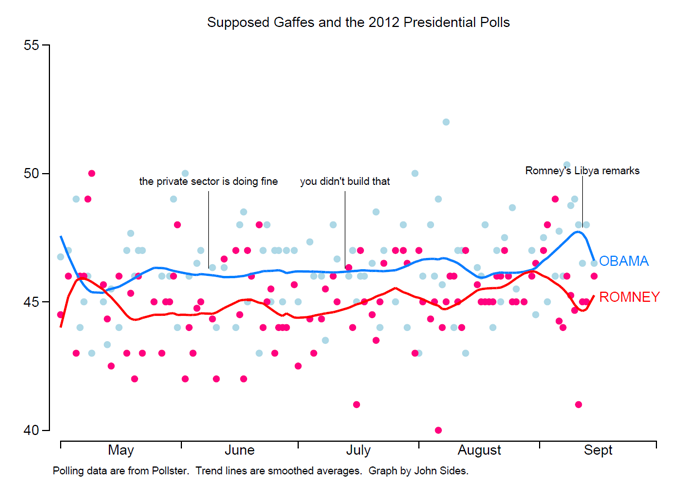
Did Romney Just Lose the Election? Ctd

Gaffes_Timeline

Joshua Tucker doubts it:

Romney has once again demonstrated the ability to be his own campaign's worst enemy and given the Obama campaign an opportunity to talk about an issue that draws an important contrast between the campaigns, but a week from now we'll probably be talking about something else entirely.

(Chart from John Sides)

Letters From The 47 Percent

A reader writes:

My mother gave birth to me at 18, went to college while raising me, got a BA, Masters and PhD by taking out student loans. She worked for 15 years to pay those back and help me go to college. When I was 21, she became very ill and has been on SSI for almost 12 years now. I have worked and paid taxes since I was 17 years old, and for the last six have paid federal income tax at the highest bracket possible with virtually no cap gains. After federal, state and city I get roughly 60 cents of every dollar. If she hadn't sacrificed the way she did, there is no way I'd be where I am today.

I pay a lot in taxes. I am happy to do so, because I know that in some small way my money goes to, among many things, people like my mother. I understand there are people out there who are gaming the system, but I'm willing to accept that knowing that people like my mother – good decent people who have had a tough time of it, and perhaps don't have sons sending them help every month – are being taken care of.

Another writes:

At first I didn't think Romney's comments were any big deal, but then I realized he was talking about me, and so many Americans like me. Then I felt insulted. My father died at age 42 after a four-year battle with extremely aggressive MS, when I was 10. Our family was financially ruined.

My mom, my older brother and I lived off his SSDI survivor benefits and help from my mom's family. My mom received the benefit until I was 16. Us kids received the benefit until we graduated from high school, me for eight years. My mom put herself through community college and found a good job. My brother graduated high school and joined the military. I graduated and went to college. The point is that we would have been destitute without the SSDI benefit, and I'm sure we didn't pay much in taxes for several years. The government benefit, which my dad paid into, did exactly what it was supposed to do – keep us afloat until we could take care of ourselves.

And that we have done. We've gone on to have good careers. I now proudly pay over twice as much tax, as a percentage of my income, as Gov. Romney does. I've not done the math, but I'm sure that the income and payroll taxes my dad paid before he died and the taxes my mom, brother, and I have paid – and continue to pay – more than make up for the years we lived on SSDI. I would have given up that benefit any day to have my dad back. It was not a political decision to take that benefit, and my first presidential vote for Bush in 1992 was not leveraged by whether or not he was going to keep me on the dole.

I feel sorry for Romney. I truly think that he and those who surround him simply don't understand how most Americans live.

Another:

I guess I'm one of the 47% that Romney rails about.  I didn't know I was "lazy" when I was six years old picking strawberries, beans and cherries every summer until I was old enough to work on a farm with cattle, pigs, and spearmint.  I didn't make enough in a summer to pay federal tax but my paycheck did include payroll taxes.  Likewise, working through college and grad school I never made enough to pay fedeal taxes.  But many jobs were paid "in kind", such as free meals at the Student Union in exchange for washing dishes or waiting tables at the fraternity for a place to sleep.

If I "mooched" on anyone it was those good people who helped me find jobs like babysitting a computer system all night (so no need to spend money on rent).  Or it was my parents who held a single GED and worked four jobs between them but sent five children and four grandchildren to college and beyond.  My computer experience led to a charmed career in international marketing of IT, where I traveled the world and got paid for it!  Believe me I was not happy to pay A LOT of taxes of all kinds for over 30 years but I certainly understood why it was the right thing to do.

And when after five decades I had to stop working for health reasons, I am thrilled that Obama passed the stimulus, longer UI, subsidized COBRA, ObamaCare, etc. – and even brought my portfolio back to life. Thanks to those lifelines, my wife and I now run a vacation rental in such a way to bring joy to hundreds of our guests. But the business doesn't yet run a profit so we don't pay income taxes yet.

So my count is I paid federal income taxes in just 30 of 53 working years in my nearly six decades of life.  Thanks to Mittens I'll remember that I'm a lazy, irresponsible 47-percenter when I clean the toilet bowl in the guesthouse tonight.     

End of rant.

One Big Change

Screen shot 2012-09-19 at 9.35.34 AM
The bounce is over in the Gallup and Rasmussen tracking polls, even though they don't yet register the fallout from Romney's "fuck-you, 47 percenters" speech. It shows a tightening of the race again. But on one measure, it shows a big shift:

The "enthusiasm gap" that favored Republicans by 11 points a year ago suddenly has moved to a 9-point advantage for Democrats — a crucial asset when it comes to turning out supporters to the polls. The percentage of Democrats who say they are extremely or very enthusiastic about voting has surged from 53% last month to 73% now. Republican enthusiasm has risen but by not nearly as much, to 64% from 55%.

Those gains in enthusiasm might reflect the effectiveness of the conventions in boosting base supporters: 16% of Democrats but just 6% of Republicans said the political conventions had "a great deal" of impact on their vote.

Now we'll see, in a tight election, just how productive Obama's deep investment in his ground game will be.

A Social Disease

Tanya Marie Luhrmann explains how our understanding of schizophrenia has shifted over the years:

[S]chizophrenia now appears to be a complex outcome of many unrelated causes—the genes you inherit, but also whether your mother fell ill during her pregnancy, whether you got beaten up as a child or were stressed as an adolescent, even how much sun your skin has seen. It’s not just about the brain. It’s not just about genes. In fact, schizophrenia looks more and more like diabetes. A messy array of risk factors predisposes someone to develop diabetes: smoking, being overweight, collecting fat around the middle rather than on the hips, high blood pressure, and yes, family history. These risk factors are not intrinsically linked. Some of them have something to do with genes, but most do not. They hang together so loosely that physicians now speak of a metabolic “syndrome,” something far looser and vaguer than an “illness,” let alone a “disease.” Psychiatric researchers increasingly think about schizophrenia in similar terms.

Our Investment In College, Ctd

Income_Probability

Deploying graphics against the "current fad" of arguing – as McArdle did last week – that college isn't worth it, Catherine Rampell makes the case for taking on loans:

[W]hile there are lots of stories about broke college grads, people with higher education are much less likely to have low incomes than those without degrees. Sure, you say, but people graduate from college with a lot of debt, which must surely wipe out their higher earnings! Even factoring in the debt, though, college is still a great investment [when looking at] return on investment for going back to school compared to investing that same tuition money in the stock market, long-term Treasury bills, housing, corporate bonds or gold.

Previous Dish coverage here, here and here.

The Perfect Climate For Crime

To track how global warming affects crime rates, Matthew Ranson examined 50 years of weather data around the country and corresponding crime statistics. Emily Badger summarizes his predictions:

By Ranson’s calculation, if global temperatures rise between now and 2099 by about 5 degrees Fahrenheit, as the Intergovernmental Panel on Climate Change has predicted, that could result over the next 90 years in an additional 30,000 murders in America (compared against a future in which climate change did not exist). Likewise, we could see 200,000 more rape cases, 1.4 million more aggravated assaults, 400,000 more robberies and 3.2 million burglaries.