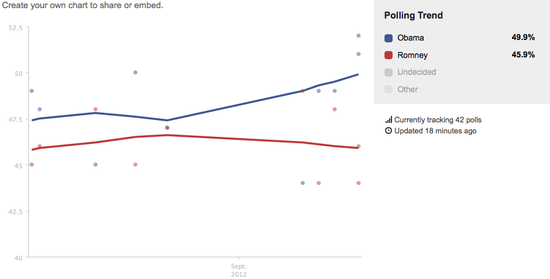
The WaPo poll just out gives Obama an eight-point lead among likely voters in Virginia, once a Republican stronghold. The poll of polls – with high sensitivity – sees a widening gap.
The WaPo poll just out gives Obama an eight-point lead among likely voters in Virginia, once a Republican stronghold. The poll of polls – with high sensitivity – sees a widening gap.
John Avlon and Michael Keller compare campaign and Super PAC expenditures:
For the presidential candidates’ actual campaigns, individual donations are capped. This means that campaign expenses tend to be tightly controlled, with contracts scrutinized to maximize impact and minimize profit. For example, FEC filing data shows that Obama campaign manager Jim Messina gets paid a yearly salary of about $90,000 while Romney campaign manager Matthew Rhoades takes home about $120,000.
But super PACs and their associated groups rely on big-dollar donors like Republican Sheldon Adelson or Democrat Jeffrey Katzenberg—who end up forking over millions at a time. As a result, political operative salaries and commissions aren’t subject to the normal laws of campaign gravity.
According to last year’s disclosure forms, the president of Crossroads, Steven Law—a longtime Rove ally and GOP operative—took home about $600,000. Paul Begala, a senior advisor to the pro-Obama super PAC Priorities USA Action (and a Newsweek/The Daily Beast columnist), is currently the highest compensated individual Democrat on the super PAC rolls, taking in more than $335,000 to date this election cycle, according to public filings. (It’s certainly possible that others are being paid more but are using techniques to hide their compensation—for instance by taking percentages of ad buys rather than regular salaries.)
Molly Redden recently highlighted "the campaign's biggest buckrackers". Chief among them:
Steve Roche began the election as the finance chair for the Romney campaign. But just as money has migrated from the candidates to the super PACs, so have some of the most experienced operatives. In August 2011, Roche became the chief fund-raiser for Restore Our Future.
The 57-year-old isn’t flashy—he "lives in a middle-American, suburban house," says his friend and Boston political consultant Matt Keswick. And yet he’s proved extremely adept at parting wealthy Republicans from their money. Restore Our Future has raked in $90 million, making it the wealthiest super PAC in the race. Roche has been paid 4 percent [$3.6 million] of that total through a limited liability company under his control.
I would go so far as to say #Romney‘s latest comments on Palestinians is as offensive as his cultural superiority argument on #Israel
— Ahmed Shihab-Eldin (@ASE) September 18, 2012
Ackerman parses Romney’s dismissal of Israeli-Palestinian peace:
U.S. policy in the Mideast does not reduce to the Israeli-Palestinian conflict. But I’ve tended to find that people in the region, Arab and Israeli, consider an American president’s perspective on the conflict to be a threshold issue, a prism through which they can understand what sort of relationship to expect from the U.S., and whether that presidency ought to be embraced or endured. Romney may not be interested in the peace process, but the Mideast is very interested in Mitt Romney, and turning away from the peace process — either explicitly or through neglect — will have a cascading effect on anything else he wants to accomplish in the region.
Erick Erickson thinks so:
For once, we see Mitt Romney undercover and off the record and he sounds like a real person not pulled by the gravitational forces of the DC GOP Elite who have capitulated to $16 trillion in national debt. And suddenly, those beltway Republicans are beating up Romney for saying something off the cuff, maybe not as polished as he should have, but that is agreed with by a majority of Americans.
John Hinderaker offers ideas on how to use this new Secret Romney:
[T]he private Mitt Romney is a heck of a lot more compelling, not to mention more conservative, than the public version. A few weeks ago I attended a Romney fundraiser in the Twin Cities, the only one scheduled for Minnesota during the campaign. Romney was electric, more passionate than I have ever seen him. I said at the time that his campaign should film him in that setting, before a friendly audience of conservatives, and edit the footage into a series of 30 or 60 second commercials. Maybe, if we were lucky, Mother Jones was there and will do it for us.
Michael Walsh calls this Romney's Gettysburg moment:
What he ought to do is step up and embrace the basic division in our nation, including the fact that nearly half the country pays no income taxes. Acknowledge it — and then explain why, morally, this is not a good thing. Why having no skin in the game while at the same time demanding a say in the proceedings at the federal level is fundamentally undemocratic.
Except, as Dylan Matthews notes, Romney's current tax plan wouldn't address this issue:
Given that the campaign has protested vigorously against the TPC’s suggestion that paying for his plan means raising taxes on lower-income people, it seems reasonable to assume that Romney won’t make much of a dent in the number of people not paying any income tax. Whatever you think about Romney’s fundraiser remarks, he doesn’t have a plan that corrects the "problem" he’s bemoaning.
Kerry Howley is skeptical that the videos reveal the "real" Romney:
Jonathan Chait says we’ve seen "an authentic Romney," echoing the general journalistic consensus. Given that Romney is at this event to beg, flatter, and beg some more, the assumption is strange. It's not clear why a slippery candidate would, amid wealthy donors, suddenly bare the dark deep hidden recesses of his soul. Strategy does not suddenly fall away when rich men pull out their checkbooks.
Paul Waldman agrees:
As I've maintained for some time, for all intents and purposes there is no "real" Mitt Romney. His political beliefs are the equivalent of Schrodinger's cat. They exist in every state at once until you open the box to observe them. If the one opening the box is a Tea Partier, they instantly lock into place as a set of Tea Party beliefs; if it's a bunch of GOP plutocrats staring down, that's whose beliefs he'll mirror. Romney has spent the last five years in an intensive period of study, with his subject the contemporary American conservative mind in all its permutations. He's well aware that the misleading talking point about 47 percent of Americans not paying taxes gets repeated all the time on the right, in private and public. What he was telling the people in that room is what he tells any group of people he speaks to. His message was, in Christine O'Donnell's immortal words, "I'm you."
A new kind of school house rock:
Via Buzzfeed:
The amount of coordination this required is absurd. The students teachers and students at the HESAV school bring 11 floors to life by opening and closing shutters and windows.
"It is the president of the United States—the same one who presented himself as the man who would transcend political partisanship because we were all Americans—who has for most of his term set about dividing the nation by class, by the stoking of resentments. Who mocks "millionaires and billionaires." Who makes it clear that he considers himself the president of the other—the good—Americans. How's that for presidential tone?" – Dorothy Rabinowitz, the day after the Romney dismissal of the 47 percent of Americans who are, apparently, parasites on the rest.
(The Dick Morris Award is what was once the Von Hoffman Award. A full award glossary is here. Readers are invited to submit quotes for the annual competition at the end of the year to select the champions.)
Joe Klein compares Romney’s closed-door speech to Obama’s 2008 closed-door “bitter clingers” quote:
Obama’s gaffe was a minor tributary off the main story of the 2008 presidential campaign, which was the economic collapse. Romney’s adoption of the Fox-Rush neo-libertarian sensibility, and the remedies that it assumes, is the main story of the 2012 campaign.
He will have to defend his fantasy in the debates. He will have to say why he believes that 47% of the American public doesn’t want to “take responsibility” for their lives. He will have to say why the Republican policies at the heart of this problem–eliminating income taxes for the working class, expanding food stamps (a George W. Bush initiative), expanding Medicare to cover prescription drugs (Bush again)–are bad for the country.
The debates are Romney’s best bet to turn this thing around, unless Netanyahu tries to help him out by blowing up the global economy. If Mitt’s constantly on the defensive in them, as Joe suggests he’ll have to be, this could turn into a rout. Down-ballot as well.
Has Obama now done to the entire GOP what he did to the Clintons, McCain and Romney? Make them somehow self-destruct? Know hope – and I haven’t said that in a while.
Nobody ever lost a U.S. election by beating up on the Palestinians.
— Blake Hounshell (@blakehounshell) September 18, 2012
It’s now clear that what I’ve been arguing these past few months – that Romney would be an extension of the Likud party in the US, that he would encourage more Jewish settlement in the West Bank, launch a war against Iran and abandon even any pretense that the US should be an honest broker between the Israelis and the Palestinians … well, I was right, wasn’t I? The man bankrolled by Sheldon Adelson whose mouthpiece is Dan Senor is a supporter of a one-state 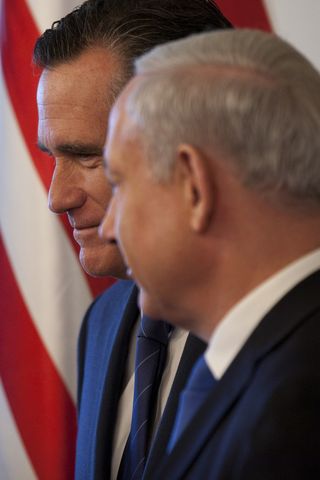 solution, presumably a starker version of his view of America in which half the country works and the other half are parasites. In Israel, that would be Israeli Jews and Palestinians respectively, because we already know that Romney believes that the Palestinians have no entrepreneurial spirit (about as far from the truth as you can get).
Again, what’s striking is the inability even to recognize the “other” as people worth talking to or engaging. He’s written off 47 percent of his fellow citizens – as hopelessly lazy and irresponsible and unreachable. He’s written off any engagement with the Palestinian leadership whom he describes in a fashion that, again, could have been taken from, say, 1979, as if there have not been some real advances in the West Bank since then. And Romney is on record as seeing no way he could ever say no to an Israeli prime minister on anything. So there you have it. If you thought I was being excitable about Romney’s foreign policy – which makes George W. Bush look like Kofi Annan – you now know why I’m so alarmed by Romney’s laziness, deceptiveness and recklessness in foreign affairs.
Dan Drezner sums up what Romney’s take on the Israel-Palestine situation says about his candidacy:
We’ve had a week where riots in the Middle East have raged against the United States, NATO’s Afghanistan policy seems to be falling apart, and China seems bound and determined to foment crises in the Pacific Rim. A smart presidential candidate could find a lot of material to criticize the Obama administration on foreign policy. Instead we have a GOP nominee that can’t manage his own campaign, much less deep thoughts on geopolitics.
Nob Akimoto is flabbergasted by Romney’s foreign policy vision:
This is seriously unreal. I was ready to chalk up some of his campaign trail nonsense to not knowing what the hell he was talking about, but he was able to go at length about the Israel/Palestine situation and his solution essentially is just one of those things you never, ever admit to, even in the most private of company. That he dismissed a former Sec-State (I’d imagine this is probably Baker) saying there’s the prospect of a settlement without even asking what that prospect is is also quite unbelievable.
Meanwhile, the Twittersphere reacted to the bizarre analogy that equated Taiwan with Palestine:
Romney said Israel / Palestine is like China / Taiwan. So US under Romney will sell weapons to Palestine? #WayToGoMitt cbsnews.com/8301-503544_16…
— Hoi Lam (@hcl21) September 18, 2012
Oh, and by the by, if Romney ever becomes President that comment about Taiwan will be just as incendiary
— Stephen Winson (@StephenWinson) September 18, 2012
Romney has been vocal in wanting to step up military support of Taiwan, and has criticized Obama’s “Asian pivot.”
To read all Dish coverage of Romney’s recent foreign policy test, including multiple “Unfit For Government” posts, go to our comprehensive thread page “The Embassy Attacks In Libya And Egypt.”
(Photo: Uriel Sinai/Getty)
“Running for president in the YouTube era, you realize you have to be very judicious in what you say. You have to be careful with your humor. You have to recognize that anytime you’re running for the presidency of the United States, you’re on,” – Mitt Romney, in a 2007 interview.
(Hat tip: Mark Leibovich)
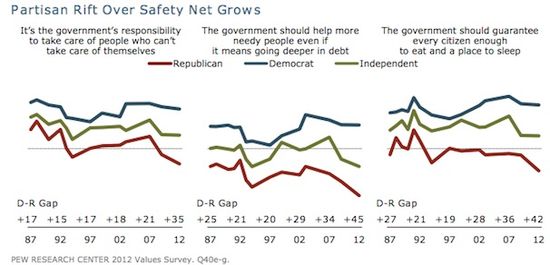
Citing a June Pew poll (pdf), Suzy Khimm pokes holes in Romney's plan to focus on "the five to 10 percent in the center that are independent, that are thoughtful":
Some of these independents may agree with Romney that more of those receiving government assistance are able to help themselves. But most independent voters also believe that the government should “guarantee every citizen enough to eat and a place to sleep.”
Jim Tankersley homes in further on Mitt's lack of appeal to independents, drawing the connection between his plan to cut taxes and his criticism of government dependency:
[A] CBS News/New York Times poll found fewer than two in five independents believe lower taxes are the route to faster growth, compared to more than half who favor increased government spending and higher taxes.
If Romney wanted to argue that the poor have grown a little too fond of government help, or that America can’t afford to keep borrowing to fund a safety net, the Pew polls suggest large swaths of independent voters would be receptive. But that wasn’t the argument he made at the fundraiser. He was contending that his low-tax message works with independents, but not the government-dependent, which appears not to be true.
 The Dish