A reader writes:
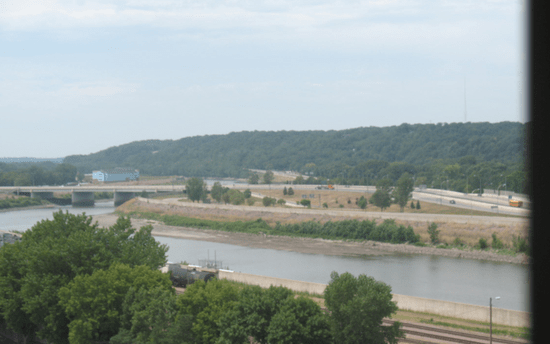
From the big red rig, the schoolbus, the large green highway signs, the Holiday Inn Express/Best Western/Residence Inn Motel 6 under construction, the railroad tracks by the river and the gently rolling tree covered hills, one can only conclude that this could be anywhere on the entire fucking Interstate Highway System. Nice one. Wild guess at somewhere near Breezewood, PA.
Another:
Well, it's the United States if that highway is any indication, and there are a lot of rivers that are about that size and flow through hilly areas, but that river looks really low, and the grass is all yellow. This has to be in a part of the country affected by bad drought, so that eliminates eastern rivers that flow through areas like that, such as the Monongahela or the Susquehanna. I'm going to take a stab in the dark and say that we're looking at the Arkansas River, and it's flowing through Fort Smith in this photo.
Another:
Blind guess, but the river is very low and not very wide. The walls and berm across the way (built by Army Corps of Engineers) suggest being very close to town. But the picture doesn't show the town, so a place big enough to have a road that size. But not a big place. Hills in the background. Why not Pine Bluff, Arkansas?
Another:
I am not the type to go hunting through the interwebs for clues, but I have driven this way for years and years. I live in MA, my husband is from Rochester, NY, so we spend a lot of time on I-90. My son adores the trains when they show up along the CSX line there on the east side of the canal. It's a relatively boring ride, but the trains help. If I had to guess, I'd say this is around the Fultonville/Fonda exit. Pretty quiet part of the world.
Another:
This is driving me crazy. It looks so familiar but in such a vague way. My gut says somewhere in NW Arkansas/NE Oklahoma/SW Missouri, but I'm so terrible at this contest generally. Hopefully I won't look like a total fool because the green interstate signs and the yellow school bus make me feel quite confident it's the USA. I'm going to guess that's I-44 (Will Rogers Turnpike) crossing the Verdigris River near Catoosa, Oklahoma, in Rogers County. Please don't make fun of me if that's really Venezuela or something.
Not Venezuela. Nor something:
My first thought, on looking at the picture, was that it looked like Afghanistan – the banks of pale brown dirt beside a river running a bit dry, the green hills, the high quality ring road built by Chinese contractors. Then I looked more closely. There seem to be a number of pretty good roads here. And a train in the foreground. And a yellow school bus. I'm still sending in my first guess – I'm going with Pul-e-Khumri in Baghlan Province as you go over some small rivers after descending from the Salang Pass traveling from Kabul up to Kunduz. But rather than hoping for a free book, I'm gunning for one of those top positions in the Tuesday reveal, where you put the Wrongest Answers. Was anybody more wrong than me?
You win that contest. Another:
Not positive about Winona, Minnesota, but I'd be shocked if that wasn't the Mississippi bluffs. If that's highway 61, keep going north towards Duluth and you've got the Bob Dylan song!
On the right track. A reader nails it:
Here we see the lower bend of the Minnesota River, looking westward or possibly west-northwestward from somewhere on the north side of downtown Mankato, Minnesota. That wasn't so hard after all, now, was it. No, not sober anyways. The road in the picture is US highway 169, MN state highway 60 & 30, (>>>"SPEED LIMIT 50"<<<). A glance at the droughtfully low water in the river shows the reinforcement of its banks with a lot of quartzite, probably hauled from quarries up to 200 miles from the west. This bend in the river is where the Minnesota begins its turn northward to St. Paul, where it flows into the Mississippi.
Mankato it is. Another:
One glance and I thought "Mankato," a city in which I've spent a total of maybe five hours of my life – once to take a kid to watch the Minnesota Vikings train, once to see my partner give the sermon at the Unitarian church. After poking around on Google, I'd say it's a view looking west toward the Hwy. 169 bridge over the Minnesota River as seen from the 5th floor of the Hilton Garden Inn. Wish I had more time and better skills to be more specific.
Another:
I love reading the entries you select for the VFYW contest but have never entered, but when I saw this I immediately thought of Mankato. In 2005, my friend and I paddled a canoe 2,000 or so miles from Minneapolis, Minnesota to Hudson Bay up in Canada, where the polar bears live. We were commemorating the 75th anniversary of a trip taken by Eric Sevareid and his friend Walter Port in 1930 (as written about in the book Canoeing with the Cree, by Sevareid.
The first 300 miles of the trip require paddling upstream on the Minnesota River, which begins on the South Dakota/Minnesota border and flows southeast until hitting a wall of rock in Mankato, at which point it turns to head northeast before joining the Mississippi in Minneapolis at historic Fort Snelling. In 1930, the Minnesota was so low (it was the beginning of the Dust Bowl) that Eric and Walt often had to pull their canoe over sandbars. For us, however, within the first few days the river rose and rose and soon flooded its banks. As large trees and other debris and the relentless gush of water made paddling upstream extremely difficult, we ended up skipping about 20 miles of river from St. Peter to Mankato.
Earlier this spring we finally made our way back to paddle that last stretch, which was delightful, especially since we went downstream. The first part of the river, though, flows through lots of concrete in Mankato, as you can see in this picture. You can also see that the river resides in a valley significantly bigger than the river itself; the valley was carved when glacial Lake Warren began draining towards the Mississippi. It's also interesting that the river valley is an oasis of trees in the otherwise flat, crop-filled land of southwestern Minnesota. And interesting that those trees by and large were not there, as I understand it, 200 years ago, when the valley was mostly filled with Dakota people, buffalo, prairie grasses and cranberries. (We used solar panels on our canoe to upload pictures and journals to our website as we paddled; our site is still up at hudsonbayexpedition.com.)
Anyway, it really does look like the Minnesota River flowing through Mankato; even the exposed sandbar looks familiar. But I don't know what building it's taken from. It looks to me like it's on the downtown side of things and the shot is taken from a west facing window. In fact, you can see the river bending from a southeasterly to a northeasterly flow in this picture.
OK, I had to do a little more research and Google maps leads me to believe this is the Hilton Garden Inn in downtown Mankato; zooming in I can even see the sandbar in the river. The blue building behind the bridge is also visible in Google maps; looks like it's under construction. So I'm guessing the 6th floor. And it is west facing, but it's really more northwest facing, or west northwest. And let's say it's a room towards the northeast end of the building because the angles line up kinda sorta … let's say the third window from the northeast end of the building next to the Verizon Center.
I'm on the phone with my paddling friend Todd now and he is looking at all this with me and we are both getting very excited; he is also a regular Dish reader. If we are wrong we will be very surprised!
One more excellent entry:
Having lived my whole life in the Upper Midwest, this week's VFYW really leapt out at me – the river with its bluffs, the nondescript freeway junction, and the railroad felt familiar. My first instinct was La Crescent, Minnesota, where Interstate 90 has a similar jog and junction, but the main channel of the Mississippi (which runs along the Minnesota side) is much wider and the bridge is higher. There are a lot of medium-sized rivers in the region, but some observations on the geography helped nail it down:
– The bluff is awfully high and the valley awfully wide for a river that small; it was probably much bigger in the recent past.
– The flood wall and levee are built for a sizable flood of snowmelt every spring; the winters must be cold.
– At least three railroad tracks are visible and there are tank cars parked behind the trees; there is a rail yard there, but it can't be too big.
– The city is big enough to require a complex junction before the river bridge, but not big enough for the freeway to be very busy at midday.
My second guess turned out to be the correct one: Mankato, Minnesota. The view is of U.S. Highway 169 at its junction with Lookout Drive, as it turns south over the Minnesota River from North Mankato into Mankato proper. And there just happens to be a tall(ish) building in line with the view: the Hilton Garden Inn, circled below:
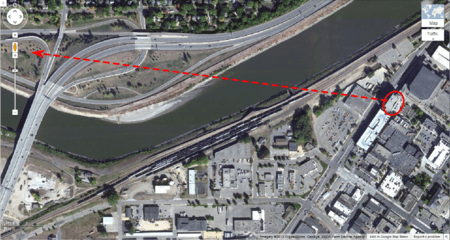
The hotel is eight stories tall and the photo was taken from a room high enough to see over the Hy-Vee grocery store across the street, but not so high as to see over the trees behind it. I would guess a fifth-floor room, but that's pure conjecture.
Growing up in the southern Twin Cities suburbs, I remember the Minnesota River being something you only noticed in the spring when the snow melted and the river flooded; in bad years half the crossings would be closed. The rest of the year it's a muddy stream unworthy of the huge valley it flows through. But in glacial times the river drained Lake Agassiz, bigger than all the Great Lakes combined, carving a deep valley through the Minnesota prairie. The river never flowed slowly enough to meander; the valley is almost perfectly straight from Big Stone Lake, on the South Dakota border, to the bend at Mankato and doesn't curve much downstream to Saint Paul.
Mankato's major place in history is as the site of the largest mass execution in U.S. history. In 1862, while George McClellan was blundering his way toward Richmond, years of shortchanging by the federal government and exploitation by Indian agents exploded into what I learned in school as the Sioux Uprising and my sisters learned as the Dakota War. A series of skirmishes in August and September ended with a Dakota surrender, and military courts sentenced 300 of the captured warriors to death for murder and rape. President Lincoln reviewed the court records and commuted the sentences of all but 39, which cost Minnesota Republicans several thousand votes in 1864. After one more Dakota was reprieved, the remaining 38 were hanged together on a specially built scaffold and buried in a mass grave. Congress dissolved the Sioux Reservation along the upper Minnesota River and most of the Dakota were expelled from Minnesota.
We have yet to hear back from the photo's submitter, so we don't know whether the 5th floor or 6th floor is the closest to the exact location, but we will update the results and contact the four Mankato guessers when we do. Update:
OK, 8th floor, north side, it's the hallway opposite the elevators, so no room number. Or was it the ninth floor? We were on the top-most floor … I called them – 9th floor!
So the paddler reader, who guessed the 6th floor, is the winner this week. The other three readers are going on our Correct Guessers list, which will give them a big advantage in future contests. Update from another reader, who more info about the view:
Your readers failed to mention that Mankato is the location of the confluence of the Minnesota and Blue Earth rivers (to form the Minnesota River that continues to the Mississippi). The word Mankato is traditionally believed to be the local native American words for "Blue Earth". According to Wikipedia, the "mighty" Blue Earth contributes 46% of the flow of the combined river leaving Mankato. Mankato was a regular stop on our annual trip back to visit relatives in various cities in southern Minnesota when I was growing up in Washington, DC. Family albums record spectacular floods in Mankato. Mankato for 47 years has been the summer camp for the MN Vikings football team. South of Mankato along I-90 is the county seat of Blue Earth, MN (Dad's hometown and Walter Mondale's county), which is where the two major branches of the Blue Earth river join on the their way to Mankato about 40 miles north.
(Archive)
 The Dish
