It was a classic. He accidentally referred to Netanyahu as "the leader of the Jewish people" on Meet The Press. He jumped to clarify later:
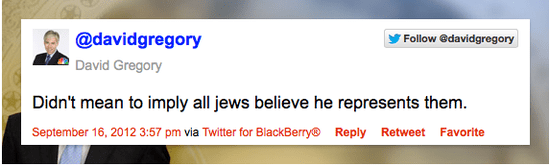
It just slipped out.
It was a classic. He accidentally referred to Netanyahu as "the leader of the Jewish people" on Meet The Press. He jumped to clarify later:
It just slipped out.
My take on his latest blatant attempt to intervene in a US election is here.
Sasha Issenberg’s advice on how to boost turnout:
In the 2006 Michigan general primary, a few voters received a letter with a chart. The letter said, “The chart shows the names of some of your neighbors, showing which have voted in the past. After the August 8 election, we intend to mail an updated chart. You and your neighbors will all know who voted and who did not.” The letter increased turnout at a rate roughly three times that of any other piece of mail ever tested.
Previous Dish on Issenberg’s moneyball approach to politics here and here.
"I witnessed Prime Minister [David Cameron] saying to a group of people, myself included, that Mitt Romney had that unique distinction of uniting all of England against him with his various remarks," – Harvey Weinstein.
I imagine that Scotland and Wales and Northern Ireland are still pretty pissed off as well. But looking beyond this anecdote, look at the views of our European allies on whom they want to win this coming election:
Forty-seven percent of UK respondents said a Romney victory would make them feel less favourable towards the US, and only 3% would make them feel more favourable. That sentiment was mirrored in Germany and France, where only 4% and 5% respectively said that he would make them feel more favourable towards the US. In Germany, 48% said it would make them feel less favourable and in France 38%.
Nate Cohn expects this week's polls to be highly significant:
If Obama’s four point lead persists through the week, Obama should be considered a very strong favorite for reelection. While it might seem that the heart of the campaign is still to come, the candidate leading two weeks after the in-party convention has gone onto win the popular vote in every presidential election since Truman's come from behind victory in 1948. And the only other comebacks were also staged by candidates or incumbents who ascended to the presidency or the nomination following resignation, assassination, or a late decision not to seek reelection.
Here's the whole graph skewed by Rasmussen and with heightened sensitivity to outliers:
And here's a key state, Florida, and the latest state of play:
Nate Cohn continues:
Truman, Ford, and Humphrey gains are hard to analogize to other contests involving incumbents, given that the candidates were forging their own electoral coalitions for the first time out of the fragmented remnants of older ones. And although Romney is behind by just four points, the race has been unusually stable and Obama may be at or very near 49 percent of likely voters, which means Romney would need to win an extremely large share of an unusually small number of undecided voters to overcome a seemingly tiny deficit.
Graphed (click to enlarge):
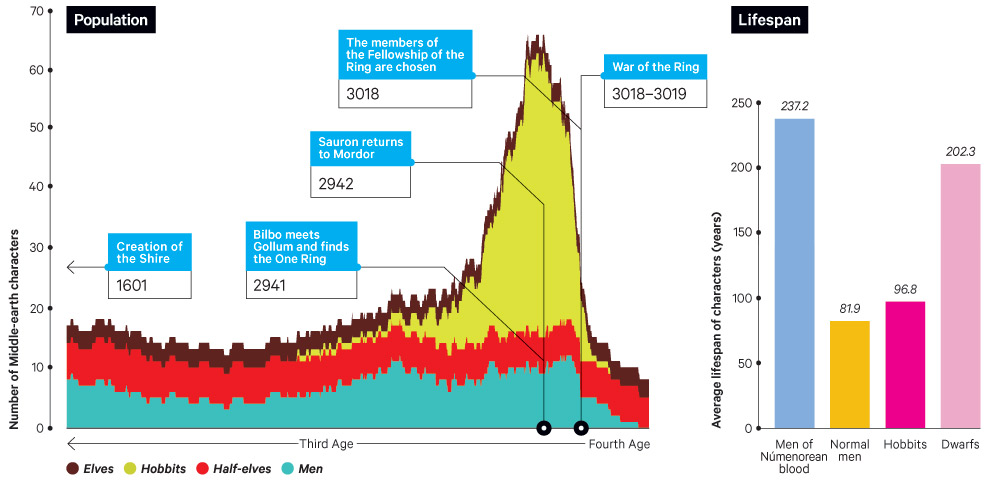
Amber Williams applauds the work of Emil Johannson, the proprietor of lotrproject.com, perhaps the most neurotically wonderful resource for Tolkien fans imaginable:
Johansson is on a quest to track every character from Tolkien’s fictional world. He started by creating a massive family tree, and from there he crafted an interactive map of Middle-earth and a timeline of events in Tolkien’s stories. He has even performed statistical analyses on the characters’ race, lifespan, and gender. Johansson points out that the lopsided gender split (81 percent male, 19 percent female) reflects the world Tolkien included in his tales of the ultimate war, but probably not Middle-earth in its entirety.
Citing a Princeton study, Tom Stafford warns that online auctions push many of our psychological buttons:
With enough guidance from the auction rules, the bidders didn't end up paying much more than they originally thought was reasonable – but only if they thought they were bidding against a computer programme. As soon as the volunteers thought they were bidding against other live humans they found it impossible to bid rationally, whatever the auction rules.
This implies that the competitive element of auctions is crucial to provoking our irrational buying behaviour. Once we're involved in an auction we're not just paying to own the sale item, we're paying to beat other people who are bidding and prevent them from having it. So it seems Gore Vidal had human nature, and the psychology of auctions, about right when he said: "It is not enough to succeed. Others must fail."
Ian Ayres encourages us to rethink how we cross the road:
One often sees pedestrians approach an intersection, press the button, and then immediately cross the street, before the crossing light changes. The pedestrian probably reasons a) "I have a right to press the button"; and b) having pushed it, I now see I can walk without inconveniencing anyone because there aren’t any cars coming. The problem with this reasoning is that just because you have the right to press the crosswalk button doesn’t mean that it is considerate for you to do so. … Pressing the button while having a conditional intention to cross the street early is inconsiderate because cars often then have to wait for a crossing light when there are no longer any crossing pedestrians to protect. It wastes gas.
This weekend on the Dish, Andrew denounced Bibi's attempts to blow up the presidential race, deconstructed Romney's "apology" nonsense, described his problem with Rasmussen polls, pointed to yet another Bill Kristol FAIL, celebrated a great new Obama ad, showcased the latest example of desperation from Karl Rove's super PAC, reminded us that Americans haven't forgotten the Bush years, and – gasp – admitted he wants to see Hillary as president someday. To read all of the latest coverage of the embassy attacks and their political fallout, see our designated thread page. It wasn't all politics for Andrew, though – he took the time to note how Dish readers can make the world less lonely.
We also provided wide-ranging coverage of both faith and doubt. Greg Garrett sketched an Augustinian approach to Christian political engagement, Casey Cep reimagined the meaning of sacraments, Robert Dean Lurie remembered Jack Kerouac's pervasive love of Jesus, and Paula Findlen uncovered the origins of modern religious pluralism. Susan Jacoby asked where all the women atheists were, great writers stared down death, Peter Lawler argued that Hitch's materialism couldn't account for his own greatness, and Josef Pieper illuminated the difficulties of sustaining hope.
In literary and cultural news, William Childress ruminated on the poet's purpose, Darryl Campbell named the foundation of criticism, Jonathon Green took a stand against democratizing definitions, Jeff Sharlet contemplated the lesson of suffering, Stefany Anne Goldberg reviewed a 19th century self-help book, and George Sugihara noted why we miss the signs of impending disaster. Read Saturday's poem here and Sunday's here.
We thought about sex and our bodies, too. Debbie Herbinick looked at the science behind good sex (it turns out Dan Savage has been right all along), Jeffrey Eugenides saw through the fantasies of the college libido, and Steven Strogatz mused on the math our bodies can teach us. Relatedly, Brian Jay Stanley explored our desparate need for validation and, for those trying to forget a fraught encounter, it turns out drinking doesn't help – but pot does. (For those interested, Keith Humphrey's debated what legalizing cannabis would mean for the potency of our weed.)
In assorted coverage, we mentioned how little cheats and rationalizations add up, James Estrin moderated a debate on how phone photography impacts our visual sense, Andrew Polsky feared the consequences of constant flattery from our politicians, The Billfold revealed the surprising story behind the IT preparations for the Iraqi elections, Karina Longworth reported on the afterlife of a defunct video store, John Churhill pondered the dignity of unglamorous work, and Alain de Botton peddled an "ethical advertising agency." We asked John Hodgman anything here and here. MHBs here and here, FOTDs here and here, VFYWs here and here, and the latest window contest here.
– M.S.
Matthew Bower used Image Atlas, a photo search tool that indexes "top image results for given search terms across local engines throughout the world," to chart how beauty is understood around the world:
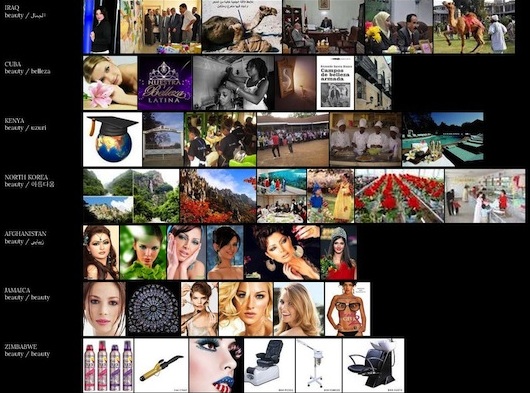
He's struck by the fact that even in non-Western countries, the images of beauty reflect fair-skinned, Western-looking women:
There’s a staggering number of beauty products, makeup applicators, and spa treatments, all of which essentially suggest that beauty is something to be purchased and applied. Notice that a person living in Jamaica gets the same search results as a person living in the United States. Some of the anomalies are interesting as well: North Korea’s results are mostly nature scenes, Kenya’s results include a graphic of the world wearing a graduation cap, and Zimbabwe depicts more products than people.
 The Dish