The Universal Commute, Ctd

Not too long ago we noted that most people in Europe and the US commute an average of 30 minutes each way. Tim De Chant dug up a treatise by Cesare Marchetti suggesting that's been true "since the dawn of human society":

Marchetti pointed out, "Walking about 5 km/hr, and coming back to the cave for the night, gives a territory radius of about 2.5 km and an area of about 20 km2. This is the definition of the territory of a village, and … this is precisely the mean area associated with Greek villages today, sedimented through centuries of history."

Marchetti—not one to think small, apparently—then used his new universal constant as a jumping off point to explore the future of tomorrow. How fast would a transportation system need to be to serve a city of 100 billion people? An average speed of 150 km/h sounds about right. Can you turn Switzerland into one giant city? Sure, so long as you run maglev trains in sealed tunnels sucked free of atmosphere. What about if you linked Paris and Casablanca with a maglev, too? "[A] woman in Casablanca could go to work in Paris, and cook dinner for her children in the evening."

Biting The Cup That Caffeinates You

Edible-cup

Behold, the edible coffee cup:

The baked cup is lined with a special icing sugar that makes the cup waterproof (for enough time to drink the espresso anyways) and sweetens the coffee at the same time. 

Michael Coren examines other types of edible packaging:

Containers to chow down on are becoming a bit of a trend. French design company Miit came up with a recipe for a digestible version of a chocolate fondue pot, while a Harvard professor has developed biodegradable plastic membranes that taste like their contents and may be eaten along with them. Bon appetit.

Update from a reader:

Not a new idea.  You no doubt know the source of the term/disease "trench mouth":

A trencher (from Old French tranchier; "to cut") is a type of tableware, commonly used in medieval cuisine. A trencher was originally a piece of stale bread, cut into a square shape by a carver, and used as a plate, upon which the food could be placed before being eaten. At the end of the meal, the trencher could be eaten with sauce, but was more frequently given as alms to the poor.

The poor used the trencher over and over, sometimes a bit too long…

Another:

Edible packaging to me isn’t new – when I was growing up back in the innocent 1950s, there was a food truck that used to come around our Brooklyn neighborhood called Chow Chow Cup. Looked similar to the Mister Softee trucks. The truck would serve up "Chinese food" (basically chow mein) in an edible bowl made from molded fried noodles – similar to an egg roll but opened flat with a depressed bowl in the center. I think the motto on the side of the truck was "A Tasty Treat In The Cup You Can Eat".

Another:

I remember something like this from my childhood, too. We called them "ice cream cones."

(Photo by designer Enrique Luis Sardi of Sardi Innovation)

George W. Bush And Apology

Obama has never apologized for America, merely at times acknowledged its mistakes (like torturing prisoners against clear prohibitions in domestic and international law) alongside its strengths (like being one of the the most stable and benign democracies in history). I don't see this acknowledgment of fallibility and error over time as some kind of craven weakness, but actually the kind of strength that a successful, self-confident democracy can deploy when necessary. Democracies can admit when they have screwed up; dictatorships cannot. I regard that as a strength. Romney for some reason regards it as a weakness.

But even George W. Bush differed from Romney on this. And so it was that after some US troops were found using the Koran for target practice, George W. Bush apologized to the prime minister of Iraq:

"He apologized for that in the sense that he said that we take it very seriously," White House press secretary Dana Perino said. "We are concerned about the reaction. We wanted them to know that the president knew that this was wrong."

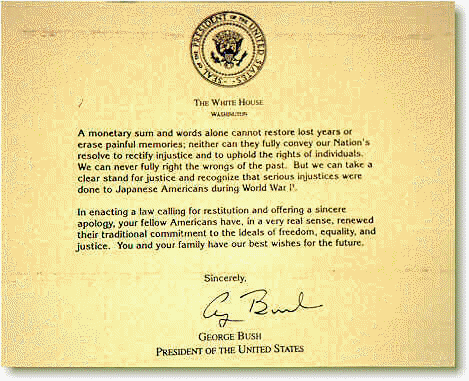
Bush apologized for Japanese-American internment (sorry, Michelle Malkin):

Apol

Here he is in Africa on the legacy of slavery:

"Human beings delivered, sorted, weighed, branded with marks of commercial enterprises and loaded as cargo on a voyage without return," Mr. Bush said. "One of the largest migrations in history was also one of the greatest crimes of history." The president recited a litany of Africans and African Americans who made contributions to American society, from the arts to politics: abolitionist Frederick Douglass, slave-poet Phillis Wheatley and Martin Luther King Jr.

"The stolen sons and daughters of Africa helped to awaken the conscience of America," he said. Mr. Bush did not apologize for slavery but noted Americans throughout history "clearly saw this sin and called it by name."

Here is the statement that Mitt Romney called "disgraceful", issued before a mob attacked the Benghazi consulate:

The Embassy of the United States in Cairo condemns the continuing efforts by misguided individuals to hurt the religious feelings of Muslims – as we condemn efforts to offend believers of all religions. Today, the 11th anniversary of the September 11, 2001, terrorist attacks on the United States, Americans are honoring our patriots and those who serve our nation as the fitting response to the enemies of democracy. Respect for religious beliefs is a cornerstone of American democracy. We firmly reject the actions by those who abuse the universal right of free speech to hurt the religious beliefs of others.

The only thing we learned last week is that Romney and Netanyahu know they are losing this race so far and are desperate to use anything to turn it into a polarizing, global religious conflict where they think they can win. That's why Romney did this week what no president should ever do: see a brushfire of anti-Americanism and pour some more gasoline on it. And why Netanyahu is standing by with a few more barrels if necessary.

Engaging The Earthly City

Matthew-Cusick_206

Deploying the theology of St. Augustine, Greg Garrett sketches an approach to Christian political engagement that focuses on "love, holiness, and humility." He especially believes we need to cultivate the last of these, recognizing the limits of what we can and do know:

Didn't almost all the speakers at both conventions act as though the truth is already discovered and possessed? Yet Augustine predated Descartes' proof of his existence ("I think, therefore I am") by reasoning outward from our inability to know the whole truth: "If I err, I exist" (City of God 11:26). This most renowned of theologians even characterized all human talk about God as "learned ignorance" (Letter 130).

Unlike most of us, Augustine saw the prevalence of error and ignorance as an opportunity for dialogue, not as an opportunity to demonize. It was possible, he said, that he might be wrong or might have only a portion of the truth, and therefore it was wrong for him to completely reject someone who believed differently. Even his enemies might teach him something.

So this final touchstone for theological decision-making asks us, is it at all possible that, as imperfect human beings, we don't hold the entire truth? And if none of us is willing to concede that possibility, can any meaningful change, compromise, or learning take place? Can candidates go to office having sworn not to raise taxes, let's say, or pledging that they will not compromise with those across the aisle?

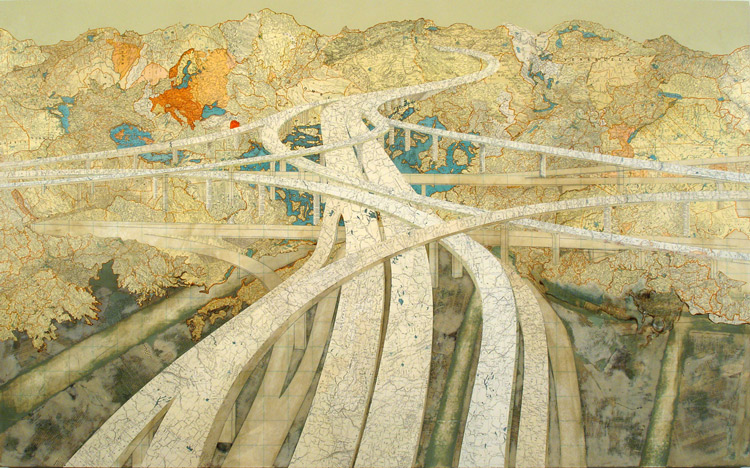
(Image: "The Course of Empire" by Matthew Cusick)

Everyday Sacraments

How should we understand the Christian sacraments of the Eucharist and baptism? Casey N. Cep approaches an answer, from the writer's point of view:

One way of understanding the sacraments, perhaps best articulated by liturgist Gordon Lathrop, is that simple things become central things. When Christians refer to the bath and the table, they refer not only to the specific sacraments of bathing and eating, but they point also to the sacramental character of every bath and every table. The setting apart of one table and one bath shows forth the splendor of all tables and all baths.

That setting apart is the calling of Christians but also the vocation of the writer. The attentiveness of the writer is shown in how that writer lifts to the level of extraordinary the most ordinary of people, places, and things.

Is Netanyahu Trying To Blow Up The Election?

This embed is invalid

He is now actively involved in the Republican campaign to get a war against Iran – preferably before the election in order to scramble a race that Obama now looks as if he could win. He is pulling a Cheney, equating Salafist Sunni mobs in Libya with the Shiite dictatorship in Iran:

“Iran is guided by a leadership with an unbelievable fanaticism. It’s the same fanaticism that you see storming your embassies today. Do you want these fanatics to have nuclear weapons?”

He is making Santorum’s argument that the entire regime in Iran sees itself and its entire country as a suicide bomber, eager to destroy itself in order to annihilate the Jewish state. Does he provide an historical example of such suicidal tendencies for the nation as a whole? No. Because there is no precedent. No precedent in Mao’s China in its most radical era. No precedent in the Soviet Union under Stalin. No precedent even in North Korea, run by total loonies. The obvious answer, if you believe in just war theory, is to ratchet up non-military pressure to get real, effective inspection of Iran’s nuclear facilities while protecting its absolute right to pursue peaceful nuclear power. Another obvious answer, if you think non-proliferation is the key to world peace (which I don’t) is to get Israel to give up its nuclear weaponry – so that the entire region is nuke-free.

There is no just war theory on earth that can justify a pre-emptive strike against nuclear facilities which have not been used to produce a weapon in a country whose Supreme Leader has explicitly called a “sin” to deploy.

As for a radical regime in terms of international relations, which country in the Middle East has launched more wars than any other since its creation, has occupied territory it has then sought to ethnically re-balance, has killed civilians outside its borders in the thousands, has developed a nuclear capacity outside of international non-proliferation treaties, has physically attacked both Iraq and Syria to destroy their nuclear programs, and is now threatening war against Iran, a war that could convulse the entire world into a new clash of civilizations?

Israel is the answer. I have no doubt that this new incident of anti-American Salafist violence in the Middle East is now being used by prime minister Netanyahu to concoct a casus belli with which to scramble global events and get rid of Obama – and his continuing threat to Israel’s illegal expansionism.

When the prime minister of an ally is openly backing one political party in the US elections in order to plunge this country into a war whose consequences are unknowable and potentially catastrophic is a new low. If it is allowed to succeed, if Romney were to win and hand over US foreign policy in the Middle East to Netanyahu and Israel’s growing religious far right, then we will be back to the Bush era without even a veneer of sympathy for Arab democratic convulsions. Above, Netanyahu calls those, like me, who favor containment, stupid. We are not as stupid as you think we are, Mr. Netanyahu.

Face Of The Day

Adrianstoreyletthepoets5

Adrian Storey's photo series focuses on the sleep-deprived:

The photographer, also known as Uchujin, has taken it upon himself to capture all of the dreaming citizens of Tokyo, where he is currently based. The series, titled Let the Poets Cry Themselves to Sleep, features plenty of commuters that can't seem to keep their eyes open, lounging in the most unusually public spaces.

(Image used with Storey's permission)

Self-Help, 19th Century Style

Stefany Anne Goldberg reviews a new edition of The Long Lost Friend, possibly "the most influential and, at one time, most well known grimoire to have originated in the New World." The "grimoire" was a genre that was basically a book of magic – and this one was "composed from bits of Santeria, hoodoo, Catholic prayers, medieval European spells, Native American herbal treatments, and German folk medicine." Goldberg sees in this 19th century text a precursor to the American obsession with self-help books:

Like [The Long Lost Friend author John George] Hohman, the self-help author is usually a channeler of a secret that — through the publication of the book — is made manifest and disclosed to the reader. The efficacy of the self-help book depends greatly on personal testimonials. The promise of all self-help books is self-improvement and self-actualization, and like The Long Lost Friend their essence is found less in the ‘help’ than in the ‘self’. How you can be improved, what inside you could be actualized — these are incidental, fluid. The primary message is that one can go it alone by tapping into inner resources that everyone holds. Self-help books — like The Long Lost Friend — are resolutely democratic. To be helped, one only needs enough money to buy the book and enough education to read the words. Whether the purpose is to heal grief or addiction or obesity, or preach the untold benefits of plain vinegar, the self-help guide proposes to improve the lot of anyone and everyone. All the self-help book needs is people who believe. Or try to believe. Or just try.

When Writers Look Into The Abyss

Tulips

To mark the recent publication of Hitch's Mortality, Emily Temple curated a selection of eminent writers on death. Here's Hitch in The Portable Atheist:

Death is certain, replacing both the siren-song of Paradise and the dread of Hell. Life on this earth, with all its mystery and beauty and pain, is then to be lived far more intensely: we stumble and get up, we are sad, confident, insecure, feel loneliness and joy and love. There is nothing more; but I want nothing more.

Michael Ondaatje, The English Patient:

We die containing a richness of lovers and tribes, tastes we have swallowed, bodies we have plunged into and swum up as if rivers of wisdom, characters we have climbed into as if trees, fears we have hidden in as if caves.

I wish for all this to be marked on by body when I am dead. I believe in such cartography — to be marked by nature, not just to label ourselves on a map like the names of rich men and women on buildings. We are communal histories, communal books. We are not owned or monogamous in our taste or experience.

Joseph Conrad, Heart of Darkness:

Droll thing life is — that mysterious arrangement of merciless logic for a futile purpose. The most you can hope from it is some knowledge of yourself — that comes too late — a crop of unextinguishable regrets. I have wrestled with death. It is the most unexciting contest you can imagine. It takes place in an impalpable grayness, with nothing underfoot, with nothing around, without spectators, without clamor, without glory, without the great desire of victory, without the great fear of defeat, in a sickly atmosphere of tepid skepticism, without much belief in your own right, and still less in that of your adversary. If such is the form of ultimate wisdom, then life is a greater riddle than some of us think it to be.

Cut By Occam’s Razor

George Sugihara explores why we miss the early warning signs of impending disaster:

Our problem is that the scientific desire to simplify has taken over, something that Einstein warned against when he paraphrased Occam: “Everything should be made as simple as possible, but not simpler.” Thinking of natural and economic systems as essentially stable and decomposable into parts is a good initial hypothesis, current observations and measurements do not support that hypothesis—hence our continual surprise. Just as we like the idea of constancy, we are stubborn to change. The 19th century American humorist Josh Billings, perhaps, put it best: “It ain’t what we don’t know that gives us trouble, it’s what we know that just ain’t so.”