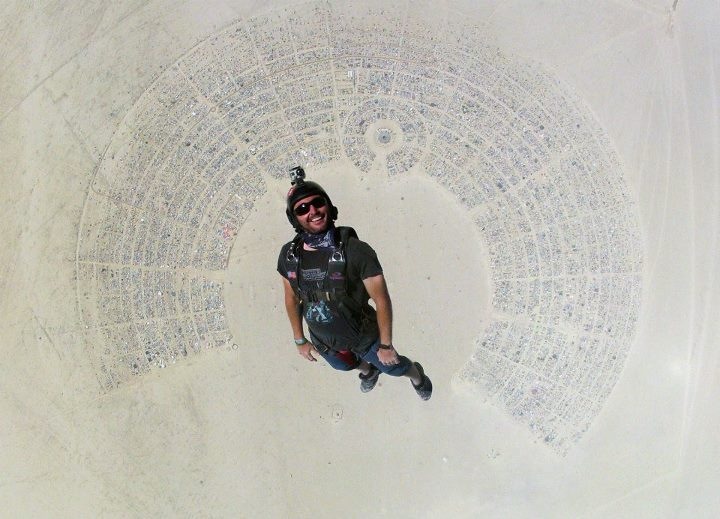
Drinking To Forget

It doesn't work:

It’s no wonder that many people with PTSD — about 14 percent — try to self-medicate with alcohol. Booze helps us forget, right? The idea lurks in idioms — I might get "trashed" or "wasted," or "drown my sorrows" — and in Proverbs 31:7, and in the gospel of Dave Matthews: Excuse me please / one more drink / Could you make it strong / ‘Cause I don’t need to think… One drink to remember / Then another to forget…

So I was fascinated by a new study showing the opposite. Alcohol, it seems, helps cement painful memories into neural circuits.

On the other hand, the authors note that a separate study suggests that cannabis can help us forget painful memories.

A Poem For Saturday

Sept

"A Field in Scurry County" by Christian Wiman:

Late evening, cool, September, and the ground
giving its clays and contours to the sky.
The colors swirl and merge and fall back down
and for a moment, as the reds intensify,

I am a ghost of all I don’t remember,
a grown man standing where a child once stood.
It is late evening. It is cool. September.
Pain like a breeze goes through me as if it could.

(Reprinted from Hard Night © 2005 Christian Wiman. Reprinted with the permission of the author and Copper Canyon Press. Image by Flickr user St0rmz)

Wiring The Iraqi Elections

An anonymous writer over at The Billfold reveals how he parlayed a lackluster IT resume into a gig building the IT and communications infrastructure for the Independent Electoral Commission for Iraq (IECI) in 2004. He managed to knock off $90,000 in student debt in the process:

If I had felt any unease that I was potentially exploiting a horrible situation for personal gain, it was short-lived. The next four months were the most stressful, difficult, and dangerous of my life until that point, and probably—hopefully—ever. … On December 31, 2004, I achieved a couple of significant milestones: I made my final student loan payment, and I had a positive net worth for the first time in my adult life. Mortars, rockets, and car bombs aside, that was pretty satisfying.

Election Day finally arrived on January 30, 2005. Somehow just about everything I had to do got done. Well, not everything, but enough. How everyone else got their jobs done, which were a lot bigger and more complicated than mine, I will never understand. I spent the last few days setting up the tally center, but I had nothing to do on the big day itself, which was weird. I wandered around the headquarters, completely idle for the first time in months. The Iraqi staff started to trickle in, their index fingers stained purple after voting. I was unexpectedly overcome with emotion. Then my staff started to arrive, the sweetest, hardest working bunch of nerds you could ever ask for, and they proudly showed me their purple fingers. As conflicted as I may have been about this entire endeavor—and I still don’t know if any of it mattered—it was a sweet day. I must have cried a dozen times.

The Cornerstone Of Criticism

Darryl Campell names "the four classical elements of literary criticism," which are: "Reaction. Summary. Aesthetic and historical appraisal." He argues the first of these, the brute fact of liking a book or not, is inescapably what drives the reviewer:

In the beginning, there is ego. As George Orwell put it in his essay "Writers and Leviathan": "One’s real reaction to a book, when one has a reaction at all, is usually ‘I like this book’ or ‘I don’t like it,’ and what follows is a rationalization"

The decision to like or not like a book is where every book review begins. This is what gives the genre its underlying suspense — will Michiko Kakutani like this book or won’t she? — but also its frustrating sense of chaos, because no matter how technically sound or philosophically sophisticated or beautiful a book might be, something minor or tangential can turn off a reviewer so much that he or she decides the book is not good.

For a review that basically shreds a book with humor and aplomb, tomorrow's NYT review of Naomi Wolf's vagina book is a classic. Money quote:

You guys know the drill, you simply must try, yet again, and try harder this time — more slowly — to worship at the “Goddess-shaped” “hole,” so that your woman will have a “showers of stars” orgasm. Are any of you men still reading this, or are you already surfing the Web for some good, speedy, get-to-it, disgusting hot porn? Some nasty girl-girl might be soothing right now. Hold on.

Wolf gives you a choice: do you “want to be married to a Goddess — or a bitch?” O.K., don’t answer that.

I don't think the reviewer liked the book very much.

Desperation, The Ad Strategy, Ctd

Karl Rove's Super PAC American Crossroads is the first out with an ad trying to use the embassy attacks to hit Obama, issuing the laughably hypocritical charge that Obama didn't suspend campaigning after Ambassador Stevens was killed. The web ad also goes kitchen-sink to try and suggest the president is somehow negligent regarding US foreign policy (the size/scope of the ad is unknown):

By the way the "Obama skips briefings" charge comes from everyone's favorite torture-monger, Marc Thiessen, and is of course, BS. Previous shamelessness from Rove's ad-makers here.

The Ad That Could Win The Election

As Greg Sargent notes, five national polls now show that Romney has lost his only real lead – on the economy. Now Obama brings out this kickass ad tackling the core Reagan question that Romney keeps asking – ” Are you better off now than you were four years ago?’ – and answers it with Clinton and Obama. Watch:

Beyond The Campaign, The Country

I rarely do this, but here is the thirty minute ceremony at Andrews Airforce Base when four American public servants were brought home after being killed by a Salafist mob in Libya. Clinton speaks at the 7-minute mark. She has shone throughout this tragedy and tension, as Dan Klaidman reports in a must-read:

Through it all, Hillary Clinton was a source of strength for her wounded department, employees say. She moved back and forth between public appearances and private internal diplomacy, showing her trademark combination of resolve, empathy, and hyper-competence. She began at State, looking drawn but determined, calling the events in Benghazi “an attack that should shock the conscience of people of all faiths around the world.” Later that morning she stood by President Obama at the White House, looking alternately stoic and stricken. Then the president and his secretary of state traveled to Foggy Bottom where they met with shocked employees. Those who saw Clinton in action this week say it was in the more private, intimate moments where she was at her best.

I never, ever, ever thought I'd say this: but Hillary Clinton's composure and competence and humility over the past four years as secretary of state make me want to see her president one day.