Reality Check

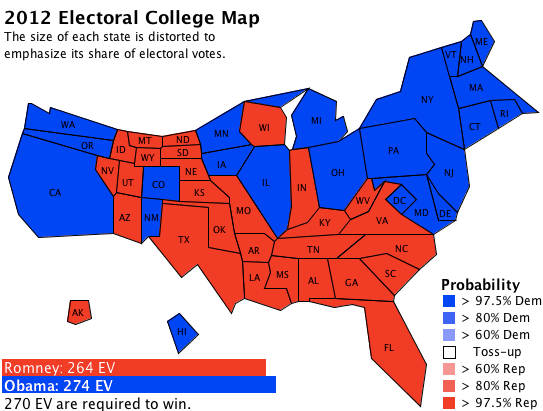
I made a decision to assign victories to Romney in two toss-up states – Iowa and Virginia – on Princeton’s EV map. Then I threw in Nevada for Romney. Then Florida, where he is currently struggling. This is the electoral collage map that emerges at this point with current polling (apart from my GOP-beneficial assignments):

Screen shot 2012-09-14 at 2.13.40 PM

Obama still wins. Romney needs Ohio or Colorado or Iowa desperately. He is behind in all three by a few points. And if I were Obama, I’d keep Bill Clinton in Florida for as long as he is prepared to campaign there. Here’s the national race, with Rasmussen removed and sensitivity increased:

Obama is coming down from his bump, but Romney is in a free-fall. I’m not sure how this past week will turn that around.

About Romney’s Next War

In a large new poll, the American public are firmly against it:

A slim majority (51%) opposes UN authorization of a military strike against Iran’s nuclear energy facilities, with a substantial minority (45%) supporting such action. A far broader majority (70%) opposes a unilateral strike by the United States if Iran continues to enrich uranium but the Security Council does not authorize a military strike.

As for a unilateral Israeli strike, 59 percent want the US to stay out of it.

How Much Do The Debates Matter? Ctd

Like Sides, Nate Cohn finds evidence that the debates are over-hyped:

Why haven’t the debates had a greater impact? It appears that most voters make up their minds before early October, usually the onset of debate season. In this environment, debates are more likely to reinforce existing perceptions rather than shake up the race. Presidential elections may be nearly as expensive as small wars these days, but the real battlefield is not the debate stage.

Romney And The Women

In an interview with Joanna Brooks, Mormon feminist Judy Dushku reflects on her personal experience with Romney, who had been her bishop and stake president in the Belmont, MA, community. Her account offers insight into both Romney's earlier pro-choice views and how, even in the early 1990s, political calculation shaped his platform:

When I entered the office, there was a table to my right where I saw women from the ward working. I said, “Hi,” and he asked, “What brings you here?” I told him I was interested in politics, that I heard he was taking a pro-choice stance [in his Senate race], and that I was wondering if, as a Democrat and fellow Mormon, maybe I could work for him…. “Yes, I’m definitely for choice,” he said. And I said, “Great, we agree on that.” Then, he said, “In Salt Lake, they told me it was okay to take that position in a liberal state.” I said, “That doesn’t make me quite as happy. I’d rather know you really believe it….” And that’s why I continued to try to understand his point on the issue. I asked, “What about women who might be on public assistance?” He said, “I would never have the state provide for abortion.” I said, “For a lot of Massachusetts women that won’t work.” He got very restless and stood up and said, “I am pro-choice; is there something else?”

Dushku paints Romney as having "disinterest and a certain attitude toward frivolousness of women's issues" that exist on a personal, as well as policy, level:

I’ve told reporters [looking for "the dirt" on Romney] they were barking up the wrong tree. Mitt is a loyal husband, and he is conscientious. But he is incredibly entitled and feels like his story is the most important. If you were ever at a ward party and sat down with your plate of food and found yourself at a table with Mitt and five other men, you would just expect that you wouldn’t be in the conversation. No one was particularly unkind, but there was an in-group made of up those who were in the circle of male leaders—many Harvard Business School types—and their wives. I was spouseless, and I didn’t live in Belmont, but Watertown, which is economically less privileged. I tried and always came to church, but it was often awkward….. [Referring to interviews she gave about Romney's abortion stance during his Senate run,] it was not that I had specific horrible stories to tell, it was that I felt people should know that he was not a caring man, particularly when it came to women. He once said to me, “Judy, I don’t know why you keep coming to church. You are not my kind of Mormon.”

Previous coverage of Romney's appeal to women – or lack thereof – here and here.

Romney’s Impossible Math, Ctd

An exchange from Romney's interview with Stephanopoulos:

GEORGE STEPHANOPOULOS: You cite your own studies. But one of the studies you cite by Martin Feldstein at Harvard shows that to make your math work, it could work, if you eliminate the home mortgage, charity, and state and local tax deductions for everyone earning over $100,000. Is that what you propose?

MITT ROMNEY: No, that’s not what I propose. And, of course, part of my plan is to stimulate economic growth. The biggest source of getting the country to a balanced budget is not by raising taxes or by cutting spending. It’s by encouraging the growth of the economy. So my tax plan is to encourage investment in growth in America, more jobs, that means more people paying taxes. So that’s a big component of what allows us to get to a balanced budget.

GEORGE STEPHANOPOULOS: But his study, which you’ve cited, says it can only work if you take away those deductions for everyone earning more than $100,000.

MITT ROMNEY: Well, it doesn’t necessarily show the same growth that we’re anticipating. And I haven’t seen his precise study. But I can tell you that we can lower our rates —

GEORGE STEPHANOPOULOS: Well, you cited the study, though.

Jonathan Bernstein pounces:

Mitt Romney’s not going to balance the budget by raising taxes or by cutting spending; we’re going to have presto-chango-magico growth. Exactly the way that Ronald Reagan and George W. Bush “balanced” the budget by projecting magical growth rates.

Chait piles on.

Why Are The Egyptians Still Protesting?

Egypt_Protests_GT

Peter Hessler reports from Cairo:

[T]he events at the U.S. Embassy seem to reflect the general deterioration of security around the country, especially with regard to diplomatic missions. Since the revolution, four embassies have been breached by protestors: Israel, Myanmar, Saudi Arabia, and the United States. These protests often begin because of some distant event—Myanmar, for example, was targeted because of the government’s treatment of the Rohingya, a Muslim minority—and demonstrators have learned that the Egyptian authorities are reluctant to use force. This is especially true now that the Muslim Brotherhood is in power, trying to establish themselves as the first democratically elected government in decades. “The problem with the current government is that there is a huge fear of hurting the protestors, especially if [the government] is defending foreigners,” the foreign diplomat told me. “It’s a very populist regime.” She continued, “That’s one of the after-effects of the revolution. They have the right to make these protests, and they know that the security forces won’t do anything.”

A diplomat Hessler talks to sees the anti-Islamic Muhammad film as an excuse for the protests rather than their cause. Kevin Drum agrees.

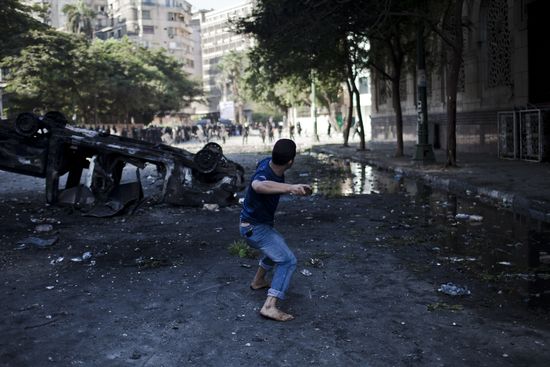
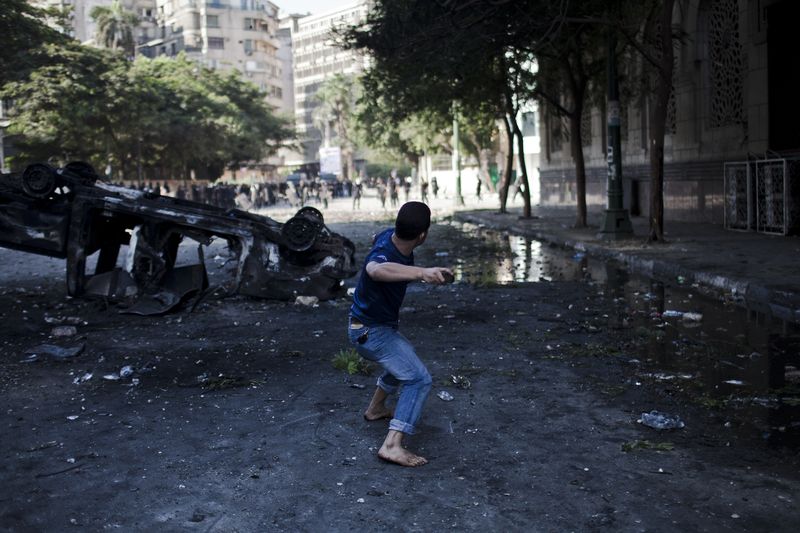
(Photo: An Egyptian protester throws a rock toward riot police during clashes near the United States Embassy and Tahrir Square on September 14, 2012 in Cairo, Egypt. Over two hundred people have been injured in clashes between protesters and security forces. By Ed Giles/Getty Images)

The Power Of Blogging

Scott Sumner puts yesterday's round of Fed activity in perspective:

Bernanke emphasized that monetary stimulus is not like fiscal stimulus, it actually reduces the budget deficit.  That’s right… He said it was an 11 to 1 vote… Bernanke deserves a lot of credit for what the Fed did today.  It’s not as much as I’d like, but he’s way out in front of the median economist.  It could be much worse.

Yglesias hails Sumner's underdog bloggy clout:

Professors at Bentley University who've never published a famous book don't normally shift the public debate. But Sumner's vigorous and relentless blogging throughout the crisis on the potential of expectations-focused monetary policy really broke through. It all began with some links from Tyler Cowen and perhaps a tiff with Paul Krugman.

I became a regular reader and his ideas have done a lot to influence me, and you can clearly see the influence on Ryan Avent at the Economist, Matt O'Brien at the Atlantic, Ramesh Ponnuru at National Review, Josh Barro at Bloomberg, and a few of the Wonkblog contributors. Outside the exciting world of online economics punditry, NGDP targeting hasn't (yet!) caught fire as rapidly but it gained explicit allegiance from Christina Romer, Krugman, the economics team at Goldman Sachs, and eventually Chicago Federal Reserve President Charles Evans who started out with a different but similar-in-spirit program.

Romney360

Truly amazing on the video condemned by the Cairo embassy:

I think the whole film is a terrible idea.  I think him making it, promoting it showing it is disrespectful to people of other faiths.  I don’t think that should happen.  I think people should have the common courtesy and judgment– the good judgment– not to be– not to offend other peoples’ faiths.  It’s a very bad thing, I think, this guy’s doing.

Why is that not as "disgraceful" as the original embassy statement? By his own logic? Or is there no logic here at all? Just shameless say-anythingism to get some kind of news cycle coup. And then lying afterwards.

Being There

131391731

Michael Lewis's Obama article is now online and worth reading in full. Michael is our greatest nonfiction writer right now, and he is able to capture the full dimensions of what being POTUS means – by telling two stories, of a soldier dropped into the Libyan night and a commander-in-chief of almost preternatural calm thousands of miles away.

I remain of the view – it has strengthened over these past four years – that while Barack Obama is obviously fallible, has made mistakes (blowing off Bowles-Simpson too soon), gaffes ("you didn't build that"), and one critical miscalculation in the debt ceiling end-game (asking for more revenue just as Boehner was being cut off at the knees by Ryan and Cantor), he is also one of the coolest temperaments to have sat in that chair. What people don't note enough is both the self-discipline (that we know doesn't come easily) and the zen-like calm he exudes. Occasionally I ask some sources close to him how he reacted to some piece of news or the other. They almost all say that his range of emotion is about a tenth of the average human being – and that he is as intent on being a good father and husband as being a good president. He is cool not in the pop culture sense, but in the "old soul" sense. This is why so many wavering Americans still like him. In an ocean of drama, he is an island of public calm.

I have very little of that temperament. I'm not good in crises. But when I think of the characteristics I want in a president in turbulent times, this capacity for calm and poise comes pretty high on the list. And that's why I think this past week was almost as damaging to Romney as the week before. He over-reacted in a petty, political way to a sudden, murky series of events that demanded restraint and calm and fact-gathering. Then he doubled down on his attempt to politicize it. This was talk-radio performance, not presidential behavior. 

Then there's just practical wisdom. Again, the right's attempt to equate Obama with Jimmy Carter – because it's their iconic moment of electoral triumph – could not be further off-base. Obama is not micro-managing the White House tennis courts. Michael (full disclosure: old friend, former colleague) asked the president to "Assume that in 30 minutes you will stop being president. I will take your place. Prepare me. Teach me how to be president." Part of Obama's response:

“You have to exercise,” he said, for instance. “Or at some point you’ll just break down.” You also need to remove from your life the day-to-day problems that absorb most people for meaningful parts of their day. “You’ll see I wear only gray or blue suits,” he said. “I’m trying to pare down decisions. I don’t want to make decisions about what I’m eating or wearing. Because I have too many other decisions to make.” He mentioned research that shows the simple act of making decisions degrades one’s ability to make further decisions. It’s why shopping is so exhausting. “You need to focus your decision-making energy. You need to routinize yourself. You can’t be going through the day distracted by trivia.” The self-discipline he believes is required to do the job well comes at a high price. “You can’t wander around,” he said. “It’s much harder to be surprised. You don’t have those moments of serendipity. You don’t bump into a friend in a restaurant you haven’t seen in years. The loss of anonymity and the loss of surprise is an unnatural state. You adapt to it, but you don’t get used to it—at least I don’t.”

I actually prefer presidents who do not seek constant exposure and remember the banal loveliness of ordinary, relatively anonymous life, and are eager one day to get back to it. That was Reagan and the Bushes. It wasn't Clinton or McCain. It is Obama – the sanest conservative president since Eisenhower.

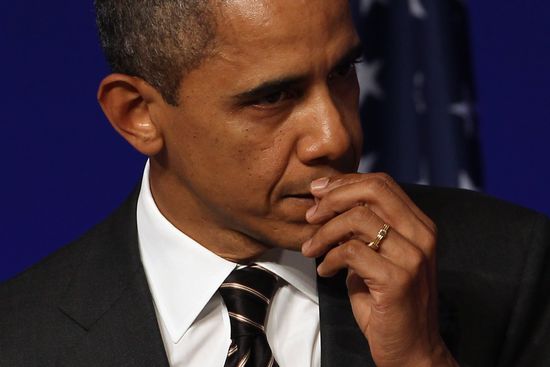
(Photo: Dan Kitwood/Getty.)