Closer To Heaven

Here's a lovely exchange in the Guardian's new interview with the Pet Shop Boys, who, nearing sixty, and after selling 100 million records worldwide, have just released a new album, with another one up their sleeve:

"We're not embarrassed to confront age. There's the paradox of making pop music when you're in your 50s. People weren't meant to be doing that originally and yet they are. Mick Jagger [used to say] we're not going to be doing Satisfaction when I'm in a wheelchair," – Neil Tennant.

"Although it would be quite an appropriate song to sing," – Chris Lowe, in response.

I've been listening to Elysium for a few days now. It's a dreamy meditation on life and death and time. The track Invisible is technically peerless and emotionally wrenching, if you're headed into middle age. The lyrics to "Your Early Stuff" are hilarious, if you've ever had a long career in something. The LA lounge-sound is both new and yet very PSB.

But the song above, "Leaving," has really stayed with me. It couples with "Breathing Space" for me as the highlight of the album. Maybe it's the time of year as the Cape light intensifies and the beaches empty and the dusk turns the tide into purple lava, and shops empty and restaurants close and "leaving" looms. Maybe it's because we're also leaving DC for the coming year to try living in New York City (for Aaron's career and my proximity to the Beast and the Dish team). But the melancholy and hope of autumn find an elegant, calming balance in this latest album. It has made me suddenly very sad at times as I bike through the dunes listening; and also, for longer periods, oddly joyous.

Most of all, the atmosphere of the album felt like home – this little home on my romanticized, elysian sandbar I return to and won't leave summer after summer, reaching forward for something I will never grasp, escaping somewhere for nowhere, wading in the tidal pools and watching the sun change the colors around me and feeling the moon pull the water past me:

There's a place beyond this world
Where the mountains meet the sky
It's a different state of mind
Like a dream where you can fly

Can I tell you this in confidence?
I need to regain that old innocence
I stop for some breathing space
Divert from the public place
Return to a private place
I know it's there just in case
I gotta get out
I gotta get out

And now I must leave.

You can buy the album here.
The Best Of Bad Options In Egypt

Frum argued yesterday that the Obama administration was wrong to engage the Muslim Brotherhood. Millman asks the question I would: what's your alternative?

I’m skeptical, personally, that the Egyptian military could have banned the Muslim Brotherhood without facing widespread civil opposition, and possibly worse. When Frum says some in the Obama Administration thought it was “preferable to live with [the Islamists] than to do what was necessary to resist them” that “what was necessary” could well have included supporting an outright military coup, and subsequent large-scale repressive violence. Meanwhile, the actual partial coup that took place has left military and civilian authorities jockeying for legitimacy, which is part of the background to provocations like the attack on the American embassy.

Drum is on the same page:

Conservatives too often assume that American power can accomplish anything we set our minds to. But it's not so. Sometimes there just aren't any good options, and the best path forward is to ride out the storm and refrain from doing anything foolish. It's not very satisfying at a gut level, but nine times out of ten it's the best you can do.

Romney’s Theory Of “Provocative Weakness”

Ambinder deciphers it:

[I]t is worth taking a brief tour through the Museum of Provocative Weakness. That phrase is a favorite of Ambassador John Bolton, who said on August 28 that Romney "doesn't believe strength is provocative, he believes that American weakness is provocative." It has been used many times by Donald Rumsfeld and Dick Cheney. After the decision had been made to invade Iraq, Rumsfeld told ABC News that it didn't really matter if a war enrages Arab populations in the Middle East. "All I can say is if history has taught anything, it's that weakness is provocative. It entices people into doing things that they otherwise would not do." When Rumsfeld was fired by President Bush three years later, he used his final turn at the podium to say that "it is not only clear that weakness is provocative, but [that] the perception of weakness on our part can be provocative."

This phrase is the beating heart of Mitt Romney's world view. You can see it in his books. You can hear it whenever he condemns President Obama for his "apology tour." In practice, this means that whenever America has a choice about whether to demonstrate its will to power, it ought to exercise it. Anything else would telegraph weakness, a lack of resolve, that tips the balance of power in the world away from the good guys.

In business, I can see the logic of this. But in diplomacy and foreign policy? Romney doesn't understand that restraint can also be a form of strength; that exercizing power incompetently can weaken a country's power; that the Iraq and Afghanistan wars deeply wounded America in human and fiscal terms, with minimal long-term gains to offset these massive short-term losses.

I can see why a decade and a half ago, you could hold these views. I was not as far out as Romney is, but after the triumph in the Cold War, cockiness got the better of me. But I cannot see how you can maintain this worldview after the Bush-Cheney debacle. But that is what we are learning about Mitt Romney: his foreign policy mind hasn't changed since the 1970s. The last decade changed nothing. His foreign policy adventures as a candidate – from alienating our closest ally, the UK, to ceding US Middle East policy to the far right in Israel, to his latest implosion on the embassies in Libya and Egypt – renders him as reckless a choice in dealing with abroad as George W. Bush.

His obtuseness is dangerous. It is a gift to America's enemies and a threat to our friends.

The Protests Spread


Anti-film protests were held today in Sudan, Iraq, Indonesia, Afghanistan, Tunisia, Lebanon, Pakistan, Israel, Jordan, Qatar, India and Kashmir, while protests continue in Egypt and Yemen. Many of the demonstrations followed Friday prayers, though they widely varied in size. The Guardian is live-blogging. From CNN:

One of the worst riots took place in Sudan, where a thousands converged on the German Embassy and set it on fire, a journalist on the scene said. Some managed to get inside and pull down a German flag before police with tear gas forced the crowd to retreat.

In Egypt, a running battle between police and protesters in Cairo continued into its fourth day. And Afghanistan saw its first demonstrations Friday, despite the government’s attempts to block the online video from sparking riots. Aware that protests were planned for Friday — the Muslim holy day — the United States beefed up security at its embassies and consulates across the Middle East.

Al Arabiya reports on the scene in Tunisia:

Police fired tear gas and warning shots as more than 1,000 stone-throwing protesters gathered on Friday outside the U.S. embassy in a Tunis suburb to denounce [the film], an AFP journalist reported. A thick black plume of smoke was seen rising from the car park of the embassy, with a policeman telling AFP that some demonstrators had thrown petrol bombs. The security forces intervened when hardline Salafis among the demonstrators outside the U.S. mission started hurling rocks, the journalist said. … Protesters also set fire to the American School in Tunis, a Reuters reporter said. The school was closed on Friday.

This was the scene in Tahrir Square, where the Muslim Brotherhood had first backed, then tried to cancel, today’s protests:

To read all Dish coverage of this week’s crisis in one convenient place, go to the “Embassy Attacks In Libya and Egypt” thread page.

Bernanke Goes Big, Ctd

Djia2000s

Greg Ip puts QE3 in perspective:

Between the ECB’s action last week and the Fed’s today, the world’s two most important central banks are bringing unprecedented resolve to bear on economic growth. The world may one day look back and conclude the first half of September was either a turning point for the global economy, or the final nail in the coffin of the doctrine of central bank omnipotence.

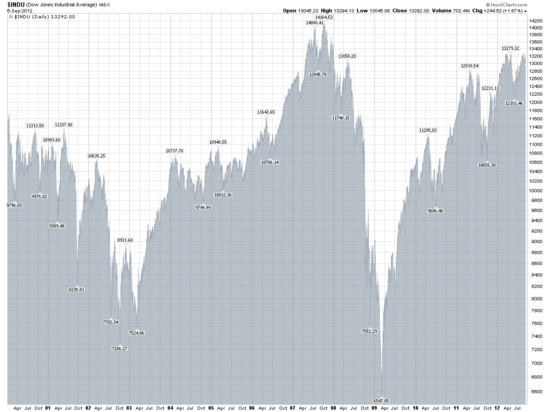
Stocks, meanwhile have doubled in value since Obama took office (see graph above). In April 2009, it was at 6,500. Today, it is at 13,600. Sarah Binder explains why Bernanke waited so long:

Judging from Bernanke’s comments … he waited far longer than a more autocratic chair might have deemed necessary. Indeed, he noted that the consensus across the FOMC was so broad, that “even as personnel changes going forward, this will be seen as the appropriate approach and we will have created a reserve of credibility we can use in subsequent episodes.” That line was probably the most important statement of the day, as it provided a glimpse of Bernanke’s strategy for addressing the intense and continuing criticism of the Fed: Build as deep and broad a consensus for aggressive Fed action, so that the Fed’s audiences will come to concur that the course of action is “appropriate”—even after Bernanke’s term as chair ends. Such confidence might be premature, but it suggests the hard challenge Bernanke has faced in leading the Fed in a polarized political environment marked by pockets of deep distrust of the Fed.

Dave Weigel rounds up the typically vague Republican outrage about QE3. Ron Paul, meanwhile, describes some more vivid concerns for the American people:

I don’t think he should raise rates. He should just get out of rigging rates. The system is so biased. It helps the bankers who get free money and then they buy government debt. What about the people who are frightened, they do not like the stock market and they are frugal and want to take care of themselves?  What do they get—1% on a CD? That is unfair.

Brad Plumer touched on some of these issues last month:

If a central bank’s easing efforts bolster the broader economy, then the trade-off might be worth it. “The fact that the rich have benefited most from QE does not mean that others haven’t benefited,” writes economist Chris Dillow. ”People without financial assets have gained, to the (small) extent that QE has increased job security and raised inflation, thus eroding the value of debt.”

Indeed, a recent NBER paper (pdf) argues that overly tight monetary policy that keeps unemployment high is far more likely to exacerbate inequality than anything else. On this view, improving the job market is the best thing the Fed can do on inequality, regardless of the near-term effects.

Bear in mind that the Fed is ultimately just the backstop, he notes:

[I]t’s worth noting that more fiscal stimulus from Congress could be a way of boosting the economy without pumping up the assets of the wealthiest. Indeed, at certain points Ben Bernanke has pleaded with Congress to do more to support the economy. But Congress isn’t doing much, which is why there’s so much attention these days on QE3.

Which is why Obama's re-election is so crucial for our economic near and distant future.

How, Exactly, Would Romney Handle The Arab Spring?

Alex Altman suggests that Romney could win the Middle East debate:

If the Arab spring turns into an “Arab winter,” as Romney put it, and tumult spreads across the region, a backlash could certainly build against Obama’s handling of the uprising, leaving Romney to profit politically.

Greg Scoblete objects:

Undoubtedly, the administration has slipped up in its handling of the Arab Spring; it’s a momentous, historic event that caught the U.S. largely off guard. But this leads to the absurd assumption implicit in the criticism of the administration: that the U.S. federal government can deftly finesse the direction of Middle East politics in the 21st century. Particularly for those who profess a love of “limited government” it seems rather farcical to claim that the same incompetent government that can’t be trusted to balance the budget can reach across the ocean and create a Middle East more to its liking.

It’s more evidence of Republican incoherence: the government can’t be trusted to intervene in Texas because it is too far away and the feds are incompetent. But Afghanistan, Iraq and Libya? Why don’t we control them directly from Washington? Larison piles on:

The most common criticism of the Obama administration’s response to these uprisings has been that it has been “too slow” to lend support to protesters. That has been one of the frequent charges from the Romney campaign and from other leading Republican hawks. However, if these uprisings are gradually leading to a so-called “Arab winter,” a reluctance to back protest movements won’t be perceived as a liability. Despite their best efforts to have things both ways, Republicans cannot coherently attack Obama for being insufficiently supportive of protests and overly supportive of majoritarian Islamist movements.

But they’ll try anything.

By the way, to read all Dish coverage of this week’s crisis in one convenient place, go to the “Embassy Attacks In Libya and Egypt” thread page.

Ask John Hodgman Anything: Best Part About Working For The Daily Show?

You probably recognize Hodgman from his appearances on The Daily Show and those ubiquitous Apple ads, but be sure to check out his book, That Is All, an audio and paperback version of which are being released October 2, along with The Complete World Knowledge box set. Check out his podcast here. Previous videos of John here, herehere and here. “Ask Anything” archive here.