Can you imagine Mitt Romney saying about Islam what George W. Bush did in the very wake of 9/11? Or any leading Republican at this point?
Month: September 2012
Romney Is No Reagan
A reader writes:
Your quoting of two then-future presidents regarding the Iran hostage crisis got me thinking even more about the horrific events of the past couple days. Candidates Reagan and Bush were responding to an event that Jimmy Carter had an actual hand in deciding. Carter was the one who made the call to attempt to rescue the hostages. By doing so Carter is accountable for what happened. And yet Reagan and Bush stood firmly behind their president and did not criticize the decision that he made. Fast forward to 2012. The Republican presidential candidate chooses to attack the Obama administration for a statement that upon reflection looks like a balanced respectful approach to a situation that President Obama had nothing at all to do with.
This was not the President’s personal decision. This was a decision by a mid-level embassy employee at a completely different embassy than the one that would later be attacked with horrific consequences. Mitt Romney’s attack (and the smirk, which I hope gets aired nonstop over the next several days) and the comments of his cheerleaders in the Republican party not only prove that this is not my father’s Republican party, but that ever since Clinton won election in 1992, the big tent has been hijacked entirely by the reactionary element of the GOP. Mitt Romney and those who classlessly have been backing his attack are not only not fit to be leaders of this nation, they are not fit to maintain any public soapbox at all.
To read all Dish coverage of this week’s big story in one convenient place, go to the “Embassy Attacks In Libya and Egypt” thread page.
Please Mind The Gap
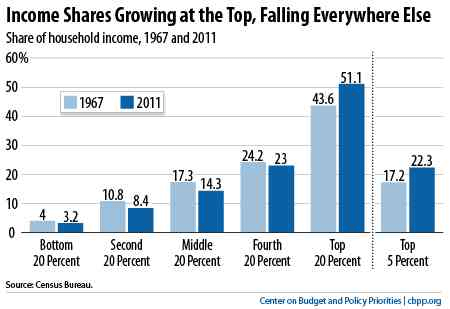
After summing up the key findings of yesterday's census report, Jared Bernstein homes in on income share trends. Commenting on the above chart, he says:
It’s a stark reminder that when it comes to the living standards of middle- and low-income families, overall economic growth is necessary but not sufficient. For these families to get ahead, the economy must not only expand but that expansion must reach more households, particularly those for whom growth has been largely a spectator sport.
Bernstein reflects on the Republicans' scuttling of the American Jobs Act:
[The] results carry two lessons. First, they pose yet another reminder to policy makers that austerity measures in an economy that remains well below potential with a job market that’s still far too slack are exactly the wrong way to go. Second, they show that the economic problems we face are, in fact, amenable to policy intervention.
I’m of course not suggesting that the anti-poverty measures noted above are solving the market failure of poverty, nor are the few pieces of the ACA that are in place solving the challenge of health coverage. But they’re both helping, and if policy makers were listening to these data, they’d recognize that such measures point the way forward.
How Important Is The Traditional Family?
Mark Silk claims "it is anything but clear that strengthening our commitment to our families is a good thing":
In a famous study half a century ago, the political scientist Edward Banfield coined the term "amoral familism" to describe how family solidarities in a southern Italian village decreased engagement in and trust of the political community as a whole. Rather than see their futures wrapped up in the success of their country and civic community, the villagers sought to maximize their family's situation by any means necessary, no matter what the cost to the larger community.
Over the past few years, economists studying social capital around the world have been studying the question anew, and have generally found that Banfield was on to something. In an important paper, Alberto Alesina and Paola Giuliano looked at 80 countries and found that those where the family ties were weakest tended to have the strongest levels of civic and political engagement and generalized social trust. And vice versa. The top performers in terms of civic engagement were northern European countries: Denmark, the Netherlands, Lithuania, and Germany. At the bottom were the Philippines, Venezuela, Egypt, and Zimbabwe. The U.S. (the greatest democracy in the history of the universe) came in 50th.
And not all great presidents were family men, as Michael Kazin points out:
Think of the three icons whose miniature, exchangeable portraits you carry around in your wallet. George Washington had no children of his own, and he placed devotion to his work over devotion to his wife; exasperated by all the official dinners she was forced to attend, Martha complained, "I am more like a state prisoner." Andrew Jackson’s wife Rachel died two weeks after he was elected in 1828; the couple had no offspring. Abraham and Mary Todd Lincoln were content enough until they moved into the White House. But in 1862, the death, from typhoid, of their young son Willie hurtled both husband and wife into a serious depression. Mary took to visiting spiritualists in order to "talk" to Willie, berated Abe in public when she thought he was flirting with other women, and went on costly shopping sprees in the middle of the Civil War. And that’s not to mention Thomas Jefferson, a widower whose most enduring sexual relationship was probably with one of his slaves.
Obamacare Kicks In
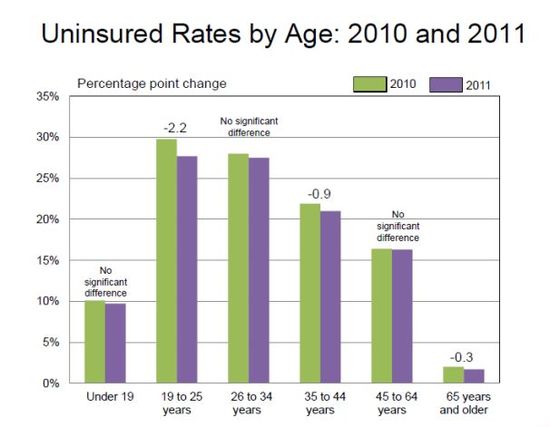
Catherine Rampell finds something to cheer about in an otherwise grim census report released this week:
The share of people without health insurance fell. The biggest drop was among those 19 to 25 years old, who can now join their parents’ health insurance plans.
Sarah Kliff picks up on another trend:
The other driver has to do with a growth of Americans using public insurance programs, like Medicaid. When you break down the insurance numbers by income, you see that the biggest gains have been made among the lowest-income Americans, most likely to be eligible for those programs.
Drum adds:
I'll note in passing that this particular provision of Obamacare is quite popular with the public, so naturally it's one of the provisions that Mitt Romney says he'd keep. He just won't explain how. But I'll give him a hint: the free market declined to allow young adults to enroll on their parents' policies for 80 years before the passage of Obamacare. If Romney really likes this idea, it's going to take something more than the free market to keep it around.
“Self-Help Books Dressed Up In A Lab Coat”
That's what Steven Poole calls books by Malcolm Gladwell and Jonah Lehrer:
Illumination is promised on a personal as well as a political level by the junk enlightenment of the popular brain industry. How can I become more creative? How can I make better decisions? How can I be happier? Or thinner? Never fear: brain research has the answers. It is self-help armoured in hard science. Life advice is the hook for nearly all such books. (Some cram the hard sell right into the title – such as John B Arden’s Rewire Your Brain: Think Your Way to a Better Life.) Quite consistently, heir recommendations boil down to a kind of neo- Stoicism, drizzled with brain-juice. In a selfcongratulatory egalitarian age, you can no longer tell people to improve themselves morally. So self-improvement is couched in instrumental, scientifically approved terms.
In response, McArdle defends self-help books:
You will say that the books are not very good. The lessons they offer are obvious–be nice to your spouse, save more, give constructive feedback to your team members, eat less and exercise more. And of course this is true, not through any particular fault of the authors, but because there are very few revolutions in human affairs. The basic facts of living, getting along with others, and dying haven't actually changed all that much since they were first discussed in blockbuster self-help titles like The Bible.
But that doesn't mean they don't bear repeating. I must have read dozens–hundreds–of melancholy laments about the process of aging when I was in my twenties. I enjoyed the writing of many, and even managed to eke a wistful moment out of a few of them. But then one day, in my mid-thirties, I found myself reading another–and resonating to its message of lost youth like a finely tuned wind-chime. Suddenly I shared the wistful and slightly angry sense of a profound loss of possibility; I too had realized that there was no longer time for me to try another career, take up ballet, or enlist in the military. For the rest of my life, I was going to be basically what I am now. I also shared the sense of comfort that that realization brings; I wasted far too much of my twenties trying to construct unlikely selves from the basic starting material I was given.
Some messages can only be heard when you are ready. And some can only be taken from a stranger, as witness the dismal record of friends who try to "help" each other with their marriages. "Practice makes perfect" may not be any more true because someone did a study demonstrating it–but the edict may be easier to swallow coming from Malcolm Gladwell than from your mother.
Time To Buy?
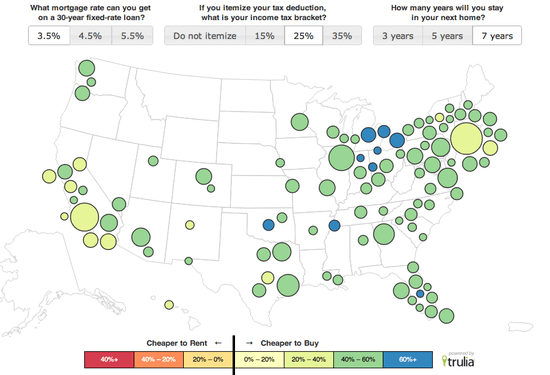
Crunching the number on renting versus buying, Jed Kolko makes the case for the latter:
Based on asking prices and rents during the summer of 2012, buying is now 45% cheaper than renting in the 100 largest U.S. metros, on average – that’s a savings of $771 a month. If you plan to stay in a home for 7 years, which is the average time that Americans traditionally live in a home before moving again, it is more affordable to buy than to rent in ALL of the 100 largest metros in the U.S.
He explains why, despite the pro-buying conditions, people are still renting:
The big obstacle holding back renters who want to buy is the down payment – even more than getting a mortgage. And keep in mind, in the metros where the cost of buying is less than half of what it would cost to rent over the long term, it still takes years to save enough for a down payment. It may be 56% cheaper to buy than to rent in Denver, for instance, but it takes more than 8 years to save enough for a down payment there.
Iraq Is A Risky Investment
Joel Wing checks in on the country's oil industry:
2009 was the first year that major oil companies returned to Iraq en mass in two rounds of auctions for oil fields in southern Iraq. Oil companies were excited about Iraq’s potential, because it had been under international sanctions since 1990, and had huge untapped reserves as a result. Those high hopes have slowly, but surely been scuttled.
First, the service contracts offered by the Oil Ministry severely limited the profits open to the companies, and did not allow them to claim the reserves in the fields they were working on in their books. Second, they ran into Iraq’s infamous bureaucracy that held up almost everything from simple things like getting visas for foreign executives to enter the country to slowing down equipment arriving. These in part explain why some foreign firms have decided to invest in Kurdistan instead, even though the fields are much smaller, and there is uncertainty over whether they will be able to export oil any time soon.
Urban Archaeology
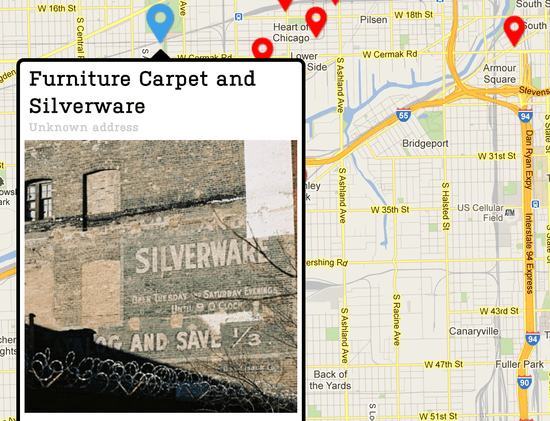
Brendan Ciecko has made an app which typography lovers can use to help make a record of old and typically unique lettering, much of which is slowly fading away. Kyle VanHemert asks him about his motivation for the project:
"The idea for Fontly was inspired by my growing interest in history, the urban landscape, and the eras and evolution of typography and visual style. After traveling from city-to-city, country-to-country, I started realizing that there is a story to be told about places, people, and time … and this story lives in signage. Without picking up a history book, you get a sense of who inhabited the Lower East Side of NYC or Boston’s South End or Krakow’s Old Town; which immigrants settled, what the community valued, their distinct aesthetic, and commercial activities of the past and present. It’s all there."
An Apple For Teacher
Leah Binkovitz traces the tradition:
Held up as the paragon of moral fastidiousness, teachers, particularly on the frontier, frequently received sustenance from their pupils. "Families whose children attended schools were often responsible for housing and feeding frontier teachers," according to a PBS special, titled "Frontier House, Frontier Life." An apple could show appreciation for a teacher sometimes in charge of more than 50 students. … By the time American scholar Jan Harold Brunvand published his book, The Study of American Folklore, in 1968, the phrase "apple-polisher" was more or less shorthand for brown-nosing suck-up.
 The Dish