Drug War Madness

One of the most powerful drug warriors is Mel Sembler, a major Romney donor who has chaired the finance committee for the party and is now funding the opposition to Colorado's Amendment 64 to legalize pot. Lee Fang explains why you should be concerned:

The Semblers have been waging a war on marijuana for decades. Before they led Save Our Society from Drugs, and its sister nonprofit, the Drug Free America Foundation, the Semblers were at the helm of STRAIGHT, Inc., which operated drug abuse treatment centers, mostly for teenagers, from 1976 through 1993. Former clients of the rehab center recount episodes of brutal beatings, rape and systematic psychological abuse. At one facility in Yorba Linda, California, state investigators found that STRAIGHT Inc. subjected children to "unusual punishment, infliction of pain, humiliation, intimidation, ridicule, coercion, threats, mental abuse…and interference with daily living functions such as eating, sleeping and toileting." Samantha Monroe, who was placed into a STRAIGHT Inc clinic in Tampa at age 13, says she was locked in a room, and forced to wear a clothes stained with urine, feces and menstrual blood—a punishment her counselors called "humble pants."

Maia Szalavitz examines other troubling policies supported by Sembler's Drug Free America Foundation:

DFAF fights not only against marijuana legalization and is in favor of a strong role for law enforcement and the drug war. It also opposes two of the most effective ways to save the lives of addicted people: needle exchange programs and methadone and buprenorphine maintenance. At several UN-related meetings, it has countered efforts to include these and other evidence-based "harm reduction" policies in the agency’s documents and strategies. Using propaganda based on junk science, the group exaggerates the negative aspects of drugs, such as their addictiveness and health risks, portraying the marijuana "menace" as if informed entirely by the 1950’s Reefer Madness—a cult classic for its over-the-top pot panic.

Sexism In The Sciences

Science_Study

Serena Dai sums up a study:

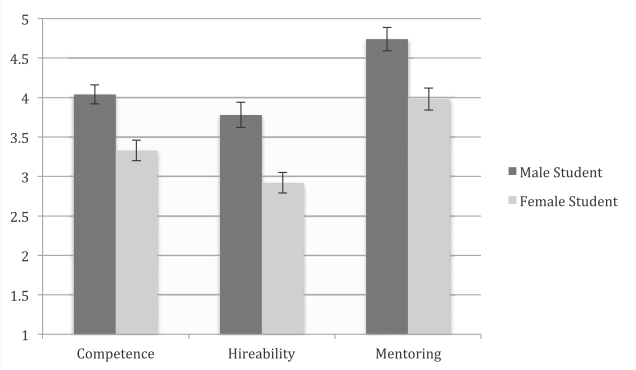
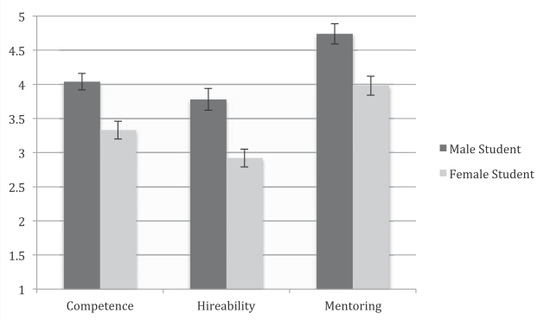
A team led by Corinne A. Moss-Racusin asked 127 professors of biology, chemistry, and physics at major research universities to rate the competency, hireability, and their own willingness to mentor of a grad school applicant on a scale of 1 to 7. Every professor got the same application except for one small difference: sometimes the aspiring scientist was named "John" and sometimes "Jennifer." Faculty—both men and women—rated the male student higher for everything.

Jenny Rohn reflects on the possible reasons for this:

[I]n her wonderful book, Why So Slow? Advancement of Women, Virginia Valian painstakingly documents many studies showing the inherent, subconscious bias that both men and women have against female scientists, who unlike men, do not conform to the "schemata" ("capable", "independent", "can-do") that we tend to think of when we envision scientists4. Picture a scientist in your head: the image is likely to be male. We're just wired that way. The same wiring causes internal dissonance when we are faced with a female scientist.

TNC puts it more simply:

I think we have this tendency to overrate our powers of reason, and underrate the lizard-brain. We have an even greater tendency to underrate the power of culture and socialization among the elite. (Cultural pathology is a phrase reserved for the barbarian poor.)

Killer Robots Above, Ctd

Erik Voeten reframes the debate:

The key question is whether the marginal cost of a drone strike is too low? There are probably good examples where a drone strike took out a dangerous terrorist with minimal collateral damage. But is the U.S. now authorizing too many drone strikes because it has paid the fixed costs of an infrastructure that makes it possible? Much of the information that would guide a better judgment is confidential. Yet, as someone who believes that assassination attempts should be rare I worry about this a lot. Multiple parts of the military and government agencies have developed the ability to use drone strikes. Generally, when bureaucracies invest in such infrastructure they will find ways to use it; allowing the standards for individual justifications to slip.

Greg Scoblete asks another question:

[H]ow many drone strikes are targeting international terrorists (i.e. those training or plotting to hit U.S. and Western targets abroad) and how many are hitting local insurgents who are fighting the U.S. because it's decamped in Afghanistan? This seems like a critical distinction (although these two militant groups likely collaborate) because one group poses an enduring threat to the United States and the other ceases to be an American problem once Washington abandons its flailing nation building effort in Afghanistan. From publicly available information, it's not always clear which of these groups is being targeted.

Who Are The Undecided Voters?

Ezra Klein describes the group:

To people personally invested in politics, the homestretch of the campaign appears loaded with the kind of political information that could change voter opinions. There are debates, a flood of ads, inevitable gaffes, the crush of election news — maybe even an October surprise or two.

But undecided voters are precisely those least likely to tune in to the debates, which helps explain why debates typically have little effect on elections. They’re the least likely to care about a gaffe — or even to know when one has occurred. They’re more likely to throw out political mail and tune out political ads. If they live in a swing state, they’ve already been buffeted by — and proved immune to — months of commercials and phone messages.

Josh Green has more:

In a Sept. 17 focus group of undecided voters in Fairfax County, Va., conducted by the Democratic pollster Peter Hart for the University of Pennsylvania’s Annenberg Public Policy Center, feelings were almost uniformly negative. Hart went around the room asking participants to describe how they feel about the presidential campaign in a word or phrase. Their answers included: “removed … ambivalent … negative … very negative … cheap slugfest … confused … contentious.” Then he asked them to describe Mitt Romney: “stiff … evasive … uppity … unfriendly.” Obama fared no better: “overly confident … unrealistic … arrogant … hollow.” A.J. Morning, a 41-year-old computer technician from Springfield, Va., summed up the group’s mood when he told Hart that the country is “mired in a bowl of stupid.”

The Debate Expectations Game

Cottle thinks Romney has lost it:

Romney may be a good debater. He may even be a great debater. But at this point his team has fumbled the expectations game to the point where the governor will need to perform at a level well above anything we’ve seen from him to date if he wants to pull off the “W.” Just holding his own against the president—often a challenger’s primary hurdle—won’t change the game, and, at this point, a game changer is what people are demanding.

Scott Conroy believes that the expectations game is over-hyped:

According to Craig Shirley, who has authored two best-selling books on Ronald Reagan, the former governor of California did benefit in his lone 1980 debate against President Jimmy Carter because he was widely perceived at the time as either "a lightweight Hollywood actor" or a "nuclear-crazed cowboy." Reagan’s competent performance went a long way toward changing those assessments just a week before Election Day, but that instance was the exception rather than the rule in recent presidential history.

Be sure to check out Amira's debate expectations parody.

Obama: More Efficient Than Romney, Ctd

Adspending

Bruce Bartlett adds his two cents on why Romney's superior fundraising hasn't paid off:

[A] dirty secret about independent PAC spending is that it is often guided more by what makes money for the managers than what’s best for parties and candidates. They typically direct TV advertising toward agencies they themselves own and where they get a 15 percent commission; direct mail campaigns are conducted by companies they own as well on which similar commissions are paid; polls are conducted by polling firms they own or are affiliated with; and of course the managers of PACs are paid well in the form of salaries and bonuses. Those who fund super PACs are often political neophytes who have no idea that they are being ripped off and taken advantage of.

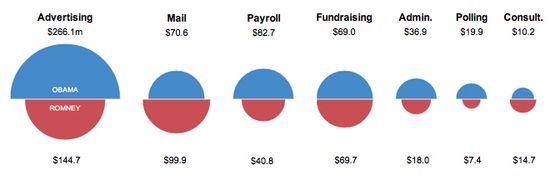
Bartlett thinks this reflects Romney's private equity background, in which he focused on raising capital, rather than operational strategy of the companies he acquired. Meanwhile, Sean Sullivan breaks down the two campaigns' fund allocation:

Interestingly, Romney and his allies have dedicated about $29 million more to mail than Obama’s side, dishing out nearly $100 million. Direct mail is a much more targeted medium that leaves room for tailoring messages to specific parts of the electorate…. One more notable observation: Obama’s side is outspending Romney and his allies more than 2-1 on polling.

Can A Dog Be Depressed? Ctd

IMG_2113

A reader writes:

When my mildly-allergic-to-dogs son went to college, we adopted Bear, a husky-shepherd rescue, and Pumpkin, a corgi-pug rescue. Bear was three and stable as a rock; Pumpkin (six months) had had a more traumatic puppyhood, but settled down as the beta dog in our pack. I purposefully got two dogs because I understood that dogs could get depressed (especially single dogs in a household where the dog was left alone during the day), and I thought meeting their needs as social animals might help prevent that.

Bear died suddenly when he was five, from hemangiosarcoma. Pumpkin was in the house when he died. For three weeks afterwards, she would just go out onto the deck and stare forlornly off in the distance.

It was summer and she wasn't eating or drinking, which was getting a little scary. I don't think she expected him back, since she had seen his corpse, but she was mourning him. I did verify with the vet and on various animal behavior sites that this was a known phenomenon.

We decided to get another dog right away. Our vet said that Pumpkin might choose to be the alpha dog this time and my daughter (who, let's face it, wanted another puppy anyway), suggested that we get a puppy for the sake of Pumpkin, who seemed to retain some maternal extinct (at least towards the guinea pigs) for all that she was spayed. So we got an eight-week old rescue pup. It turned Pumpkin around almost immediately.

Good luck with Eddy. I hope she feels at home soon.

Another reader:

Last year, my husband and I adopted a rescue dog, a hound mix from Tennessee that we named Presley.  She was the sweetest, most placid of dogs – at least until we tried to leave her alone in the house; then she'd howl almost continuously and scratch furiously at the door.  Our neighbors understandably complained; our landlord said we'd have to get rid of her.  I called a dog trainer in tears, and the first thing she did was recommend Patricia McConnell's I'll Be Home Soon, which is a short, exceedingly helpful book on addressing separation anxiety in dogs.  

We didn't follow the book to the letter, but I found one of McConnell's tricks particularly helpful: don't let your dog see you leave.  Apparently "out of sight, out of mind" works for some dogs. We got an extra-tall baby gate and installed it the door to the spare bedroom.  We'd lure Presley in there with a couple of treats, shut the gate, and leave the TV on a soothing, white-noise station, like the Cooking Channel. From inside the spare bedroom, she couldn't see the front door, and for the first time in months we were both able to leave without being followed by her howls.  After a couple of months, we could just throw a treat into the spare bedroom without closing the gate; eventually we took the gate down entirely.  Lately, she doesn't even bother to hop off the couch when I leave.

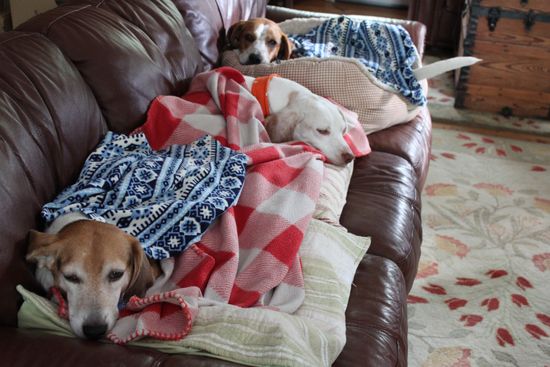
Another sends the above photo:

I'm in the middle of packing for a move taking me from upstate New York to Santa Fe, New Mexico.  I have a house full of stuff and I've been packing going on three weeks now.  I have three beagle mixes, and they are definitely starting to feel some stress.  This is most pronounced in their willingness to be right on top of each other.  They generally like their space and usually spread out across the living room.  I like to think this is because they are standing as one, a wee band of brothers, even though I know it has more to do with boxes encroaching on their turf.  Atticus (he's the one in the front, with Fred and Homer down the line) is persistently giving all the corrugate the stink eye.

Also, some good advice from my sister: I was going to have the rugs cleaned before my move, but she suggested waiting until after – that the scents that the beagle boys were used to in a new place would make them feel more at home sooner.

Earlier discussion here. Update from a reader:

The Dish is a big place, so I sometimes don't know if I saw a link first on your site or somewhere else … so if you haven't yet seen this cartoon series from Hyperbole and a Half, here's a treat!

We posted it a while ago, but it's so good it's worth highlighting again.
“The Greatest Time To Be Gay Since Aristotle”

That's Charles Kaiser's description of the last 40 years in America. And it was forged in part by the sudden courage of one disgracefully forgotten writer, whose essay is now back in print (Dan Savage wrote the foreword):

If you were born after 1970, I think it is nearly impossible to imagine how it felt to open up The New York Times Magazine on a Sunday morning in January 1971 to discover "What it Means to be a Homosexual," a deeply personal and beautifully written piece in defense of homosexuality. Nothing like this had ever been printed in a newspaper like the Times before.

I was a junior at Columbia University in the City of New York when the novelist and journalist Merle Miller’s piece appeared, and I had undoubtedly purchased the Sunday Times at a newsstand on Saturday night. But I’m sure I didn’t share my fascination with his article with any of my classmates on Sunday morning.

I had been aware of my attraction to other boys throughout my teens, and even earlier, but I always assumed that I was going through "a stage"—because that is what you were taught to believe back then, to spare yourself the possibility that you might be afflicted by something that would condemn you to "permanent niggerdom among men," as Joseph Epstein so delicately put it in Harper’s, shortly before Miller wrote his rejoinder to Epstein’s piece.

Did Romney’s “47 Percent” Kill His Campaign?

There is reason to think so:

Congrats, David Corn! Chait admits a mistake:

I’ve been wrong before, and I’ll be wrong again, but I may never have been as wrong as I was when I initially predicted that Mitt Romney’s heinous diatribe against 47 percent of America would have little direct impact on the election. It’s an absolutely crushing blow. Obviously it doesn’t guarantee his defeat — if a secret video surfaces depicting Obama promising to impose Sharia law in his second term, Romney will stand a good chance of coming back — but it destroys his public standing in ways that make a comeback nearly impossible.

Silver notes that since the tape was unearthed "Obama has gained further ground in the polls." He cautions that it's "hard to tell whether this recent gain for Mr. Obama reflects the effect of the '47 percent' comments specifically" but he also points out that "the most typical pattern after a party convention is that a candidate who gains ground in the polls cedes at least some of it back."