Shards Of Our Selves

Screen shot 2012-09-10 at 2.53.53 AM

In reviewing Nora Young's The Virtual Self, Navneet Alang lingers on how our digital lives have evolved our sense of self-image:

[T]o exist online is to be famous—or at least "micro-famous," as Internet entrepreneur Rex Sorgatz once called it. To be known by the collection of words and images we put out into public space was once the domain of a tiny few, those whose fame allowed them to be known by many. But in a remarkably short amount of time, many of us have come to exist in relation to a public projection of ourselves, a stand-in that more or less works as a separate yet fundamental part of who we are. What is true for Marilyn, Madonna and Lady Gaga—that there are always at least two versions, the public circulation of chatter and pictures, and the private—is now true for most of us.

She considers the philosophical implications:

All we can say is that we are never more to be simply "individuals." Descartes ‘left’ his body so as to return to it, certain of the relationship between that one solitary object and the world out there. Alas, such sureness is not for us. It is the overlapped duality of the digital and the bodily that is our fate. Where we once had a private journal or the insides of our minds, we now have a kaleidoscopic public canvas onto which to paint ourselves for others to see. And in the future, who we are will always be both our bodily self and its public hologram—sometimes together, sometimes apart—but never again a version of us that is to be found in just one place.

(Photo from Mathieu Grac’s series of social media portraits in progress)

Reality Check: 2012 And 1980

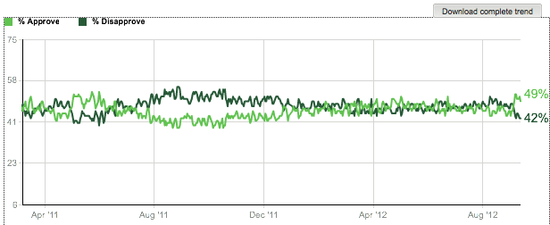
Behind Obama's move in the polls is a big move in his approval ratings in the last couple of weeks. Here's the last few months showing the disapproval/approval numbers from RCP:

Screen shot 2012-09-13 at 4.37.38 PM
The bounce is slipping a little, but it's bigger than anything Obama has experienced since March. Gallup finds the same thing:

Screen shot 2012-09-13 at 4.46.15 PM

These are not horse-race numbers; they are approval ratings. Fox's latest poll shows Obama at 50 percent approval – which makes him very hard to beat if he's an incumbent. Nate Cohn examines the Fox poll internals, and it looks worse:

While Romney argues that Obama has failed on the economy, the Fox polls suggests that most voters don’t quite see it that way. Just 36 percent of voters give Obama a D or an F on the economy, compared to 38 percent of voters who give him an A or a B. There are a lot of voters with a decidedly mixed view, including 14 percent who give him a “C” and 11 percent who give him an “incomplete,” as the president did himself….

50 percent of likely voters say that if Obama is elected, they would feel that “the country’s improving and I look forward to another 4 years" compared to 43 percent who would say “the country’s going down the drain and I’m dreading what is going to happen next.” While 49 percent of voters say the country is worse off than it was four years ago, that’s not enough to outweigh the other numbers.

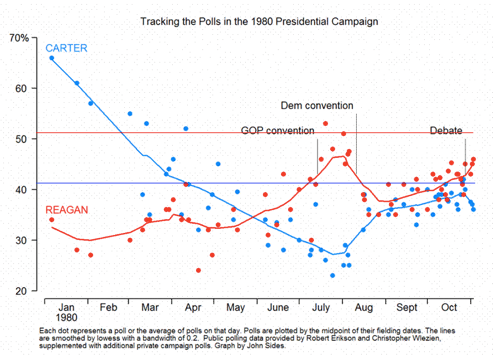
In other words: Americans aren't as dumb and Manichean as Mitt Romney thinks they are. The Romneyites push back that this is a convention sugar high, and it's really 1980 and that Reagan surged at the end from behind, and Romney can too. But the Reagan comeback myth is a myth, derived from Gallup.

Check this timeline of all the polling in 1980 from John Sides earlier this year:

Screen shot 2012-09-13 at 4.54.54 PM

Reagan was never behind Carter in the poll of polls from May of 1980 onwards. Equally, Obama has never been behind Romney in national polls from November of 2011 onwards. Yes, Reagan did have a last minute surge to give him a landslide, thanks to the debates, but he would have won without it. From September on, the 1980 race looks a little like the current gap between the two candidates, but with the roles reversed. Carter was a few points behind, like Romney, but never managed to overtake him when it mattered, and then suddenly lost in a landslide.

As Nate Cohn notes, if this is Romney's view of the race, he's gonna lose. He and his party are zombie Reaganites living in a different time with different challenges. And they have no idea what to do. Or how talented a campaigner their opponent is.

Bernanke Goes Big, Ctd

GT_BERNANKE_120913

Josh Barro celebrates QE3:

While overly tight monetary policy has hit the unemployed the hardest, it has been bad for almost everybody, including rich people. It’s true that disinflation has been good for certain securities, particularly low-risk bonds. But wealthy bondholders also tend to be wealthy stockholders, and Fed policies that hold economic growth down are bad for equities. Most advocates of hard money are simply making a mistake, not putting their interests ahead of the common good.

Felix Salmon thinks "the real innovation here is that the Fed is moving aggressively into the world of words rather than deeds" by not just buying bonds but "trying to boost the economy by promising to continue buying bonds":

None of this is going to make any noticeable difference before the presidential election: it’s all marginal, really. But if it seems as though QE3 is having a bit more of a real-world effect than QE2 did — if, that is, it helps the job numbers rather than just the markets — then the lesson will be clear. The Fed’s balance sheet is a powerful tool to use — but its vocal chords might be even more powerful still.

Derek Thompson adds:

Bernanke essentially said: I'm going to keep my foot on the gas even after the economy starts to recover. Good economic reports or bad, the Federal Reserve will be working to keep interest rates low "for a considerable time after the economic recovery strengthens." We don't know what impact this will have on the housing and jobs market. But we're all about to learn the value of a Ben Bernanke promise.

Brad Plumer rounds up other reactions. As does John Hudson. Earlier commentary here.

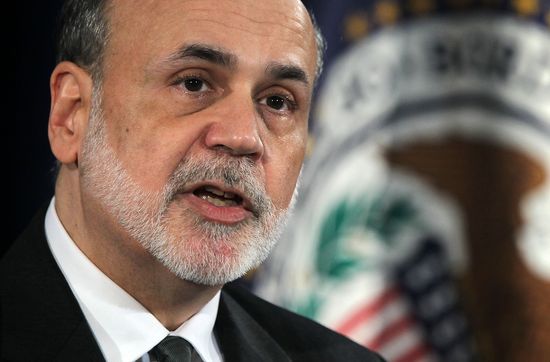
(Photo: Chairman of Federal Reserve Board Ben Bernanke speaks during a news conference on September 13, 2012 in Washington, DC. Following a two-day Federal Open Market Committee meeting, Bernanke presented the FOMC’s current economic projections and provided additional context for the FOMC’s policy decision. The Federal Reserve announced it will purchase additional agency mortgage-backed securities at a pace of $40 billion per month to support a stronger economic recovery and to help ensure that inflation is at the rate most consistent with its dual mandate over time. By Alex Wong/Getty Images)

Mental Health Break

MicMac Lane from Eric Funk on Vimeo.

This is my Degree Project from MassArt. The goal was to capture the energy and fluidity that goes into the sport of basketball. I hand drew every frame of this using Microns and composited them onto brown paper. Original Music by my good friend Evan Morse who's work you should definitely check out at http://evanmorse.bandcamp.com/


A Map Of Ourselves

ENCODE, an Encyclopedia Of DNA Elements, is a massive international project aimed "to catalogue every letter (nucleotide) within the genome that does something." Ed Yong marvels:

Think of the human genome as a city. The basic layout, tallest buildings and most famous sights are visible from a distance. That’s where we got to in 2001. Now, we’ve zoomed in. We can see the players that make the city tick: the cleaners and security guards who maintain the buildings, the sewers and power lines connecting distant parts, the police and politicians who oversee the rest. That’s where we are now: a comprehensive 3-D portrait of a dynamic, changing entity, rather than a static, 2-D map.

Brendan Maher has more.

To See What Is In Front Of One’s Nose

Warning-label

Walter Kirn, who is not a regular political journalist and whose time in Charlotte was his first convention, found the pervasive groupthink among writers intellectually stultifying:

To disagree with the conventional wisdom even as it’s being born around you—and even as you’re trying with all your might to anticipate and even shape it—is a profoundly disorienting experience. It makes you wonder if you were there at all, or if there even exists a there to be at. Ideally, a convention would be a ground zero of factuality, an objective reality in a shifting universe of spin and opinion and second-order commentary. But the further you get inside one, I’m discovering, the more deliriously lost you feel, particularly to the self that you came in with. How does one both enter the group mind and stay inside one’s own mind? It’s a challenge.

That's one reason I don't go. It's a television infomercial best judged by watching the television!

(Image from Tom Scott's Journalism Warning Labels)

The Battle In The States

Abby Rapoport thinks the real GOP victory in 2010 wasn't in Congress, but in the gaining "control of 21 house and senate chambers" at the state level:

While Republican members of Congress were focused on blocking the Democratic agenda, Republican state lawmakers began to drive the national policy debate. They wasted no time slashing social programs, weakening women’s reproductive rights and collective bargaining, and creating new barriers to voting rights.

What's more, she notes, the GOP bankrollers understand the superior return on investment of down-ticket races. She claims that "Republican groups, with their deep-pocketed backers, are aiming for a repeat performance in 2012":

The outcomes will have enormous implications. States’ refusal to expand Medicaid could derail Obama’s health-care plan. Anti-immigration laws will continue to proliferate in the states while Congress hems and haws about comprehensive reform. Republican lawmakers will continue to push for charter schools and private-school vouchers at the cost of traditional public education. Fights over civil-rights issues like gay marriage and voting rights, not to mention women’s rights, will play out almost entirely in the halls of state capitols.

Is Egypt An Ally?

Obama says Egypt is neither an ally nor an enemy:

Richard Engel reacts to Obama's statement:

For the last forty years, the United States has had two main allies in the Middle East — Saudi Arabia and Egypt, the other ally in the Middle East being Israel.  For the President to come out and say, well, he’s not exactly sure if Egypt is an ally any more but it’s not an enemy, that is a significant change in the perspective of Washington toward this country, the biggest country in the Arab world.  It makes one wonder, well, was it worth it?  Was it worth supporting the Arab Spring, supporting the demonstrations here in Tahrir Square, when now in Tahrir Square there are clashes going on behind me right in front of the US embassy?

The administration later tried to walk back the comment. Meanwhile, Frum questions US strategy regarding Egypt:

The central test of the engage-political-Islamists policy is post-Mubarak Egypt. Nobody remembers now, but after Mubarak's fall there was much debate whether the Muslim Brotherhood should be allowed to participate in Egypt's new political system. It is hardly illiberal to ban a party that aims at the overthrow of a liberal state. West Germany banned neo-Nazi parties after 1945; the post-1989 Czech Republic forbade former communist officials to hold government jobs – and both democracies are stronger for it. In the end, the Muslim Brotherhood escaped the ban by promising not to run a candidate for president, a promise it promptly broke.

Through it all, the Obama administration pressed for engagement, inclusion and acceptance, provided only that the Muslim Brotherhood complied with the rules of the political system. It did – and here we are.

Joshua Tucker tries to get inside Morsi's head:

He’s trying to win support from his own constituency while trying (somewhat) not to completely infuriate the US and Egyptian military. Yet, there’s another constituency that Mursi must not ignore: the very citizens outside his constituency who gave him the opportunity to lead. Many in Egypt see the US role in the future of Egypt as absolutely critical to the development of that country. Despite a strong current of anti-Americanism — only 19% of Egyptians have a positive opinion of the US – many in Egypt, especially those that stand to benefit from greater links to globalization, are worried that weaker ties between the US and Egypt could result in further deterioration of existing economic conditions. That’s why when asked about future relations between Egypt and the US—55% of Egyptians would like relations to stay the same as before Mubarak’s overthrow (35%) or grow even stronger than that (20%).

To read all Dish coverage of the diplomatic crisis in one convenient place, go to the "Embassy Attacks In Libya and Egypt" thread page. (To jump to today's coverage, click here.)

“Bushism Without The Money”

150882259

I'd prefer "Cheneyism on the cheap" myself. But here's Beinart:

Bush’s foreign policy, especially in his first term, consisted of a hyper-aggressive, hyper-expensive effort to use the 9/11 attacks to extend American dominance of the greater Middle East without much serious thinking about whether such an effort could succeed. Romney can’t continue that effort because Americans are sick of it and the federal coffers are empty. What’s left is bluster and apple pie. Romney rarely discusses how long he wants to continue the war in Afghanistan, for instance, but he constantly attacks Obama for apologizing too much and not believing in America.

Which is why it would be the worst combination ever – diplomacy designed for the Fox News audience and a military follow-through that would permanently cripple the US's already-precarious fiscal standing. John Judis rejects the Frum idea that Romney is all talk:

Some cynics argue that you should ignore what a presidential candidate says about foreign policy. But this analysis makes a rule out of exceptions. Over the last four decades, presidents have generally attempted to do what they said they would. It is only when they have encountered impediments that they have changed course. Bill Clinton promised to emphasize geoeconomics over geo-politics and did so until he was brought up short by Japan’s resistance to trade pressures and by the outbreak of genocide in the Balkans. George W. Bush vowed to conduct his foreign policy with “humility” and to oppose “nation-building,” but he was confounded by the September 11 attacks.

Joyner's view:

The Romney campaign’s foreign policy approach ultimately suffers the same basic flaw as its domestic policy approach: in trying to be all things to all people, it ultimately satisfies no one. Those of us in the increasingly marginalized Realist foreign policy camp are left clinging to the hope that the appointment of seasoned hands like Bob Zoellich to the team signals that Romney will be the serious pragmatist that he was as governor of Massachusetts. But the empty saber rattling and cozing up to Netanyahu and John Bolton are attempts to satisfy the neoconservative wing that Mitt’s one of them. The net result is that no one really knows what a Romney foreign policy would look like. Increasingly, I’m not sure that even Romney knows.

To read all Dish coverage of the diplomatic crisis in one convenient place, go to the "Embassy Attacks In Libya and Egypt" thread page. (To jump to today's coverage, click here.)

(Photo: Former US Ambassador to the UN John Bolton speaks to Tagg Romney during the Republican National Convention at the Tampa Bay Times Forum on August 28, 2012 in Tampa, Florida. By Chip Somodevilla/Getty Images.)

Is Sam Bacile Even A Real Person? Ctd

Noah Shachtman reports that the man behind "Sam Bacile" is a serial fraudster:

He went by many names, the man who helped produce "The Innocence of Muslims," the inflammatory video now roiling the Middle East: Matthew Nekola; Ahmed Hamdy; Amal Nada; Daniel K. Caresman; Kritbag Difrat; Sobhi Bushra; Robert Bacily; Nicola Bacily; Thomas J. Tanas; Erwin Salameh; Mark Basseley Youssef; Yousseff M. Basseley; Malid Ahlawi; even P.J. Tobacco.

But his real name — the one he used when he was sent to prison for bank fraud —  was Nakoula Basseley Nakoula. His habit of adopting other identities earned him a 21-month sentence in federal prison. During 2008 and 2009, court documents reviewed by Danger Room show (.pdf) that Nakoula again and again opened bank accounts with fake names and stolen social security numbers. Then Nakoula would deposit bogus checks into the new accounts and withdraw money before the checks bounced. The scheme worked for more than a year, until he was indicted in June of 2009. Eventually, he was ordered to stay off of the internet unless he got his probation officer’s permission, and pay a $794,700 fine.

To read all Dish coverage of the diplomatic crisis in one convenient place, go to the "Embassy Attacks In Libya and Egypt" thread page. (To jump to today's coverage, click here.)