
The Numbers To Watch

Ambers reads the post-convention polls:

Until the last three weeks before the election, you can safely skip the top-line numbers for every poll you read. That's why I'm less impressed by the president's post-convention "bounce," a term that implies that whatever is up shall come down. Generally, what's more striking is that the president's enthusiasm deficit among self-described independents who tend to vote Democratic has been erased. Those voters are moving (back) into his corner, and they're providing his buoyancy.

Along the same lines, Nate Cohn notices more enthusiasm among non-white voters, who heavily favor Obama.

Chart Of The Day

Newspaper_Ad_Money

Mark Perry checks in on the decline of newspapers:

The blue line in the chart above displays total annual print newspaper advertising revenue (for the categories national, retail and classified) based on actual annual data from 1950 to 2011, and estimated annual revenue for 2012 using quarterly data through the second quarter of this year, from the Newspaper Association of America (NAA).  The advertising revenues have been adjusted for inflation, and appear in the chart as millions of constant 2012 dollars.  Estimated print advertising revenues of $19.0 billion in 2012 will be the lowest annual amount spent on print newspaper advertising since the NAA started tracking ad revenue in 1950.   

Why Romney’s Welfare Attacks Aren’t Working

In short:

[T]he racially tinged ads now running in Ohio, Colorado and other battleground states may succeed in influencing racially resentful white voters, but if so, the people they influence are more likely to be educated than not. Consequently, this is less likely to translate into more Republican votes, for two reasons. First, on average, educated whites are more racially tolerant than non-college-educated whites. Since racial tolerance diminishes support for candidates who appear to make racial appeals, politicizing the racial attitudes of these voters is unlikely to be an effective strategy. Second, educated voters hold stronger partisan attachments than less educated voters. By the time they see campaign advertisements, they are more likely to have made up their minds about which candidate to support, and they will not be easily budged.

The Making Of “Strange Fruit”

Elizabeth Blair profiles the man who wrote the famous song about lynching:

It's been recorded dozens of times. Herbie Hancock and Marcus Miller did an instrumental version, with Miller evoking the poem on his mournful bass clarinet. Miller says he was surprised to learn the song was written by a white Jewish guy from the Bronx. "Strange Fruit," he says, took extraordinary courage both for [composer Abel] Meeropol to write and for [Billie] Holiday to sing. "The '60s hadn't happened yet," he says. "Things like that weren't talked about. They certainly weren't sung about."

How Meeropol's story intertwines with McCarthyism and Julius and Ethel Rosenberg (the Meeropols adopted their two sons) is equally fascinating.

Will Social Media Sell Out?

Derek Thompson examines the industry:

Look at your smart phone or your tablet. Some of the best apps out there are free programs that bring down walls, connecting you to businesses and information that generally makes you life easier or more enjoyable, whether it's finding transportation, ordering dinner, or naming a song. Many of these companies either have no business model, or have a business model so thin as to be practically imperceptible to its users. In some corners, this is a mockable fact, but rather than mock it, you should stop and appreciate how amazing this is: Some of the smartest and most creative entrepreneurs and developers of our generation are dedicated to making awesome stuff for you, and, bankrolled by deep-pocketed venture capitalists, their determining business metric was not "How will you make money from credit cards and marketing departments?" but rather: How many millions of people are you delighting with your exceptionally cheap product? It is hard to imagine an industry built on a more satisfying premise for customers.

Facebook's stock price troubles could threaten the state of affairs:

The first few years of the social media revolution have been a golden age of tech utilitarianism, where maximizing users' delight was considered, quite literally, the only currency that mattered. In Part II of the revolution, the desired currency is poised to change from attention to profit. That's a shame. It doesn't mean that the programs you love are anywhere close to coming to an end. It just means that things are about to get a little less awesome.

The Daily Wrap

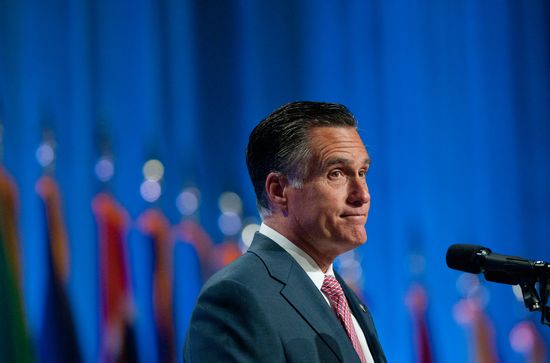
Romney-podium

Today on the Dish, after summing up the situation in Libya and Egypt, Andrew laid out his case for why Romney is unfit to govern, as Romney continued to lie unflinchingly. Larison then weighed in on Romney's recklessness, Nicholas Burns spoke out and the NYT mused on the possibility that the Libya attack was planned. Then as Fallows called Romney's statement the "3 a.m. test," Buzzfeed rounded up bipartisan reactions and Obama's numbers continued to climb. Kristol, meanwhile, doubled down, Jon Kyl offered up a rape analogy and Reince Priebus earned a Hewitt nomination.

Rosie Gray wondered if the "anti-Muslim movie" was real, while Goldblog defended Obama, found a Sam Bacile wingnut associate and, along with others, tried to nail Bacile down. Daniel McCarthy contextualized free speech, Mohamed El Dashan dreamed of a more reasonable response and Shadi Hamid reminded us of Libya's progress. While Christian Caryl noted the similarities between Libya and Egypt, signs looked bad for a Morsi apology and David Remnick responded to Netanyahu's grotesque meddling. Romney QOTD here, FOTD here and, for keeping track of all this, the handy Libya/Egypt thread here.

In other political news, Political Math kept Obama honest on jobs, the blogosphere speculated on the Fed's action and Obama released new ads. And while readers prevailed upon Andrew to change the Von Hoffman award name and Japan nanny-stated the obese, Orhan Pamuk imagined life after the Bosphorus and the Iranian rial declined. Meanwhile, Andrew was at peace with his bald pate, ASL-fluent readers offered perspective on a recent MHB and John Hodgman discussed the Apocalypse. And as McArdle defended her argument on college degrees, Kafka praised patience. MHB here, VFYW here, and Ask Reihan anything!

G.G.

(Photo by David Calvert/Getty)

The Outrage Cycle

Egypt_Embassy_GT

Mohamed El Dashan dreams of a more reasonable response to anti-Islam speech from the West:

Is the film insulting? Yeah, sure. But the best reaction would have been to ignore it completely. There is no virtue in displaying lethal outrage (as in Benghazi) whenever anyone throws a feeble punch at Islam and Muslims. Doing so is only a display of weakness, a fear that our religion cannot withstand even the silliest of skits. This idea is insulting in itself. Bring on the insults, I say — bring on the hatred, the mockery, the piques, the spitballs. The amateur films, the Danish cartoons, the Geert Wilders, and the like. There is little harm than can befall Islam as a faith. It has withstood, over the past fourteen centuries, infinitely worse attacks, yet it has neither weakened nor vanished.

Dan Murphy acknowledges the cycle:

In some ways, [the aftermath of the Danish Muhammad cartoon] was the beginning of an era of manufactured outrage, with a group of fringe hate-mongers in the West developing a symbiotic relationship with radical clerics across the East. The Westerners deliberately cause offense by describing Islam as a fundamentally violent religion, and all too often mobs in Muslim-majority states oblige by engaging in violence.

Murphy reports that the protest and attacks in Egypt were sparked by a religious TV station there:

Jones and Mr. Bacile cannot be blamed for the violence and death of the ambassador. That blame goes to the perpetrators. Who whipped them up? Ground zero for bringing attention to the movie in Egypt appears to be Al-Nas TV, a religious channel owned by Saudi Arabian businessman Mansour bin Kadsa. A TV show presented by anti-Christian, anti-Semitic host Khaled Abdullah before the violence showed what he said were clips from the film, which he insisted was being produced by the United States and Coptic (Egyptian) Christians.

A reminder of the real victims in this whole saga:

GT_CHRIS-STEVENS_120912

(Bottom photo: Libyan civilians help an unconscious man, identified by eyewitnesses as US ambassador-to-Libya Chris Stevens, at the US consulate compound in Benghazi in the early hours of September 12, 2012, following an overnight attack on the building. Stevens and three of his colleagues were killed in an attack on the US consulate in the eastern Libyan city by Islamists outraged over an amateur American-made Internet video mocking Islam, less than six months after being appointed to his post. By STR/AFP/Getty Images.

Top photo: The outer wall of the United States Embassy in Egypt covered in graffiti, the morning after it was vandalised by protesters during a demonstration on Septmeber 12, 2012 in central Cairo, Egypt. By Ed Giles/Getty Images.)

Romney’s Chief Ally

David Remnick responds to Netanyahu's latest grotesque meddling in US politics:

Netanyahu seems determined, more than ever, to alienate the President of the United States and, as an ally of Mitt Romney’s campaign, to make himself a factor in the 2012 election—one no less pivotal than the most super Super PAC. “Who are you trying to replace?” the opposition leader, Shaul Mofaz, asked of Netanyahu in the Knesset on Wednesday. “The Administration in Washington or that in Tehran?”

Washington, of course. Remnick offers some insight into what motivates the leader:

On a trip I took to Israel a few weeks ago for The New Yorker, the political philosopher Avishai Margalit told me that Netanyahu was a kind of “mythomaniac,” a politician utterly absorbed and guided by his sense of heroic mission, and dismissive of the opinions and analyses of even his closest advisers. This goes for his innate distrust of any and all Palestinians, as well as for the vast range of military and intelligence experts, both inside and outside the Israeli government, who are constantly telling him that a unilateral attack on Iranian nuclear facilities will end in political, diplomatic, and military disaster. Netanyahu’s opponents include the current leaders of the Israeli military and the major intelligence branches and their most recent predecessors, to say nothing of a decisive majority of the Israeli population. They fear consequences as dire as regional war and an Iranian regime unified and strengthened by a sense of common purpose.

It's worth wondering if Netanyahu is just completely delusional:

In Netanyahu’s view, Obama, despite instituting crippling economic sanctions, despite carrying out a series of covert operations, despite diplomatic pressure, despite vows that an Iranian bomb is impermissible—despite all that—is weak and deluded. The Israeli Prime Minister has made no secret of his distrust, even though Israeli politicians acknowledge that intelligence and defense coöperation has never been stronger. His trusted American allies are not the elected President but, rather, his friends on the American right, the politicians, business people, and lobbyists, who are never willing to disagree with Israel at all. It has reached the point where even Netanyahu’s principal ally in sabre-rattling, the Defense Minister, Ehud Barak, has shown signs that he, too, believes the Prime Minister has gone too far.

But the GOP is right behind him – and whatever he wants.

Ad War Update: Thankfully Nothing On The Embassies – Yet

The Obama campaign is out with a few new ads today. Up in four states, this one hits Romney for his evasiveness on both his and voters' taxes:

And here they work in the AARP Voter Guide for an ad targeting seniors (ad buy size/scope unknown):

The Obama people also announced an $8 million buy in Wisconsin, and they've released a new TV ad thumping Romney/Ryan again on women's issues. Meanwhile, the Romney campaign is extending last week's avalanche with another $8.1 million, as well as translating its Medi-scare attacks on Obama (ad buy size/scope unknown):

Stepping back, an independent study suggests that Obama's post-convention bounce may be at least partially the result of his team's ad strategy:

According to the Wesleyan Media Project's analysis of Kantar Media Campaign Media Analysis Group data between Aug. 26 and Sept. 8, Obama and his allies aired 40,000 ads. During the same time, Romney and his allies aired 18,000 ads on broadcast and national cable. That added up to $21.1 million spent by the pro-Obama camp, versus $12.9 million spent by the Romney side. "This advantage may help to explain why Obama's convention bounce was larger than Romney's," concluded Erika Franklin Fowler, co-director of the Wesleyan Media Project.

Elsewhere, the RNC is pushing grassroots campaigning in a new web video. And in outside spending news, Rove's American Crossroads Super PAC has produced its own version of the RNC's "Heard It All Before" videos, which NRO says "is apparently a test run for a national campaign in the closing weeks":

The pro-Romney Super (non-profit "issues") PAC American Future Fund released a bizarre ad saying that Obama is the preferred candidate of Wall Street (ad buy size/scope unknown):

Lastly, from the other side in outside spending, the pro-Democrat House Majority PAC is dropping $2.2 million on six new ads attacking House Republicans.

Ad War archive here.

Malkin Award Nominee

"It's like the judge telling the woman who got raped, 'You asked for it because of the way you dressed.' OK? That's the same thing. 'Well America, you should be the ones to apologize, you should have known this would happen, you should have done — what I don't know — but it's your fault that it happened.' You know, for a member of our State Department to put out a statement like that, it had to be cleared by somebody. They don't just do that in the spur of the moment," – Republican Senator Jon Kyl.